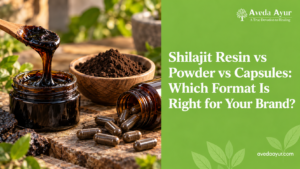


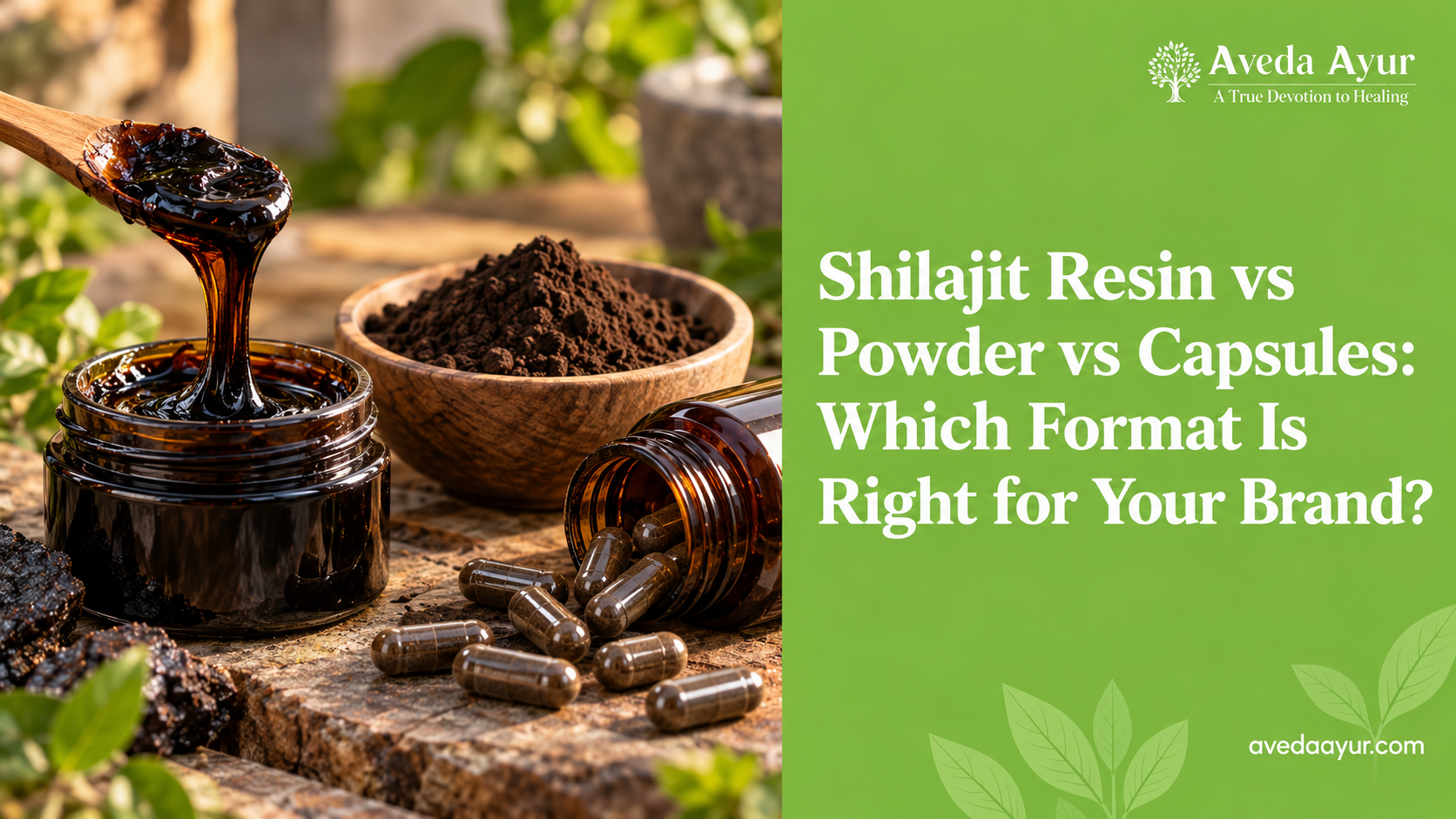
Choosing between shilajit resin, powder, and capsules involves more than deciding how a product will look on the shelf. For supplement brands, the format influences ingredient specifications, manufacturing feasibility, packaging, quality control, and cost per finished serving.
Shilajit resin suits brands prioritizing traditional presentation, powder suits compatible dry-ingredient applications, and capsules suit brands focused on pre-measured servings. The right choice depends on your target market, product specifications, manufacturing capabilities, and commercial objectives.
Shilajit Resin vs Powder vs Capsules: Key Differences
|
Factor |
Shilajit Resin |
Shilajit Powder |
Shilajit Capsules |
| Product format | Semi-solid resin | Dry powder or extract | Encapsulated ingredient |
| Manufacturing focus | Handling, filling and portioning | Powder flow and blending | Fill-weight consistency and encapsulation |
| Consumer experience | Traditional resin format | Depends on the intended preparation | Convenient, pre-measured servings |
| Packaging priorities | Compatible containers and closures | Moisture protection and powder containment | Capsule protection and container compatibility |
| Key quality checks | Identity, purity, and batch consistency | Ingredient identity, composition, and moisture | Ingredient quality and finished-product specifications |
| Commercial suitability | Traditional-formatted product ranges | Dry ingredient applications | Convenience-oriented supplement ranges |
One distinction that matters before comparing suppliers is shilajit resin, dried shilajit extract, and capsules containing shilajit are not automatically equivalent in composition. Brands should evaluate the actual ingredient specifications rather than assume that different formats provide the same composition or potency.
Shilajit Resin: Is It Right for Your Brand?
Shilajit resin is a semi-solid format that can suit brands seeking a product aligned with the traditional presentation of shilajit.
From a manufacturing perspective, resin requires attention to consistency, handling, filling, portioning, and packaging compatibility. Variations in its physical properties can affect processing efficiency and the uniformity of the finished product.
Before sourcing shilajit resin, brands should evaluate:
- Raw-material quality: Identity, source traceability, purification records, and relevant contaminant testing.
- Processing requirements: Whether the resin can be handled and filled consistently using the manufacturer’s available equipment.
- Packaging compatibility: Whether the container and closure are suitable for the resin’s physical properties and storage conditions.
- Batch consistency: Whether the supplier can meet agreed specifications across successive batches.
Resin should not be considered inherently purer or more potent simply because it is less processed or retains its traditional appearance. Those attributes require appropriate evidence.
Best fit: Brands developing traditional-format or premium-positioned shilajit products where resin presentation is central to the product concept.
Shilajit Powder: When Does It Make Sense?
Shilajit powder may suit brands that need a dry ingredient for a powder-based product or a formulation compatible with powder processing.
However, the term “shilajit powder” can describe different materials, including dried extracts. Extraction methods, drying processes, standardization, and added carriers can influence the final ingredient’s composition.
Before selecting a powder, assess:
- Ingredient identity: Establish whether the material is a dried extract or another processed shilajit ingredient.
- Composition: Verify extraction details, standardization criteria, and carrier ingredients where applicable.
- Processing performance: Assess powder flow, bulk density, moisture sensitivity, and blending uniformity.
- Quality documentation: Request batch-specific analytical results and specifications for relevant contaminants.
These details matter commercially. For example, a powder may meet its ingredient specifications but still be unsuitable for a particular encapsulation line because its flow properties or bulk density create filling difficulties.
Best fit: Brands that require a dry shilajit ingredient and have a formulation and manufacturing process compatible with its characteristics.
Shilajit Capsules: Are They Better for Supplement Brands?
Shilajit capsules offer a convenient format with a defined serving, making them an option for brands developing standardized supplement products.
However, successful capsule manufacturing depends on more than selecting a capsule shell. The ingredient must be suitable for encapsulation, and the production process must deliver consistent fill weights.
Key considerations include:
- Formulation compatibility: Evaluate flow properties, bulk density, moisture, capsule shell compatibility, and any excipients.
- Serving accuracy: Distinguish the actual shilajit content from the total capsule fill weight.
- Finished-product quality: Establish appropriate specifications for capsule integrity, fill-weight consistency, and disintegration where applicable.
- Packaging and stability: Select packaging based on the product’s moisture sensitivity, storage conditions, and supporting stability data.
Capsules may simplify serving measurement for consumers, but they introduce additional formulation and production requirements. Their suitability depends on the ingredient and the manufacturer’s capabilities.
Best fit: Brands prioritizing pre-measured servings, convenient product use, and a standardized supplement format.
How to Choose the Right Shilajit Format for Your Brand
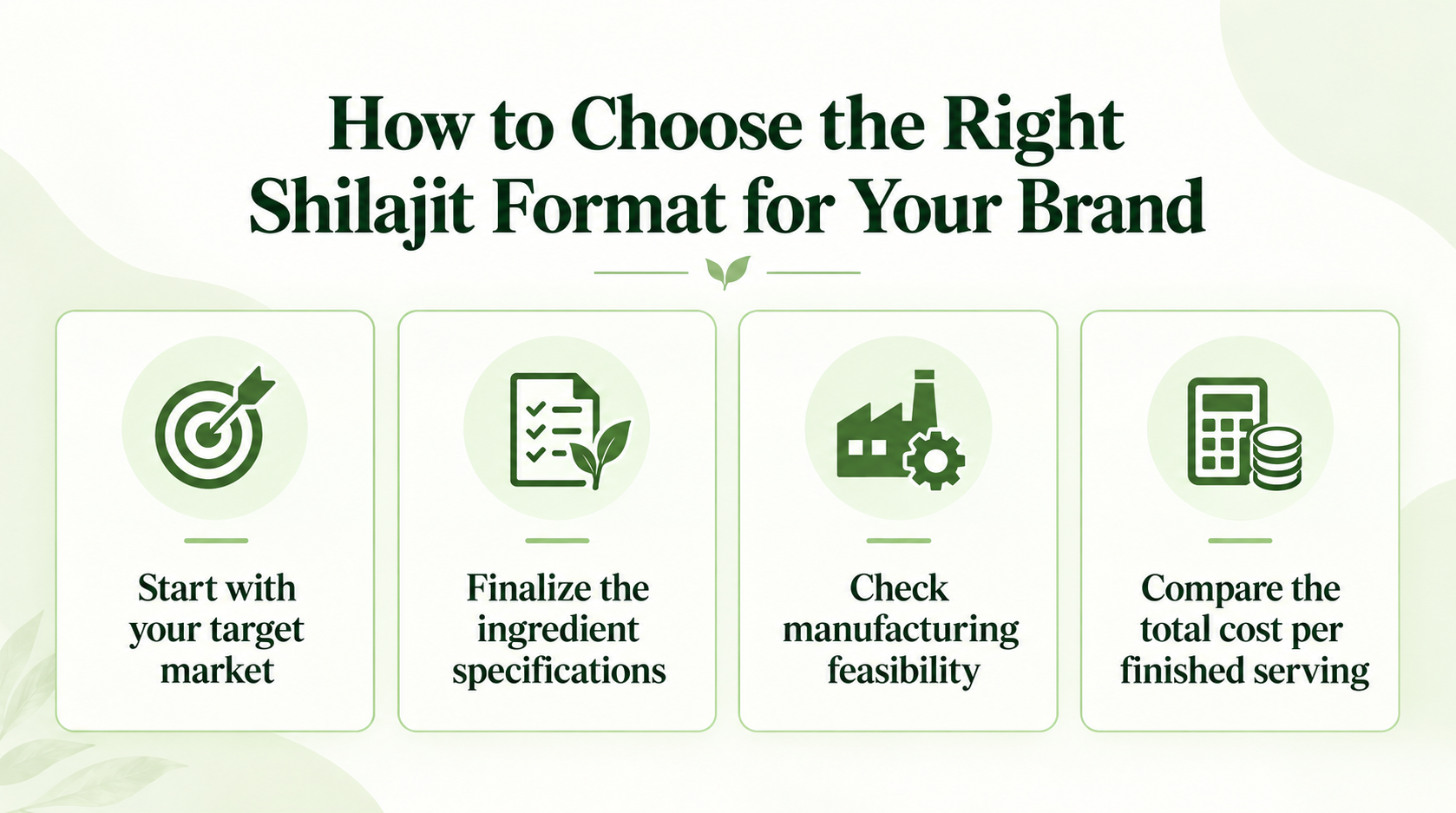
The most suitable format is the one that meets your product requirements without creating avoidable manufacturing or quality-control challenges.
-
Start with your target market
Determine whether your customers are looking for traditional resin, a dry ingredient, or a convenient capsule format. Use market research and customer feedback to validate the choice rather than relying on assumptions about popularity.
-
Finalize the ingredient specifications
Define identity, composition, purity criteria, relevant marker compounds, and contaminant limits before requesting quotations. This helps you compare suppliers offering equivalent specifications instead of selecting solely on price.
-
Check manufacturing feasibility
Discuss equipment compatibility, processing requirements, batch sizes, production capabilities, and minimum order quantities with prospective manufacturers.
A format may suit your brand positioning but prove commercially impractical if the manufacturer cannot process it consistently at your required volume.
-
Compare the total cost per finished serving
A meaningful cost comparison should include:
- Raw-material and processing costs
- Formulation and encapsulation requirements, where applicable
- Packaging and labeling
- Quality testing and batch release
- Production yield and minimum order quantities
The lowest ingredient price does not necessarily deliver the lowest finished-product cost. Additional processing, packaging, or testing requirements can change the economics significantly.
Quality Checks Before Choosing a Shilajit Manufacturer
Whether you select resin, powder, or capsules, quality assurance should cover the ingredient, manufacturing process, and finished product.
Before finalizing a supplier, request:
- Raw-material specifications and traceability records.
- Batch-specific certificates of analysis (COAs).
- Appropriate identity, heavy-metal, and microbiological testing.
- Relevant marker-compound or extract-standardization data.
- Finished-product specifications and release procedures.
- Stability data supporting the proposed shelf life and storage conditions.
Shilajit’s composition can vary between samples, making product-specific verification important. Published research on shilajit’s chemical and elemental composition provides further context for the need to assess material quality rather than rely on format or origin alone. See the research available through.
For products marketed in India, confirm the applicable AYUSH or FSSAI requirements for product classification, permitted ingredients, contaminants, labelling, and claims. Export-oriented brands must also assess the requirements of their destination markets.
Develop Your Shilajit Product with Aveda Ayur
Selecting a shilajit format is only one part of launching a supplement. Brands also need a manufacturing partner that understands ingredient specifications, quality documentation, packaging requirements, and commercial production needs.
Aveda Ayur offers Ayurvedic product manufacturing, private-label solutions, and contract manufacturing services. Its website lists shilajit resin among its product offerings.
If you are planning to launch or expand a shilajit product line, discuss your intended format, target market, batch requirements, packaging preferences, and quality specifications with the Aveda Ayur team. Confirm the availability and feasibility of your chosen format, along with applicable minimum order quantities and production timelines, before finalizing your project.
Planning your own shilajit brand? Explore Aveda Ayur’s shilajit resin offering, or visit Aveda Ayur to discuss your private-label or manufacturing requirements.
Conclusion
Choosing between shilajit resin, powder, and capsules depends on your brand positioning, ingredient specifications, manufacturing capabilities, and cost targets. The right format should balance product appeal with consistent quality and commercial feasibility.
Looking to launch your own shilajit product? Partner with Aveda Ayur to explore shilajit sourcing and private-label manufacturing options tailored to your business requirements. Visit Aveda Ayur to discuss your project.
FAQs
- What is the difference between shilajit resin, powder, and capsules?
Resin is a semi-solid product, powder is a dry ingredient, and capsules contain a measured quantity of an ingredient within a capsule shell. Their processing, packaging, and formulation requirements differ.
- Which shilajit format is best for private-label brands?
The best format depends on target customers, product positioning, ingredient specifications, manufacturing capabilities, and total product cost. Brands should assess these factors before choosing a format.
- Is shilajit powder the same as powdered shilajit extract?
Not necessarily. Powder may refer to a dried extract or another processed material. Verify its manufacturing process, composition, extraction details where applicable, and carrier ingredients before sourcing.
- What should brands check before choosing a shilajit manufacturer?
Evaluate ingredient traceability, batch-specific COAs, testing procedures, manufacturing capabilities, packaging options, minimum order quantities, and stability documentation. Confirm that the manufacturer can meet the product’s specifications and target-market requirements.
- Can Aveda Ayur help brands develop shilajit products?
Aveda Ayur offers private-label and contract manufacturing services and lists shilajit resin among its offerings. Brands should contact its team to confirm the available formats, project requirements, minimum order quantities, and production timelines.