

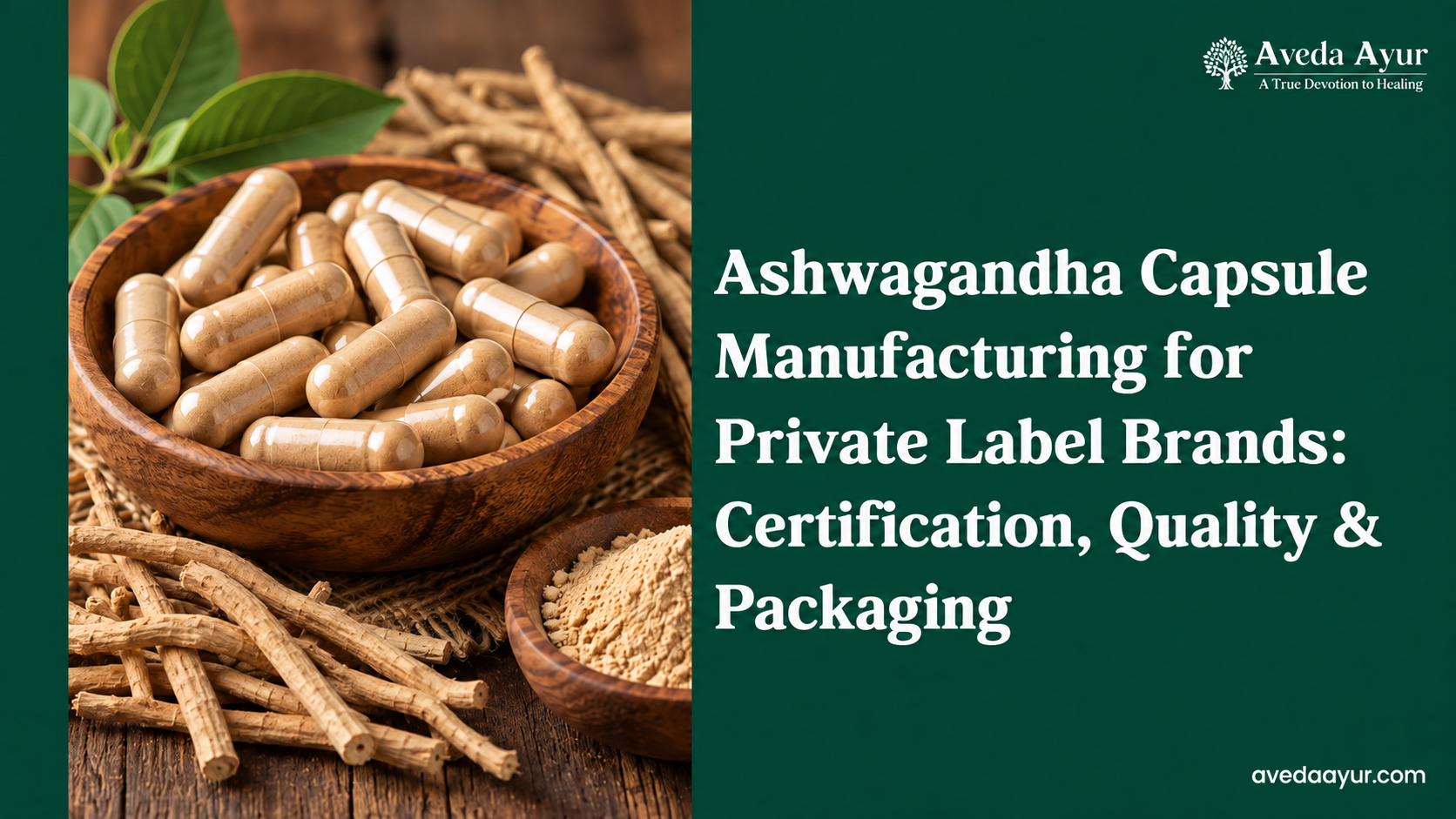
Private-label Ashwagandha capsules require more than a reliable filling and packaging line. Brands need a manufacturing partner that can control raw-material quality, maintain consistent formulations, provide appropriate testing and documentation, and support compliant packaging for the target market.
For brands sourcing from India, evaluating an Ashwagandha capsule manufacturer should therefore cover certifications, raw-material specifications, quality control, manufacturing capabilities, packaging and export readiness.
What Is Ashwagandha Capsule Private Label Manufacturing?
Ashwagandha capsule private label manufacturing allows a brand to sell capsules under its own brand name while a third-party manufacturer manages production.
Depending on the manufacturer’s capabilities, private-label services may include:
- Ashwagandha raw-material sourcing
- Formula development or customization
- Capsule manufacturing
- Quality testing
- Bottle, blister or other packaging
- Custom labels and cartons
- Batch documentation
- Export support and shipping documentation
The exact regulatory requirements depend on how the finished product is classified and where it will be sold.
What Certifications Should an Ashwagandha Capsule Manufacturer Have?
There is no single certification that makes a manufacturer suitable for every private-label project. Buyers should verify the licenses, certifications, and quality systems applicable to the product category and target market.
Ashwagandha supplements manufactured in India , buyers may evaluate the following:
| Certification or Documentation | Why It Matters |
| Applicable manufacturing license | Confirms authorization for the relevant product category |
| GMP compliance | Supports controlled manufacturing processes |
| Food-safety certification | Helps demonstrate systematic food-safety controls |
| Quality-management certification | Indicates documented quality procedures |
| Certificate of Analysis (COA) | Provides batch-specific test results |
| Laboratory test reports | Support verification of product quality and safety |
| Organic certification | Relevant when certified-organic claims are required |
| Halal/Kosher certification | Useful for specific international markets |
For products regulated as health supplements or nutraceuticals in India, FSSAI’s applicable regulations should be checked before finalizing the formulation and label. FSSAI’s current framework specifically covers health supplements and nutraceuticals.
Do not assume that every certification is legally mandatory. The appropriate requirements depend on the product category, formulation, claims, and destination market.
How to Evaluate Ashwagandha Capsule Quality
For private-label brands, quality should be evaluated from the raw material through finished-product release.
-
Check Ashwagandha Raw-Material Specifications
The manufacturer should be able to document the identity and specification of the Ashwagandha used in production.
Ask about:
- Botanical identity: Withania somnifera
- Plant part used
- Raw-material source
- Supplier qualification
- Specification and acceptance criteria
- Traceability between batches
- Storage and handling conditions
If a standardized extract is used, ask how the manufacturer verifies the relevant marker compounds and maintains consistency between batches.
-
Review Quality Testing
Depending on the formulation and applicable requirements, testing may address:
- Identity and purity
- Microbiological quality
- Heavy metals
- Pesticide residues
- Mycotoxins or aflatoxins, where applicable
- Active or marker compounds
- Finished-product specifications
A batch-specific COA is more useful than a generic quality statement because it provides evidence for the actual production batch.
-
Check Batch-to-Batch Consistency
Private-label brands need consistency because customers expect the same product from one production run to the next.
A capable manufacturer should have documented procedures for raw-material approval, formulation, production, in-process checks, testing, and finished-batch release.
How Are Ashwagandha Capsules Manufactured?
A typical Ashwagandha capsule manufacturing process follows these stages:
Raw-material inspection → testing → formulation and blending →
capsule filling → in-process quality checks → finished-product testing →
packaging → batch release
The exact process depends on whether the product uses Ashwagandha powder, extract, or a customized blend.
For private-label buyers, the important point is not simply how quickly capsules can be produced, but whether the manufacturer has controlled processes, documented specifications and appropriate quality checks at each stage.
Ashwagandha Capsule Packaging for Private Label Brands
Packaging affects product protection, shelf presentation and market compliance. Indian Ashwagandha capsule manufacturers may offer different packaging formats depending on their capabilities.
Common options include:
- HDPE or PET bottles: Widely used for retail supplement products
- Amber bottles: Useful where additional light protection is required
- Blister packs: Suitable for unit-dose presentation
- Custom jars: Useful for premium brand positioning
- Custom cartons and labels: Support branded retail presentation
When selecting packaging, private-label brands should consider:
- Moisture protection
- Light exposure
- Container-closure compatibility
- Tamper evidence
- Desiccant requirements, where appropriate
- Shelf-life requirements
- Label space and regulatory declarations
- Batch and traceability information
What Should Be on a Private-Label Ashwagandha Capsule Label?
The required label information depends on the product category and destination market.
For products sold as health supplements in India, brands should verify applicable FSSAI requirements before approving artwork. Current FSSAI regulations include requirements concerning product category declarations, recommended usage, warnings, and other information.
Brands should typically work with the manufacturer or regulatory team to verify:
- Product name and category
- Ingredient information
- Net quantity
- Recommended usage
- Required warnings
- Batch or lot number
- Manufacturing and expiry information
- Storage instructions
- Manufacturer details
- Other mandatory declarations for the destination market
Health-supplement claims also require attention. FSSAI’s framework restricts disease prevention, treatment and cure claims for nutraceutical products.
How to Choose an Ashwagandha Capsule Manufacturer in India
When sourcing Ashwagandha capsules from India, compare manufacturers on quality, compliance and production capability, not only price.
Before placing a bulk order, verify:
- Manufacturing credentials: Check applicable licenses and quality certifications.
- Raw-material specifications: Confirm botanical identity, form, source and testing.
- Quality-control system: Ask how raw materials and finished capsules are tested.
- COA availability: Request batch-specific documentation.
- Private-label capability: Confirm formula, capsule and packaging customization.
- MOQ and capacity: Check minimum order quantities and production scalability.
- Packaging support: Review bottle, blister, label, and carton options.
- Sample approval: Evaluate a production-representative sample before bulk manufacturing.
- Export experience: Confirm documentation and labeling support for the intended market.
- Repeat-production capability: Ensure the manufacturer can maintain specifications across future orders.
For international brands, an Indian manufacturer with established export processes can simplify coordination between manufacturing, documentation, packaging and shipment.
Questions to Ask an Ashwagandha Capsule Manufacturer
Before signing a private-label manufacturing agreement, ask:
- What type and specification of Ashwagandha do you use?
- Can you provide raw-material and finished-product COAs?
- Which quality and manufacturing certifications do you hold?
- What testing is performed on each batch?
- Can you customize the formulation?
- What is the MOQ per SKU?
- What capsule sizes are available?
- Can you provide custom bottles, labels and cartons?
- Can you support destination-market labeling requirements?
- What are the production lead times?
- Can you provide samples before bulk production?
- Do you have experience exporting Ashwagandha capsules?
Conclusion
Choosing an Ashwagandha capsule manufacturer is a quality and compliance decision, not simply a price comparison. Private-label brands should evaluate the manufacturer’s applicable certifications, Ashwagandha raw-material specifications, testing procedures, batch consistency, capsule manufacturing controls and packaging capabilities before placing a bulk order.
For brands sourcing Ashwagandha capsules from India, it is also important to verify whether the manufacturer can support custom formulations, private-label packaging, compliant labeling, batch documentation and export requirements for the intended market.
A reliable manufacturing partner should be able to provide clear specifications, relevant quality documentation, and production samples before commercial manufacturing. By assessing these factors upfront, private-label brands can reduce quality risks and build a more consistent Ashwagandha supplement line for domestic or international markets.
FAQs
- What certifications should I look for in an Ashwagandha capsule manufacturer?
Look for the applicable manufacturing license, GMP compliance, relevant food-safety or quality certifications, and batch-specific quality documentation. The exact requirements depend on the product category and target market, so verify that the manufacturer’s certifications and licenses apply to your specific Ashwagandha capsule product.
- How do I verify the quality of Ashwagandha capsules before placing a bulk order?
Verify the botanical identity and raw-material specifications, testing procedures, finished-product specifications, batch-specific Certificate of Analysis (COA), and production sample. Also check testing for relevant contaminants and marker compounds based on the product specification and destination-market requirements.
- Can I customize Ashwagandha capsules and packaging for my private label brand?
Yes. Private-label manufacturers may offer custom formulations, capsule sizes, bottles, blister packs, labels, cartons and other packaging options. Confirm the manufacturer’s customization capabilities, minimum order quantity, artwork requirements and packaging specifications before production.
- What should I check before choosing an Ashwagandha capsule manufacturer in India?
Check the manufacturer’s licenses and certifications, raw-material quality controls, testing procedures, manufacturing capacity, MOQ, private-label capabilities, packaging options, batch documentation and export experience. Request samples and relevant quality documents before committing to a bulk order.
- What is the MOQ for private-label Ashwagandha capsules?
There is no standard MOQ for private-label Ashwagandha capsules. The minimum order quantity depends on the formulation, capsule size, number of SKUs, packaging format, customization, and the manufacturer’s production setup. Ask for the MOQ and pricing separately for each product configuration.