

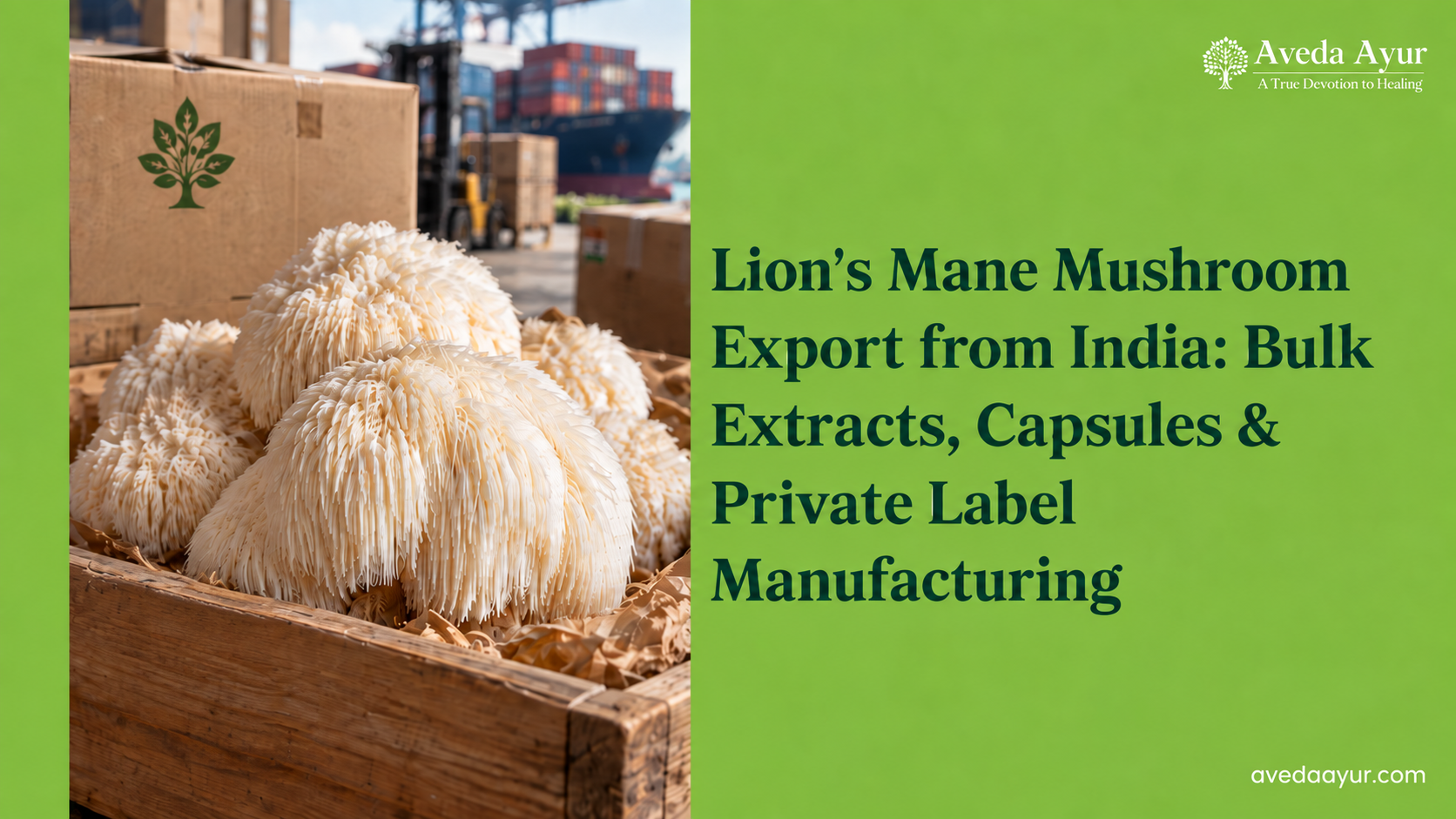
India is an emerging sourcing destination for businesses looking for lion’s mane mushroom bulk extracts, capsules, and private-label supplements. Indian manufacturers can support B2B buyers with bulk ingredients, finished capsules, customized formulations, packaging, and export documentation. However, buyers should evaluate the mushroom specification, testing, manufacturing capability, certifications, MOQ, and destination-market requirements before placing a bulk order.
Why Is the Lion’s Mane Mushroom in Demand?
Lion’s mane mushroom is gaining attention in the global functional mushroom and nutraceutical market as consumers and supplement brands look for innovative mushroom-based ingredients and wellness products. Its growing presence in capsules, powders, extracts, beverages, and functional formulations is creating opportunities for manufacturers, distributors, and private-label supplement brands.
Several factors are contributing to this growing demand:
- Growing interest in functional mushrooms: Lion’s Mane is increasingly included alongside other functional mushrooms in wellness and nutraceutical product ranges.
- Product innovation: Manufacturers can use Lion’s Mane mushroom powder or extracts in capsules, powders, beverages, and customized supplement formulations.
- Private-label opportunities: Supplement brands can introduce branded Lion’s Mane products without establishing their own manufacturing facilities.
- Global supplement demand: Established and emerging wellness brands are expanding their portfolios with mushroom-based products to meet changing consumer preferences.
- Flexible sourcing formats: B2B buyers can source lion’s mane as bulk powder or extract or purchase finished capsules and private-label products.
- Growing interest in scientific research: Lion’s Mane has been the subject of ongoing research, particularly concerning its bioactive compounds and potential effects on cognitive and neurological functions. However, research findings should not be presented as proof of disease treatment or guaranteed health outcomes.
For B2B buyers, this growing interest makes reliable sourcing, consistent specifications, quality testing, and private-label manufacturing capability increasingly important when selecting a Lion’s Mane supplier.
Why Source Lion’s Mane Mushrooms from India?
India has an established herbal, nutraceutical, and contract-manufacturing ecosystem, making it a potential sourcing base for international brands seeking Lion’s Mane ingredients and finished products. The advantage for B2B buyers is not simply manufacturing cost; it is the ability to source ingredients, develop formulations, manufacture finished products, package them under a private label, and coordinate export requirements through an Indian manufacturing partner.
Depending on the supplier’s capabilities, buyers may source the following:
- Bulk Lion’s Mane mushroom powder or extract
- Standard or customized capsule formulations
- Private-label nutraceutical products
- Custom formulations and dosage formats
- Branded bottles, pouches, blisters, and cartons
- Batch-specific quality documentation
- Export documentation and shipping support
However, not every Indian supplement manufacturer has the same Lion’s Mane capability. Buyers should verify whether the supplier actually handles the required stages in-house or sources them through third parties.
Buying Lion’s Mane Mushroom Extract in Bulk
When purchasing Lion’s Mane mushroom extract in bulk from India , the first step should be to establish a written product specification. Comparing suppliers solely on price, extract ratio, or a headline percentage can result in products that are not technically equivalent.
A B2B specification should address the following:
- Scientific identity: Confirm Hericium erinaceus and the required raw-material identity.
- Material type: Specify whether the product must be derived from fruiting bodies, mycelium, or another defined source.
- Extraction method: Request details relevant to the intended formulation and required specification.
- Extract ratio: Where an extract ratio is specified, clarify how it is calculated and what raw material it represents.
- Active-marker specification: If beta-glucans or another marker is required, define the minimum specification and analytical method.
- Excipients/carriers: Confirm whether carriers, processing aids or other excipients are present.
- Contaminant limits: Establish requirements for microbiological parameters, heavy metals, pesticides, and other applicable contaminants.
- Moisture: Set an acceptable specification because moisture can affect stability and storage.
- Shelf life: Confirm the declared shelf life and recommended storage conditions.
- Traceability: Require batch or lot identification linking the finished extract to its production records.
- Certificate of Analysis: Request a batch-specific COA rather than relying only on a generic specification sheet.
One important technical distinction is polysaccharides versus beta-glucans. A supplier’s total polysaccharide figure should not automatically be interpreted as a beta-glucan specification. If beta-glucan content is important to the finished product, buyers should request the defined specification, testing method, and corresponding batch result.
For larger or recurring orders, buyers should also consider independent or third-party testing where appropriate, particularly when the product is intended for regulated export markets.
Lion’s Mane Capsules for Export
For international brands, Lion’s Mane capsules can be sourced as standard finished products or developed as private-label formulations. The commercial objective, however, should be to ensure that every production batch conforms to an agreed product specification.
Before approving production, buyers should establish:
- Capsule specification: Size, material and vegetarian/vegan requirements
- Fill weight: Amount of powder or extract per capsule
- Ingredient specification: Exact Lion’s Mane powder or extract being used
- Active-marker requirements: Any agreed beta-glucan or other specification
- Excipients: Identity and permitted use of flow agents, fillers or other formulation ingredients
- Serving size: Number of capsules and quantity per serving
- Packaging: Bottle, pouch, blister or other format
- Label requirements: Ingredients, directions, warnings, net quantity, batch details and other market-specific information
- Shelf life: Stability and storage requirements
- Batch testing: Quality parameters that must be verified before release
- Traceability: Batch numbers connecting the finished capsules to the underlying raw materials and production records
The export destination should be established before formulation and label approval. Ingredient permissions, dosage requirements, health claims, warnings, nutrition information, packaging, and labeling rules can differ between markets.
For this reason, an export-ready Lion’s Mane capsule should not be treated as a one-size-fits-all product. A formulation and label accepted in one market may require modification for another.
Lion’s Mane Private Label Manufacturing in India
Private-label Lion’s Mane manufacturing allows supplement brands to outsource formulation, production, and packaging instead of establishing their own manufacturing facility.
A typical process is the following:
Product specification → formulation → ingredient sourcing → manufacturing → quality testing → packaging → labelling → shipment
Depending on the manufacturer, private label services may include the following:
- Custom formulation
- Capsule manufacturing
- Dosage customization
- Brand and label printing
- Bottle, pouch or blister packaging
- Carton packaging
- Batch documentation
- Export support
This model is suitable for supplement brands, nutraceutical distributors, wellness companies, retailers, e-commerce businesses, and importers seeking finished Lion’s Mane products.
How to Choose a Lion’s Mane Manufacturer in India
A reliable Lion’s Mane mushroom manufacturer in India should be assessed through documented capabilities rather than marketing claims.
- Verify manufacturing capability: Determine which stages are performed in-house, including formulation, processing, encapsulation, packaging, and quality control.
- Check product specifications: Confirm the mushroom species, raw-material type, extraction specifications, and required active markers.
- Review quality testing: Ask for batch-specific COAs and relevant testing for identity, microbiological contaminants, heavy metals, pesticides, and other parameters applicable to the product.
- Verify certifications: Check applicable GMP, HACCP, ISO, and other certifications and ensure that certificates are current and relevant to the manufacturing facility.
- Confirm private-label capability: If launching a branded product, verify formulation, packaging, labeling, customization, and repeat-production capabilities.
- Establish MOQ and lead time: MOQ can vary by formulation, capsule quantity, packaging, customization, and production requirements. Confirm these details for each SKU.
- Evaluate export experience: Ask whether the manufacturer can provide the documentation required for your destination country.
Quality and Regulatory Requirements for Export
Quality requirements depend on the product format and destination market. Buyers should establish testing specifications before production rather than after manufacturing.
For products manufactured in India, applicable FSSAI requirements should be reviewed where relevant. FSSAI maintains regulations covering health supplements and nutraceuticals, along with requirements relating to product standards, contaminants, packaging, and labeling.
For international shipments, the importing country’s food, supplement, labeling, and ingredient requirements must also be checked.
Documents for Lion’s Mane Mushroom Export from India
Export documentation varies according to the product and destination, but commonly requested documents can include:
- Commercial invoice
- Packing list
- Certificate of Origin
- Certificate of Analysis
- Inspection or quality certificates, where applicable
- Shipping documents
- Export-related documentation
- Product specifications
- Batch records
Export documentation depends on the requirements of both the exporting and importing countries.
Why Consider Aveda Ayur for Private Label Manufacturing?
Aveda Ayur is an India-based herbal and Ayurvedic manufacturer offering private-label and contract manufacturing services for businesses seeking customized wellness and nutraceutical products. For B2B buyers, working with an established manufacturer can simplify the process of developing, producing, and preparing a branded product for the market.
Potential benefits of working with Aveda Ayur include:
- Private-label manufacturing: Develop products under your own brand name and packaging.
- Customized formulations: Discuss product specifications, dosage formats, and formulation requirements based on the target market.
- End-to-end support: Coordinate formulation, manufacturing, quality testing, and packaging through one manufacturing partner.
- Custom packaging: Support for branded labels and packaging formats based on product and market requirements.
- B2B production: Suitable for businesses looking to develop products for wholesale, retail, or e-commerce distribution.
- Export support: Buyers can discuss documentation and product requirements applicable to their intended export market.
- Quality-focused manufacturing: Buyers can evaluate applicable certifications, testing procedures, batch documentation, and quality-control practices before production.
For businesses considering private-label Lion’s Mane capsules or other Lion’s Mane formats from India, Aveda Ayur can be evaluated according to the required formulation, ingredient specification, packaging, MOQ, and destination-market requirements. Buyers should confirm the current availability of Lion’s Mane manufacturing, relevant certifications, testing capabilities, and production capacity before placing an order.
Conclusion
Lion’s Mane mushroom exports from India can serve international buyers looking for bulk extracts, capsules, and private-label supplements. The strongest sourcing strategy is to define the product specification first, verify the manufacturer’s actual capabilities, review testing and documentation, approve samples, and confirm destination-market compliance before placing a bulk order.
FAQs
- Can I buy Lion’s Mane extract in bulk from India?
Yes. Indian manufacturers and ingredient suppliers may offer Lion’s Mane powder or extract in bulk. Buyers should specify the mushroom material, extraction requirements, testing parameters, packaging, and quantity before requesting quotations.
- Can Indian manufacturers make private-label Lion’s Mane capsules?
Yes. Private-label manufacturers may produce customised Lion’s Mane capsules with specified formulations, packaging, and branding. MOQ, formulation options, and documentation vary by manufacturer.
- What should I check before buying Lion’s Mane extract?
Check the scientific identity, fruiting body or mycelium, extraction specifications, active-marker requirements, COA, microbial testing, heavy metals, pesticides, shelf life, traceability, and applicable certifications.
- What is the MOQ for private-label Lion’s Mane capsules?
There is no universal MOQ. It depends on capsule quantity, formulation, packaging, customisation, and manufacturing requirements. Always request MOQ and lead time for each SKU.
- How do I choose a Lion’s Mane manufacturer in India?
Compare manufacturers based on technical specifications, quality testing, certifications, manufacturing capability, MOQ, capacity, private-label services, export experience, and sample approval, not price alone.