

A Shilajit brand should consider reformulating its product when quality issues arise, regulatory requirements change, or market demand shifts, requiring a different formulation, ingredient composition, or product format. Before making changes, brands should identify the underlying need and determine whether it requires reformulation, process improvements, supplier changes, or packaging adjustments.
For Shilajit manufacturers and private-label brands, the objective is to maintain product quality and regulatory compliance while adapting formulations to evolving customer preferences and target-market requirements.
6 Signs a Shilajit Product May Need Reformulation
-
Inconsistent Raw-Material Quality
Repeated variations in Shilajit raw materials can compromise batch consistency. Review ingredient specifications, traceability, supplier documentation, and relevant test results. If a new supplier’s material differs in composition or quality, assess its suitability before production approval.
-
Stability or Shelf-Life Issues
If a Shilajit product fails to maintain its specified quality throughout its intended shelf life, investigate the cause. Review stability data, changes in appearance or texture, and packaging compatibility. Reformulate if the issue is formulation-related; otherwise, address the packaging or manufacturing process.
-
Repeated Quality Testing Failures
Repeated failures in raw-material or finished-product testing signal a need to investigate existing controls. Assess relevant parameters, including identity, composition, microbiological quality, and contaminants such as heavy metals. Reformulation may be necessary if the formula cannot consistently meet established specifications.
-
Changes in Regulatory Requirements
Changes in ingredient requirements, permitted conditions of use, labelling rules, or product claims may require a formulation review. In India, Shilajit brands should assess applicable regulations. Depending on the compliance gap, the solution may involve reformulation, revised labelling, or updated documentation.
-
Supplier or Manufacturing Changes
Changes in raw-material sourcing, purification, or manufacturing can affect product consistency. If these changes cause unexplained batch variations or deviations from specifications, reassess the process and ingredient suitability. Improve supplier controls or manufacturing methods where appropriate, and reformulate only when the existing formula is no longer suitable.
-
Market Demand and Product Customisation
Changing customer preferences or target-market requirements may require adapting a Shilajit formulation. Brands may consider changes to ingredient composition, serving format, or other product characteristics when market research identifies a clear demand.
Before proceeding, evaluate the commercial opportunity, technical feasibility, product stability, and regulatory implications. Not every market-driven change requires reformulation; some needs can be addressed through packaging, presentation, or product-format adjustments.
How Should Brands Evaluate a Shilajit Reformulation?
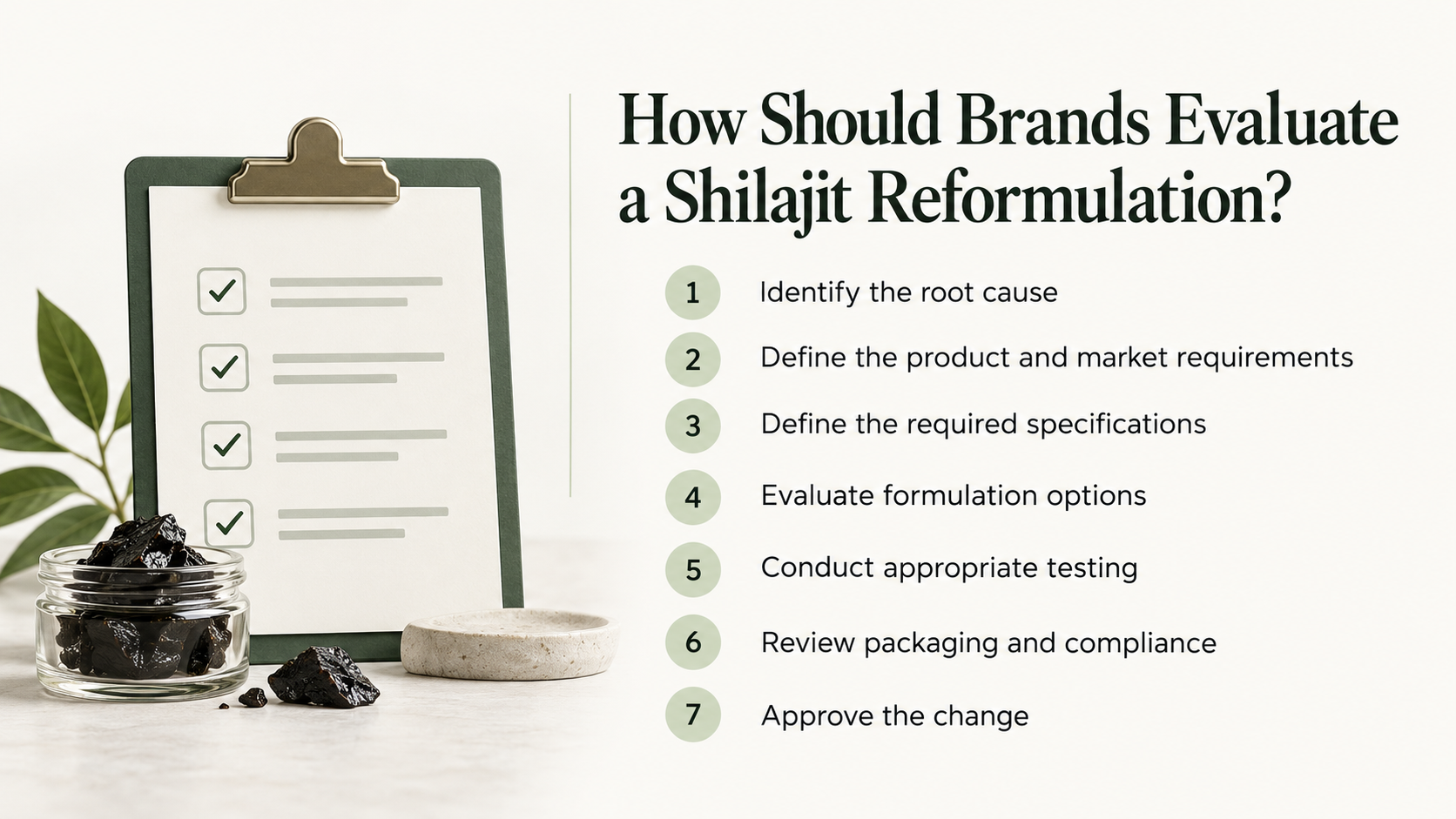
A structured process helps brands avoid unnecessary formula changes and maintain documented quality controls.
- Identify the root cause: Review test results, complaints, supplier records, and manufacturing data.
- Define the product and market requirements: Identify whether the change addresses a quality issue, regulatory requirement, or customer demand. Establish clear product specifications before selecting a revised formulation.
- Define the required specifications: Establish measurable quality, safety, and stability criteria for the revised product.
- Evaluate formulation options: Work with qualified formulation and quality professionals to assess ingredient suitability and compatibility.
- Conduct appropriate testing: Assess the revised formulation using relevant laboratory tests and stability studies.
- Review packaging and compliance: Check packaging compatibility, ingredient declarations, product claims, and market-specific requirements.
- Approve the change: Document the evaluation, update relevant specifications and manufacturing records, and complete required approvals before commercial release.
Testing should reflect the nature and risk of the proposed change. A packaging adjustment may require a different assessment from a substantial ingredient or concentration change.
Reformulation vs. Quality Improvement: Which Is Necessary?
Not every product issue requires a new formula. The corrective action should address the actual cause.
| Problem identified | Appropriate response to evaluate |
| Raw material fails specifications | Investigate supplier controls or material suitability |
| Manufacturing causes batch variation | Correct process controls and investigate deviations |
| Packaging affects product stability | Assess alternative packaging |
| Formulation fails quality or stability criteria | Evaluate reformulation |
| Label does not meet applicable requirements | Correct labelling or assess whether the formula must change |
This distinction helps brands avoid unnecessary development costs while maintaining product quality and compliance.
Common Mistakes to Avoid When Reformulating Shilajit
- Changing the formula without investigating the root cause.
- Selecting replacement ingredients on cost alone.
- Assuming higher ingredient concentration automatically means better quality.
- Skipping appropriate testing or stability assessment.
- Overlooking labelling and target-market requirements.
- Making unsupported claims about improved potency, absorption, safety, or efficacy.
Every change should have a clear technical or commercial justification supported by appropriate evidence.
Shilajit Custom Formulation and Private-Label Manufacturing by Aveda Ayur
Developing a Shilajit product for a specific market requires alignment between formulation requirements, product format, quality specifications, and customer preferences.
Aveda Ayur offers brands an opportunity to explore Shilajit custom formulation and private-label manufacturing for new product development or existing formulation requirements.
Looking to develop a Shilajit product tailored to your target market? Contact Aveda Ayur to discuss your formulation concept, customisation requirements, and private-label manufacturing needs.
Conclusion
Shilajit reformulation should be driven by clear quality concerns, stability findings, regulatory requirements, or defined product-development needs. Identifying the root cause and validating every formulation change helps brands maintain product consistency and meet applicable quality standards.
For brands planning to develop a new Shilajit product or refine an existing formulation, Aveda Ayur’s custom formulation and private-label manufacturing services offer an opportunity to discuss product requirements and manufacturing goals.
FAQs
- When should a Shilajit brand consider reformulating its product?
When quality or stability issues arise, regulatory requirements change, or market research identifies a need for a different formulation, ingredient composition, or product format.
- Does changing a Shilajit supplier require reformulation?
Not necessarily. Brands should assess the new supplier’s raw material against approved specifications and determine whether its composition or quality affects the existing formulation.
- What tests are needed before approving a revised Shilajit formulation?
Depending on the product and proposed changes, testing may include ingredient identity, composition, relevant contaminants, microbiological quality, and stability.
- Can market demand justify Shilajit reformulation?
Yes. Documented customer preferences or target-market requirements may justify changes to the formulation or product format, provided the revised product meets applicable quality and regulatory requirements.
- How can brands determine whether they need reformulation or a packaging change?
Brands should identify the root cause. If the issue relates to ingredient composition or formulation performance, reformulation may be necessary. If it concerns product protection, storage, or usability, a packaging change may be sufficient.
- What should brands consider when choosing a Shilajit custom formulation or private-label manufacturer?
Evaluate the manufacturer’s formulation capabilities, quality-control procedures, testing support, regulatory expertise, and ability to meet your product specifications and target-market requirements.