

For Ayurvedic brands entering the private label market, one of the most important decisions is choosing between standard products and new product development.
Standard products help brands launch faster with lower investment, while new product development allows businesses to create exclusive formulations with stronger market differentiation.
The right choice depends on:
- Launch timeline
- Investment capacity
- Brand positioning
- Target audience
- Long-term business strategy
In Ayurvedic private label manufacturing, many startups begin with standard formulations to reduce operational risk, while established wellness brands often invest in custom product development to create proprietary products and premium positioning.
What Are Standard Products in Ayurvedic Private Labeling?
Standard products are ready-made ayurvedic formulations offered by manufacturers for private labeling or white labeling.
These products are already developed, tested, and production-ready. Brands can sell them under their own label without creating a new formulation from scratch.
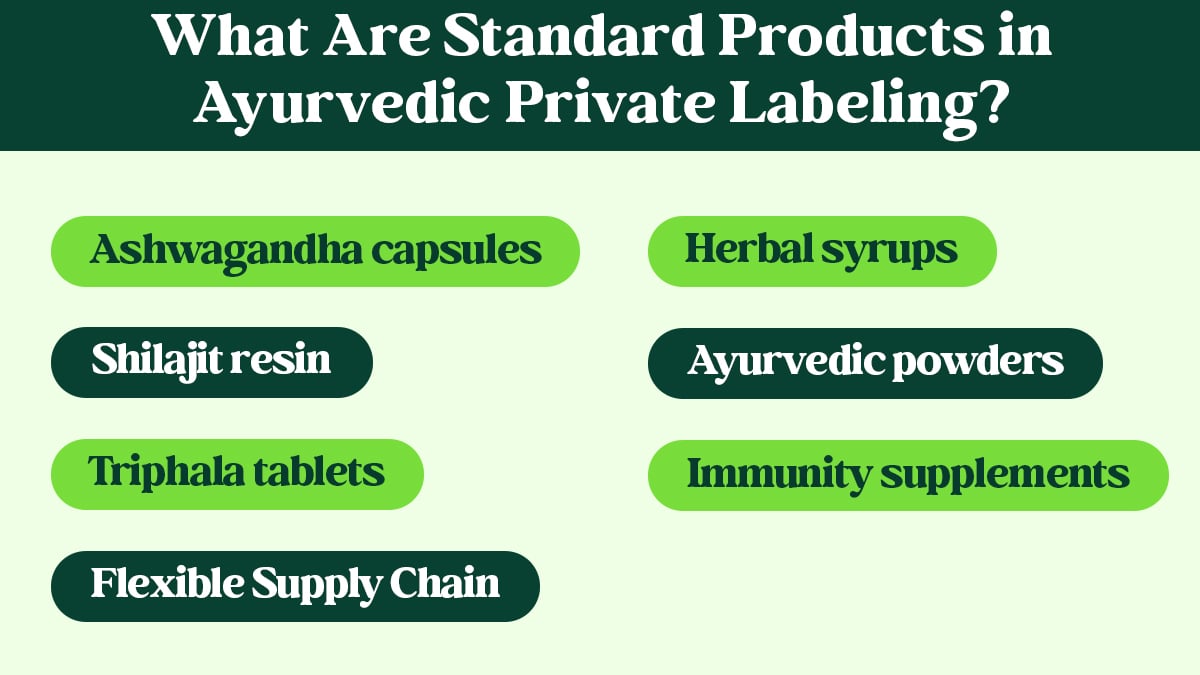
Standard Ayurvedic products typically include:
- Ashwagandha capsules
- Shilajit resin
- Triphala tablets
- Herbal syrups
- Ayurvedic powders
- Immunity supplements
In private label manufacturing, businesses mainly customize:
- Products under your Brand name
- Packaging
- Label design
- Product presentation
The formulation itself usually remains unchanged or only slightly modified.
Why Brands Choose Standard Ayurvedic Products?
Standard formulations are commonly selected because they simplify the launch process.
Key advantages of standard Ayurvedic products:
- Faster market entry
- Lower upfront investment
- Reduced development complexity
- Faster production timelines
- Easier inventory planning
- Lower formulation risk
For startups and emerging wellness brands, this approach helps validate market demand before investing in extensive product development.
Standard products are best for brands that want to launch quickly, reduce development costs, and enter the Ayurvedic market with lower operational complexity.
What Is New Product Development in Ayurvedic Manufacturing?
New product development (NPD) is the process of creating a custom Ayurvedic formulation specifically for a brand.
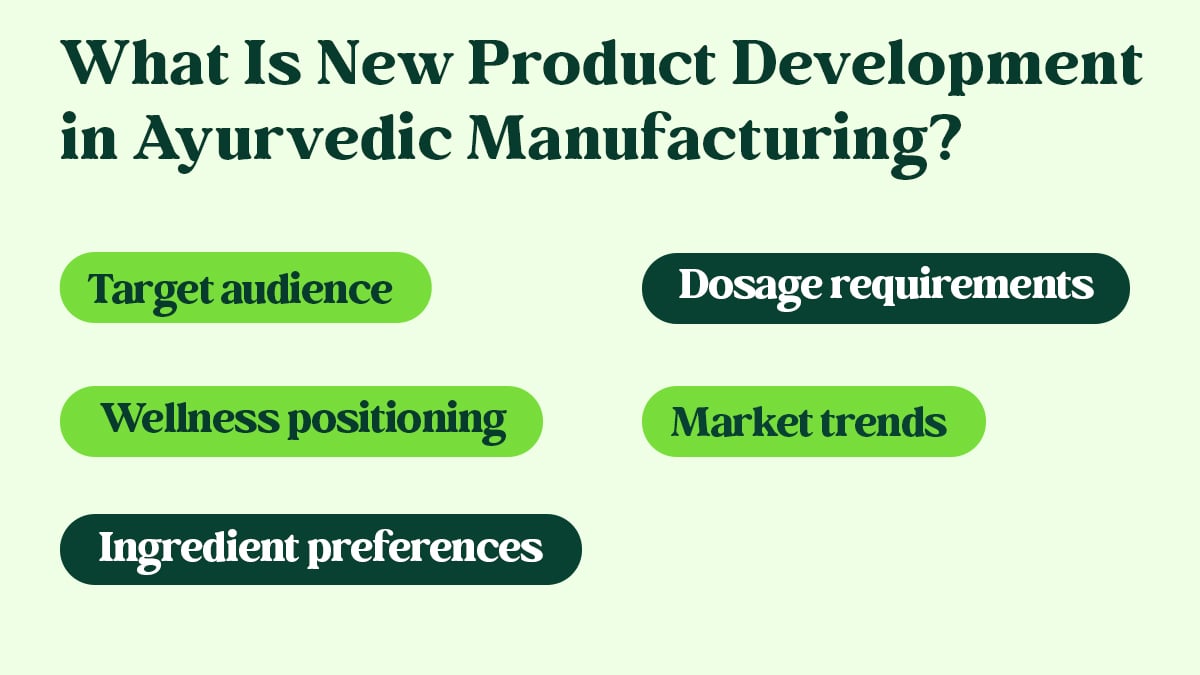
Instead of selecting an existing product, the business works with the manufacturer to develop a formulation based on:
- Target audience
- Ingredient preferences
- Wellness positioning
- Dosage requirements
- Market trends
This approach is commonly used by brands looking for exclusivity and long-term differentiation.
What Does Ayurvedic Product Development Include?
Custom Ayurvedic formulation development may involve:
- Ingredient research: Identifying effective herbal ingredients based on target health benefits, formulation goals, market trends, safety standards, and consumer preferences.
- Formula creation: Developing balanced Ayurvedic formulations with suitable ingredient combinations, dosage accuracy, product stability, efficacy, and manufacturing feasibility considerations.
- Sample development: Creating initial product samples for evaluation, texture analysis, ingredient compatibility, effectiveness assessment, and brand-specific customization requirements approval processes.
- Flavor optimization: Improving taste, aroma, and overall sensory experience to increase consumer acceptance, especially for syrups, powders, and chewables.
- Packaging compatibility testing: Evaluating whether packaging materials maintain product stability, prevent contamination, preserve quality, and support long-term storage requirements effectively.
- Regulatory documentation: Preparing required compliance documents, ingredient records, labeling details, and manufacturing documentation according to applicable Ayurvedic industry regulations.
From a manufacturing perspective, custom formulations often require additional testing and multiple sampling stages before commercial production begins.
Why Brands Invest in Custom Formulations
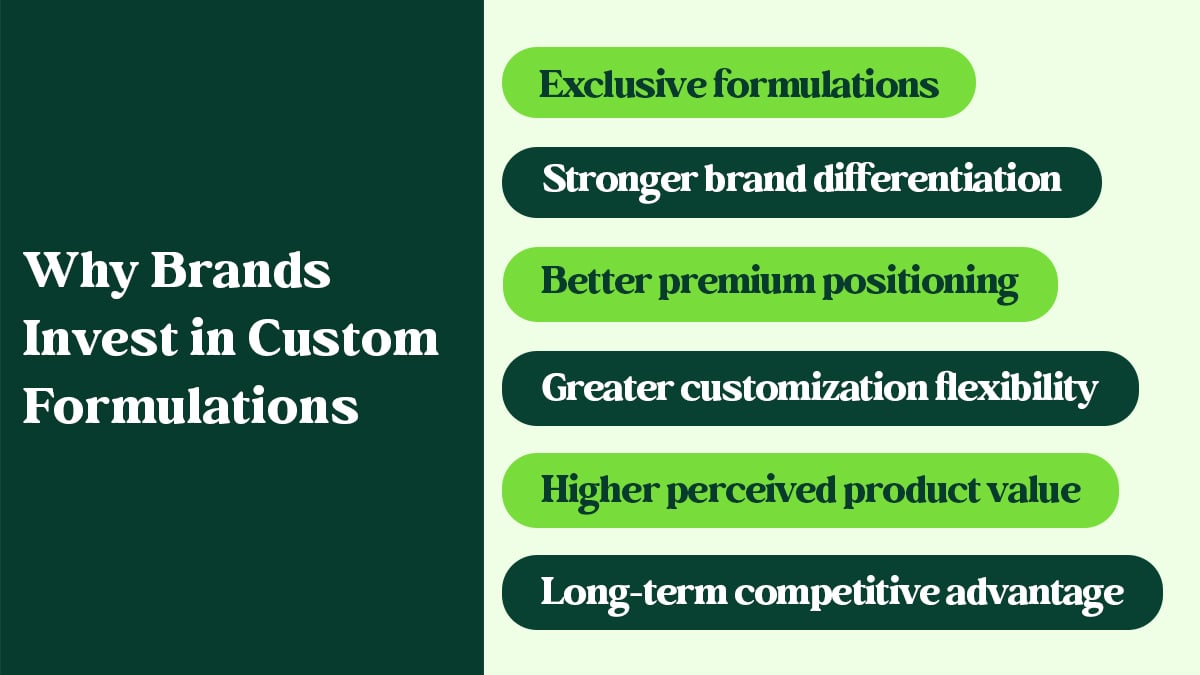
Many premium wellness brands choose custom product development because it allows them to create proprietary positioning.
Key advantages of new product development:
- Exclusive formulations
- Stronger brand differentiation
- Better premium positioning
- Greater customization flexibility
- Higher perceived product value
- Long-term competitive advantage
For example, instead of selling a generic herbal supplement, a brand may develop:
- A sugar-free Ayurvedic syrup
- A vegan herbal gummy
- A targeted stress-support formula
- A women’s wellness blend
- A clinically positioned herbal supplement
This level of customization helps brands stand out in highly competitive wellness markets.
New product development is best for brands that want exclusive formulations, premium positioning, and stronger long-term differentiation.
Standard Products vs New Product Development: Key Differences
|
Factor |
Standard Products |
New Product Development |
| Development Time | Faster | Longer |
| Initial Investment | Lower | Higher |
| Formulation Customization | Limited | Extensive |
| Product Exclusivity | Moderate | High |
| Manufacturing Complexity | Lower | Higher |
| Market Differentiation | Lower | Stronger |
| Launch Process | Simpler | More Detailed |
| Best For | Fast launches | Premium brand building |
Standard products prioritize speed and cost efficiency, while new product development focuses on exclusivity, customization, and long-term brand value.
Which Option Launches Faster?
Standard products usually launch faster because the formulation already exists.
Standard product launch process:
- Product selection
- Packaging finalization
- Label approval
- Production scheduling
Since the formulation is already tested, businesses can move to manufacturing more quickly.
Custom product development process:
- Research and formulation
- Prototype sampling
- Product revisions
- Quality evaluation
- Commercial batch approval
Because additional R&D and testing are involved, new product development generally requires longer timelines.
Standard products launch faster because they use pre-developed formulations, while custom product development requires additional research, testing, and approval stages.
Which Option Requires Lower Investment?
Standard products usually require lower upfront investment because:
- No extensive formulation research is needed
- Development costs are reduced
- Existing production systems can be used
- Testing requirements are lower
This makes private labeling more accessible for startups and growing businesses.
Why Custom Product Development Costs More
New product development may involve:
- R&D expenses
- Ingredient sourcing
- Sample iterations
- Qualitytesting
- Specialized packaging evaluation
- Regulatory documentation
However, custom formulations may create stronger long-term value through exclusivity and premium positioning.
Standard products are generally more cost-effective initially, while custom formulations may provide higher long-term brand value.
How to Decide Between Standard Products and Custom Formulations
The right choice depends on your business priorities.
|
If Your Goal Is |
Better Option |
| Launch quickly | Standard products |
| Reduce upfront investment | Standard products |
| Test market demand | Standard products |
| Create exclusive products | New product development |
| Build a premium wellness brand | New product development |
| Differentiate from competitors | New product development |
| Develop proprietary formulations | New product development |
In ayurvedic contract manufacturing , many brands initially launch with standard formulations and later transition toward custom product development after identifying high-performing product categories.
This phased approach helps reduce risk while supporting long-term brand expansion.
How Aveda Ayur Supports Both Manufacturing Models
Aveda Ayur supports both standard private label manufacturing and custom Ayurvedic product development for wellness brands, startups, distributors, and exporters.
The company provides:
- Ayurvedic private labeling
- White label manufacturing
- Custom formulation development
- Packaging support
- Label assistance
- Manufacturing guidance
- Quality-focused production processes
By offering both manufacturing models, Aveda Ayur helps brands choose solutions based on launch timelines, product strategy, and long-term business goals.
Conclusion
Standard products and new product development both play an important role in ayurvedic private label manufacturing . Standard formulations are ideal for brands that want faster market entry, lower investment, and simpler operations, while custom product development is better suited for businesses focused on exclusive formulations, premium positioning, and long-term differentiation. The right choice depends on factors such as launch timeline, budget, target audience, and overall brand strategy. Many Ayurvedic brands start with standard products and later move toward custom formulations as their business grows and market demand becomes more defined.
FAQs
- What is the difference between standard products and new product development?
Standard products are ready-made formulations available for private labeling, while new product development involves creating a custom formulation specifically for a brand.
- Which option is better for Ayurvedic startups?
Standard products are usually better for startups because they reduce development costs and allow faster market entry.
- Are custom Ayurvedic formulations more expensive?
Yes. Custom formulations generally require additional research, testing, sampling, and development processes, which increases overall investment.
- Can private label Ayurvedic products be customized later?
Yes. Many brands begin with standard formulations and later move toward custom product development as their business expands.
- Why do brands choose custom Ayurvedic formulations?
Brands choose custom formulations to create exclusive products, improve differentiation, and build stronger premium positioning in competitive wellness markets.
- Which option is better for long-term brand growth?
New product development is often better for long-term differentiation because it enables brands to develop proprietary formulations and strengthen market positioning.