

Scaling Shilajit production involves more than increasing the quantity manufactured. As a brand moves from small batches to larger orders, it must plan raw material procurement, maintain batch consistency, coordinate production schedules, manage packaging inventory, and control costs.
For Shilajit brands expanding their customer base, understanding these changes helps prevent stock shortages, delayed deliveries, inconsistent product quality, and unnecessary inventory expenses.
What Does Scaling Shilajit Production Mean?
Scaling Shilajit production means increasing manufacturing volume to meet growing demand while maintaining the same agreed product specifications, quality requirements, and delivery commitments.
For example, a brand that initially orders small quantities to test market demand may eventually need larger, recurring orders to support retail distribution or e-commerce growth. At this stage, informal purchasing and production arrangements may no longer be sufficient. The brand and its manufacturing partner need clearer processes for procurement, quality control, production planning, and inventory management.
Successful scaling means producing more without losing control over product quality, costs, or supply reliability.
What Changes When You Increase Your Shilajit Order Quantity?
Increasing Shilajit order quantities affects five areas: raw material sourcing, batch consistency, production timelines, packaging and inventory, and manufacturing costs. Managing these changes requires documented quality controls, realistic demand forecasts, and clear agreements with your manufacturing partner.
-
Raw Material Sourcing and Availability
Larger Shilajit orders require reliable raw material supplies and stronger procurement planning. Manufacturers must verify incoming materials against defined specifications, maintain traceability records, and plan for potential supply disruptions.
What brands should check: Supplier reliability, incoming material inspection procedures, sourcing documentation, and raw material availability for repeat orders.
-
Product Quality and Batch Consistency
Maintaining consistent Shilajit quality across larger production runs requires standardised processing procedures, documented batch records, and testing against predefined acceptance criteria.
Depending on the product specification and target market, quality checks may cover identity, composition, moisture content where relevant, and specified contaminants.
What brands should check: Documented processing procedures, batch-specific test results, defined acceptance criteria, and traceability from raw materials to finished products.
-
Manufacturing Capacity and Delivery Timelines
Larger orders require manufacturers to coordinate production capacity, equipment availability, raw materials, packaging, laboratory testing, and final batch release. A manufacturer that fulfils small orders may not have immediate capacity to deliver larger quantities within the same timeframe.
What brands should confirm before ordering:
- Available capacity for the required quantity.
- Expected production and quality-release timelines.
- Raw material and packaging availability.
- Agreed dispatch dates and procedures for communicating delays.
For recurring orders, demand forecasts and planned production schedules help reduce the risk of stock shortages.
-
Packaging and Inventory Management
Bulk Shilajit orders require sufficient packaging materials and storage capacity. For resin products, these may include jars, closures, seals, labels, cartons, and shipping materials. Delays in packaging procurement or artwork approval can postpone dispatch.
Brands should approve packaging specifications in advance, confirm component availability, and plan finished-goods storage around expected sales.
Key consideration: Excess inventory ties up working capital and increases storage requirements. Align production quantities with demand forecasts and expected stock turnover.
-
Manufacturing Costs and Bulk Pricing
Bulk Shilajit orders may lower per-unit costs through more efficient production scheduling, material procurement, or packaging purchases. However, savings depend on the order size, manufacturing process, supplier terms, and additional inventory costs.
For example, switching from monthly orders to a larger quarterly order may reduce the number of production cycles but require more upfront capital and storage space. Slower-than-expected sales can offset the savings from bulk pricing.
Before accepting a quotation, compare:
- Unit price and minimum order quantity (MOQ).
- Testing, packaging, and logistics charges.
- Payment terms and storage costs.
- Working capital requirements and expected stock turnover.
The goal is to choose an order quantity that balances unit-cost savings with actual demand and cash flow.
What Problems Can Occur When Shilajit Production Scales Too Quickly?
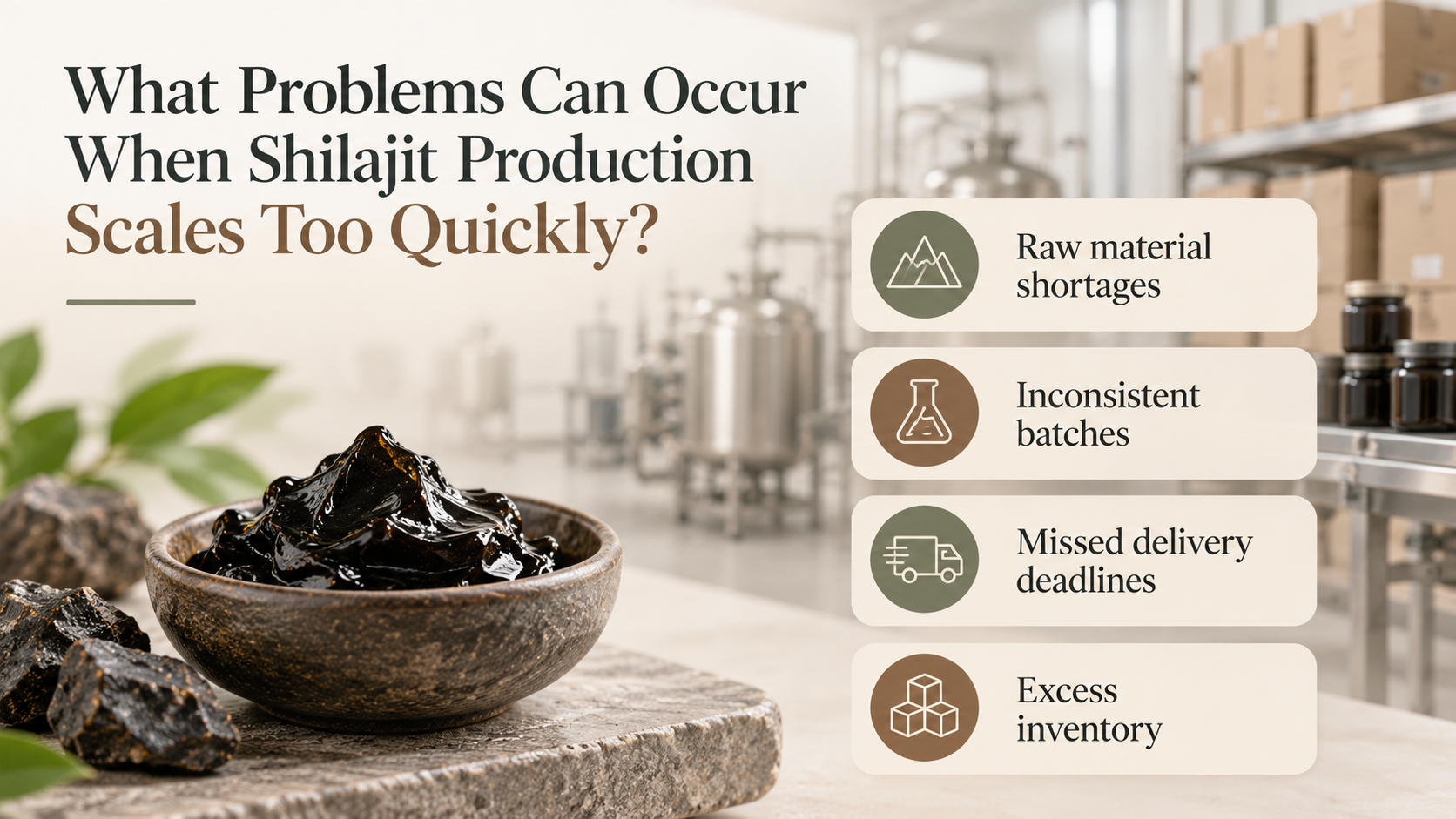 Scaling without adequate planning can create operational and financial problems.
- Raw material shortages: Insufficient supplier capacity can delay production or disrupt planned replenishment.
- Inconsistent batches: Weak process controls can make it harder to demonstrate that every batch meets the agreed specifications.
- Missed delivery deadlines: Limited production capacity, delayed testing, or unavailable packaging can postpone dispatch.
- Excess inventory: Ordering more than the business can sell can tie up working capital and increase storage costs.
These problems are not inevitable consequences of larger orders. They are risks that brands can reduce through demand forecasting, documented quality procedures, and realistic production planning.
How Can a Shilajit Brand Prepare for Larger Orders?
Before increasing order quantities, brands should take five practical steps:
- Forecast demand: Review sales trends, expected growth, inventory turnover, and planned distribution expansion.
- Confirm product specifications: Document the agreed composition, quality attributes, packaging requirements, and applicable acceptance criteria.
- Agree on production timelines: Confirm capacity, testing and release schedules, and expected dispatch dates with the manufacturer.
- Plan inventory and packaging: Coordinate raw materials, packaging procurement, storage capacity, and finished-goods requirements.
- Review total costs: Compare bulk pricing against working capital needs, storage, logistics, and the risk of unsold inventory.
These steps help brands increase production in line with actual business requirements rather than placing larger orders based on unit-price savings alone.
How to Choose a Shilajit Manufacturer for Bulk Orders
A suitable manufacturing partner should be able to demonstrate that it can manage higher production volumes without compromising agreed quality requirements or delivery commitments.
Evaluate potential manufacturers using the following criteria:
- Production capacity: Can the manufacturer fulfil the required quantity within the agreed timeline?
- Raw material traceability: Are sourcing records and incoming material checks maintained?
- Quality control: Are processing procedures, batch specifications, and release criteria documented?
- Testing and documentation: Can the manufacturer provide relevant test results, batch-specific certificates of analysis, and supporting quality records?
- Regulatory compliance: Are the applicable licences, product requirements, and labelling obligations addressed for the target market?
- Supply reliability: Can the manufacturer plan repeat orders and communicate potential delays?
For Shilajit products sold in India, applicable regulatory requirements depend on the product’s classification, composition, intended use, and relevant regulations. Brands should verify the requirements through AYUSH and other relevant authorities where applicable.
Assess manufacturers on their documented capabilities and ability to meet your specific requirements, not solely on the volume they claim to produce.
Conclusion
Scaling Shilajit production successfully requires brands to coordinate procurement, quality control, manufacturing, inventory, and costs as order volumes increase. The goal is to meet growing demand without compromising product specifications or creating avoidable supply and cash-flow problems.
Before placing larger orders, evaluate your sales forecasts and choose a manufacturing partner with the documented capacity and quality systems to support your growth.
FAQs
- When should a Shilajit brand increase its order quantity?
Increase order quantities when demand forecasts support higher sales, working capital is sufficient, and the manufacturer can meet the required quality specifications and delivery schedule.
- Does bulk Shilajit manufacturing reduce costs?
Bulk orders may lower certain per-unit procurement, production, and packaging costs. Actual savings depend on order size, supplier terms, testing, storage, and inventory requirements.
- How is batch consistency maintained during larger production runs?
Manufacturers use documented processing procedures, defined acceptance criteria, appropriate testing, and batch records to verify that each production batch meets the agreed specifications.
- How long does a bulk Shilajit order take?
Lead times depend on raw material availability, production capacity, packaging readiness, testing, and quality release. Brands should obtain a confirmed schedule for their specific order.
- What should brands check before choosing a bulk Shilajit manufacturer?
Check production capacity, sourcing traceability, quality-control procedures, testing documentation, applicable regulatory compliance, packaging capabilities, pricing, and delivery commitments.