

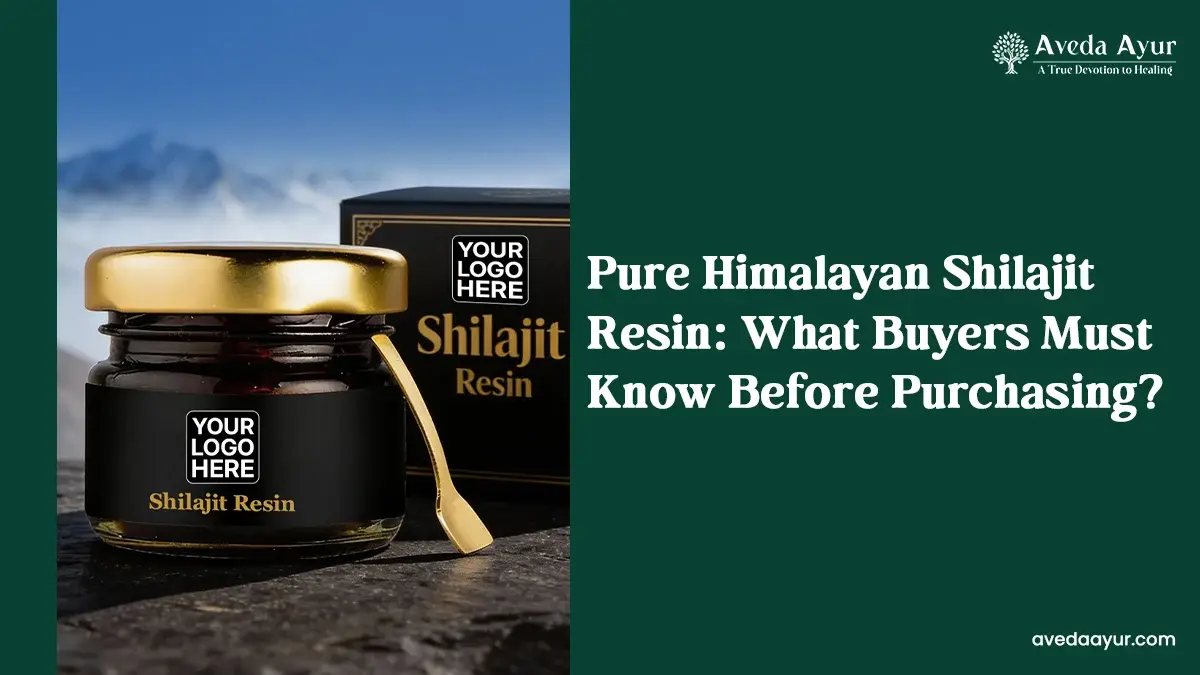
Pure Himalayan Shilajit Resin has become one of the most searched Ayurvedic wellness ingredients in recent years. But with rising demand, the market has also seen fake, diluted, overprocessed, and poorly tested products.
For buyers, importers, wellness brands, and private label businesses, the real question is not just “Where can I buy Shilajit?” The better question is:
How do I know the Shilajit resin is pure, safely processed, and suitable for my brand?
This guide explains the key factors buyers should check before purchasing Himalayan Shilajit resin.
What Is Pure Himalayan Shilajit Resin?
Shilajit is a dark, sticky, tar-like natural substance found in high-altitude mountain regions. It forms over a long period through the natural decomposition of plant matter and minerals under rock layers.
Pure Shilajit resin is usually dark brown to black, sticky, and softens with warmth. It contains naturally occurring compounds such as fulvic acid, humic substances, and trace minerals. However, natural origin alone does not guarantee safety or purity.
Raw Shilajit must be properly purified and tested before it is used in finished products.
Why Buying Shilajit Resin Is Riskier Than It Looks
Many products are marketed as “pure Himalayan Shilajit,” but packaging claims are not enough. Some low-quality products may be diluted, mixed with additives, poorly purified, or sold without proper laboratory testing.
The biggest concern with Shilajit is contamination. Raw or poorly processed Shilajit can contain heavy metals, microbial impurities, or unwanted substances. Cleveland Clinic notes that raw Shilajit may contain toxic or potentially toxic materials such as arsenic, lead, mercury, cadmium, and fungus.
That is why serious buyers should never depend only on color, smell, taste, or simple home tests.
1. Check the Source of Shilajit
The source matters because Shilajit quality can vary depending on region, altitude, collection practices, and natural mineral composition.
A reliable supplier should clearly mention sourcing details and should not rely only on vague phrases like “mountain sourced” or “100% natural.” For B2B buyers, traceability is important because it helps maintain consistency across batches.
2. Ask for a Certificate of Analysis
A Certificate of Analysis, or COA, is one of the most important documents buyers should ask for before purchasing Shilajit resin.
A proper COA should include:
Fulvic acid content
Heavy metal testing
Microbial testing
Batch number
Testing date
Name of the testing laboratory
Home tests may help identify obvious fakes, but they cannot confirm heavy metal safety or microbial quality. Third-party lab testing is the reliable way to verify product quality.
3. Check Heavy Metal Testing
Heavy metal testing is not optional. Because Shilajit is naturally collected from mineral-rich rock regions, improper purification can leave unwanted contaminants in the final product.
Buyers should check whether the product has been tested for metals such as lead, arsenic, mercury, and cadmium. This is especially important for brands planning to sell in regulated or export markets.
4. Look for Transparent Fulvic Acid Information
Fulvic acid is one of the key naturally occurring compounds associated with Shilajit. However, buyers should be careful with exaggerated claims.
A responsible supplier should provide a realistic fulvic acid range supported by testing. If a brand claims extremely high potency without lab proof, buyers should treat it as a red flag.
5. Understand the Difference Between Resin, Powder, Capsules, and Gummies
Shilajit is available in many forms:
Resin
Powder
Capsules
Tablets
Drops
Gummies
Resin is the traditional sticky form and is often preferred by buyers looking for a less processed format. Powders, capsules, and gummies may offer convenience, but they can involve additional processing or excipients.
For private label brands, the right form depends on target market, pricing, compliance needs, packaging format, and customer preference.
6. Do Not Trust Only “At-Home Purity Tests”
Many blogs talk about water solubility, flame tests, smell, and texture. These checks may help detect obvious adulteration, but they are not enough.
A product can pass basic physical checks and still fail heavy metal or microbial testing. Serious buyers should treat at-home tests as basic screening only, not final proof of purity.
7. Choose a Manufacturer With Compliance and Documentation
For brands, the manufacturer is as important as the ingredient itself. A responsible Shilajit resin manufacturer should offer:
Batch-wise testing
Proper purification process
GMP/ISO/AYUSH-aligned manufacturing standards
Documentation support
Private label packaging options
Scalable production capacity
Export-ready support if required
This is especially important for businesses that want to build long-term trust rather than launch a low-quality product quickly.
Buyer Checklist Before Purchasing Shilajit Resin
Before buying Shilajit resin, ask these questions:
Is the source clearly mentioned?
Is the product purified?
Is COA available?
Is heavy metal testing included?
Is microbial testing included?
Is fulvic acid content mentioned with proof?
Does the manufacturer follow quality standards?
Can the supplier support private label or bulk requirements?
Is packaging suitable for resin stability?
Is the supplier transparent with documentation?
Why Aveda Ayur for Shilajit Resin Manufacturing?
Aveda Ayur supports brands with Shilajit resin manufacturing, sourcing support, purification, private label development, and documentation-focused production.
For businesses planning to launch or scale a Shilajit-based product, working with an experienced manufacturer can help reduce quality risks and improve product consistency.
Aveda Ayur focuses on quality, documentation, and scalable manufacturing support for domestic and international wellness brands.
Final Thoughts
Pure Himalayan Shilajit Resin can be a valuable ingredient for wellness brands, but buyers should not rely on marketing claims alone.
Before purchasing, always check source transparency, purification method, COA, heavy metal testing, microbial testing, fulvic acid details, and manufacturer credibility.
In the Shilajit market, the cheapest option is rarely the safest option. A clear, tested, and well-documented product is what helps a brand build long-term trust.