

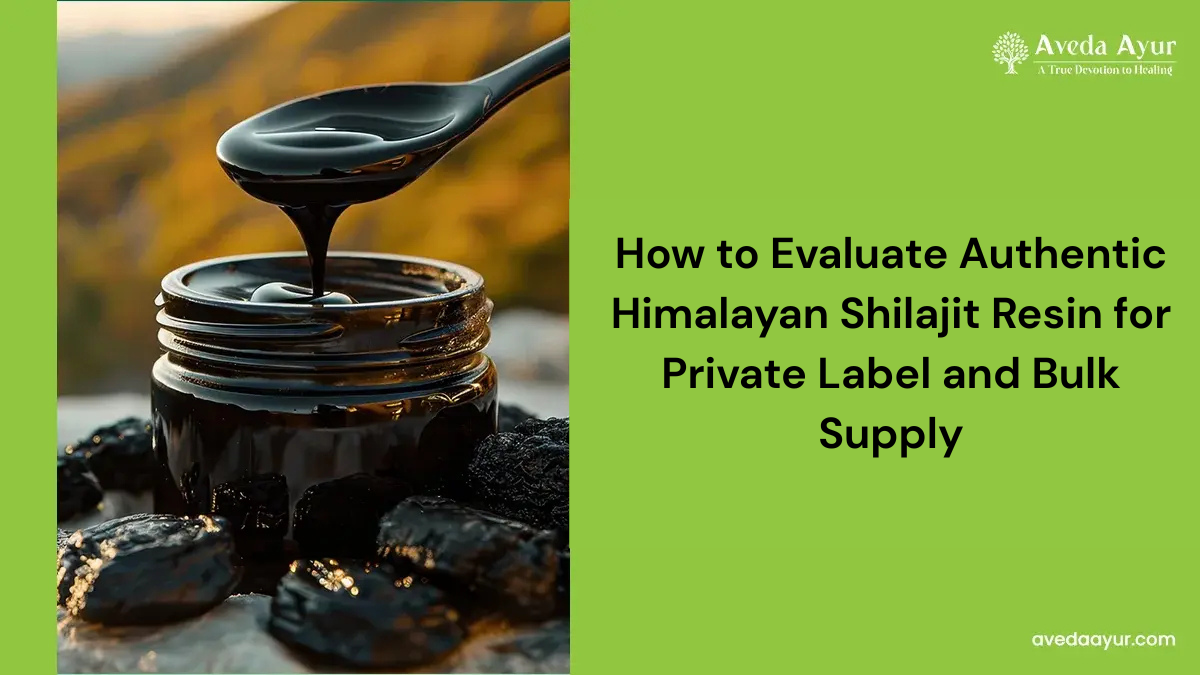
Finding a Shilajit resin supplier is the straightforward part. Every supplier you will encounter claims their product is pure, Himalayan-sourced, and high in fulvic acid. What is harder and what actually matters for a brand owner or bulk buyer is knowing how to evaluate whether a specific product sample in front of you meets the standard your brand and your target market requires.
This is a different question from supplier verification. Supplier verification asks: is this manufacturer certified, compliant, and operationally reliable? Product evaluation asks: is this specific resin, from this specific batch, authentic, well-processed, and consistent with the quality benchmarks your brand depends on?
Both questions matter. But most buying guides focus on the first and skip the second leaving brand owners in the position of trusting supplier claims about product quality rather than knowing how to verify it directly.
This guide covers the product evaluation side. It gives you the specific quality markers, laboratory parameters, and practical checks that help you assess a Shilajit resin sample or batch documentation with confidence whether you are sourcing for a private label launch, scaling an existing product line, or evaluating a new supplier’s sample for the first time.
Why Shilajit Resin Is the Reference Format for Quality Evaluation
Shilajit is commercially available in several formats resin, powder, capsules, drops, and extract concentrates. For B2B buyers evaluating product quality, resin is the reference format. It is the least processed presentation of the raw material, which means its quality parameters most directly reflect the quality of the underlying source material and purification process.
When Shilajit is converted into powder or capsule form, additional processing steps are involved spray drying, encapsulation, standardisation each of which introduces variables that can mask underlying quality issues. A poor-quality resin can be spray-dried and encapsulated with added fulvic acid to reach a target specification on paper, while the whole-resin bioactive profile that makes Himalayan Shilajit valuable is absent.
This is why brands serious about Shilajit product quality typically evaluate the source resin directly before deciding on the finished product format. The resin’s quality determines what any downstream format can genuinely deliver.
What Makes Himalayan Shilajit Resin Chemically Distinct
Authentic Himalayan Shilajit forms at altitudes above 3,000 metres across specific high-altitude regions of India primarily Ladakh, Uttarakhand, and Himachal Pradesh. At these elevations, centuries of geological pressure and plant decomposition produce a resin with a specific chemical composition that distinguishes it from both lower-altitude varieties and synthetic substitutes.
Fulvic acid — the primary quality marker
Fulvic acid is the most studied bioactive compound in Shilajit and the most commonly used quality benchmark. In genuine, properly purified Himalayan Shilajit resin, fulvic acid accounts for 60 to 80 percent of the nutraceutical composition by dry weight. This range reflects the natural variation across harvesting seasons and source regions it is not a fixed number.
Products reporting fulvic acid content above 85 percent should be evaluated with caution. At those levels, the fulvic acid concentration almost certainly reflects addition of isolated synthetic fulvic acid to a lower-grade base rather than the natural composition of whole resin. A COA showing 90 or 95 percent fulvic acid in a product described as ‘natural resin’ is a technical inconsistency that warrants a direct question to the supplier.
Trace mineral profile — the authenticity indicator
Genuine whole Himalayan Shilajit resin contains a broad spectrum of trace minerals including iron, zinc, magnesium, calcium, potassium, selenium, and manganese derived from the geological environment of its formation. A COA that reports only fulvic acid content without a trace mineral panel is documenting an incomplete picture of the product. The mineral profile alongside fulvic acid content is what confirms you are working with whole resin rather than a reconstituted or synthetic product.
Humic acid ratio
Shilajit contains both fulvic acid and humic acid as part of its naturally occurring humic substance complex. In genuine whole resin, humic acid is typically present alongside fulvic acid at a measurable concentration. Products with extremely high fulvic acid and near-zero humic acid content have likely been processed in a way that fractionates the natural complex which affects the product’s authenticity as whole resin, regardless of the fulvic acid percentage shown on the label.
How Purification Method Affects the Final Product
The purification process is the step between raw collected resin and the finished product that reaches your brand. How it is done directly determines the quality, safety, and authenticity of what you are buying.
Water-based purification — the traditional method
Traditional Ayurvedic purification of Shilajit uses a water-based process: the raw resin is dissolved in water, filtered through fine cloth or membrane systems to remove physical impurities rock particles, soil, plant debris and then concentrated through controlled low-temperature evaporation. This method removes contaminants while preserving the natural fulvic acid, humic acid, and trace mineral composition of the original resin. The finished product retains the biochemical complexity that characterises genuine Himalayan Shilajit.
Solvent-based purification — faster but destructive
Some commercial producers use chemical solvent extraction for speed and yield. This approach is faster and can produce higher visual purity, but it strips bioactive components along with contaminants. The resulting product may show acceptable heavy metal results on a COA but lacks the full humic substance profile of properly purified whole resin. Some producers then add synthetic fulvic acid back in to reach a target percentage which is how products with 90 percent fulvic acid claims and no genuine whole-resin characteristics reach the market.
When evaluating a supplier or sample, ask directly: what purification method do you use, and do you add any ingredients after purification? A supplier using water-based methods with no post-purification additions should be comfortable answering this clearly. Request the processing summary from their batch manufacturing record if you want documentary confirmation.
7 Product Quality Checks for Himalayan Shilajit Resin — A Practical Evaluation Checklist
Use this checklist when evaluating any Shilajit resin sample or batch documentation. Apply it consistently across all suppliers you are comparing the differences in what each can and cannot provide are often the most informative part of the evaluation.
- Check fulvic acid content against the 60–80% benchmark. Request a COA from a third-party accredited laboratory. Fulvic acid content should fall between 60 and 80 percent. Confirm the measurement method is specified — AOAC titration is the industry standard. Suspect any result above 85 percent in a product described as natural whole resin. Ask the supplier directly how the fulvic acid content is achieved if the figure sits outside the natural range.
- Request the full trace mineral panel, not just fulvic acid. Genuine whole Himalayan Shilajit resin contains measurable concentrations of iron, zinc, magnesium, selenium, and other trace minerals from its geological formation environment. A COA that reports only fulvic acid is incomplete. Ask for the mineral profile alongside the organic acid analysis. If the supplier cannot provide it, that tells you something about how thoroughly their product has been tested and characterised.
- Verify heavy metal results against internationally accepted limits. All natural mineral resins contain some heavy metals from their geological environment. What matters is that concentrations fall within safe limits for human consumption. Reference limits per serving typically include: lead below 10 ppm, arsenic below 10 ppm, cadmium below 3 ppm, and mercury below 1 ppm, per USP dietary supplement guidelines. EU limits are stricter across most parameters. Confirm that the COA shows quantified results for each heavy metal against stated specification limits — not just a combined pass stamp.
- Confirm microbial safety results. Request microbiological testing results for: total aerobic microbial count, total yeast and mould count, Salmonella (absent per gram), E. coli (absent per gram), and Staphylococcus aureus (absent per gram). These should be tested on finished product, not raw material only. A product that passes chemistry testing but has not been tested for microbiological safety is not fully characterised from a regulatory standpoint.
- Verify the COA is batch-specific, not a generic template. Check that the COA contains the specific batch or lot number matching the sample you are evaluating, the date of analysis, and the full name and accreditation number of the testing laboratory. ISO/IEC 17025 accreditation for the testing lab is the benchmark it means the lab’s testing methods have been independently validated. A COA without a batch number, without a dated analysis, or from an in-house non-accredited lab does not meet the documentation standard required for B2B procurement or export compliance.
- Conduct a basic physical authenticity check on your sample. Genuine purified Shilajit resin has specific physical characteristics that can be checked without laboratory equipment. It should be dark brown to black, with a smooth, slightly sticky texture at room temperature. It softens and becomes pliable when warmed between the fingers. It should dissolve fully in warm water, producing a clear amber-coloured solution without visible sediment. It should have a distinctly earthy, slightly bituminous odour. Resin that is brittle at room temperature, that leaves visible sediment after dissolving, or that has no characteristic odour has likely been processed in a way that has altered its natural matrix.
- Confirm geographic origin documentation. Ask the supplier to specify the sourcing region Ladakh, Uttarakhand, or Himachal Pradesh and the approximate altitude. Authentic Himalayan Shilajit is harvested at altitudes above 3,000 metres where the specific geological conditions produce the characteristic mineral and organic acid profile. A supplier who sources authentic Himalayan material will know their collection regions and be able to describe them specifically. A supplier unable to give a named region beyond ‘Himalayan mountains’ warrants further scrutiny.
Format Considerations for Brand Owners: Resin, Capsules, or Drops
Once you have evaluated the source resin quality, the next decision for a brand owner is which finished product format serves your target market best. Each format has specific implications for regulatory classification, consumer appeal, and the documentation required for your destination market.
Resin
Shilajit Resin is the most potent and least processed format. It is the preferred choice for markets where ingredient authenticity is a primary selling point particularly the UK, USA, and European supplement markets where informed consumers research sourcing and processing. Resin requires specific packaging glass jars with moisture and light protection and clear consumer guidance on dosing and storage. It has a strong sensory profile (smell, texture, appearance) that can be unfamiliar to first-time users in some markets.
Capsules
Shilajit capsules offer familiar format convenience and are suitable for markets where supplement consumption is primarily through capsule and tablet products. Quality evaluation for capsules requires the same underlying resin assessment the capsule fill content should be traceable to a tested, documented resin batch. Request the COA for the underlying resin, not just the finished capsule product, to confirm the source material quality.
Drops
Shilajit liquid drops are an emerging format with growing consumer interest in Western markets. They combine the convenience of a liquid with the positioning of a concentrated natural extract. Quality parameters are the same as for resin — fulvic acid content, mineral profile, heavy metals, microbiological safety — but the dilution ratio of the formulation affects how these values are expressed per serving on the label. Confirm the per-serving specification explicitly, not just the bulk concentration figures.
Export Compliance Considerations by Market
Product quality evaluation does not happen in isolation from the regulatory environment of your target market. The documentation and compliance requirements that accompany a Shilajit resin product vary significantly by destination, and understanding them before placing a production order prevents compliance gaps that surface at the wrong moment.
- United States. Shilajit sold as a dietary supplement in the US requires the manufacturing facility to be registered with the FDA under 21 CFR Part 110. Labelling must comply with FDA dietary supplement labelling requirements including a Supplement Facts panel. The COA and product specification must be maintained in the facility’s quality records for a minimum of two years for FDA inspection purposes.
- United Kingdom. Post-Brexit, herbal products in the UK are regulated under MHRA guidelines. Products making health claims require compliance with the Food Supplements (England) Regulations. For Ayurvedic products specifically, some categories require Traditional Herbal Registration (THR). Confirm with your regulatory advisor which classification applies to your specific Shilajit product and intended label claims before entering the UK market.
- UAE and Gulf markets. Halal certification is a standard commercial requirement for supplement products in the UAE and Gulf Cooperation Council markets. The Halal certificate must be from a recognised certifying body. Product registration with the UAE Ministry of Health may also be required depending on the intended health claims and distribution channels.
- European Union. Food supplements in the EU are governed by Directive 2002/46/EC and individual member state implementations. Heavy metal limits are typically stricter than US benchmarks. Products containing minerals require that the mineral forms used are on the EU-approved list of mineral substances for use in food supplements.
Evaluating Shilajit Resin for Your Brand
Aveda Ayur is a GMP-certified, AYUSH-licensed herbal and Ayurvedic product manufacturer based in India, producing Shilajit resin for brand owners and bulk buyers across the UK, USA, UAE, Canada, and other international markets.
If you are in the process of evaluating Shilajit resin for a private label brand or bulk supply arrangement and want to understand our product specifications, available documentation, and production capabilities, reach out to our team with your requirements. We will respond with the relevant product and compliance information for your specific market.
Frequently Asked Questions
What fulvic acid percentage should authentic Himalayan Shilajit resin contain?
In genuine, properly purified Himalayan Shilajit resin, fulvic acid accounts for approximately 60 to 80 percent of the nutraceutical composition by dry weight. This range reflects natural variation across harvesting seasons and source regions. Products reporting fulvic acid above 85 percent in a natural whole resin are technically inconsistent — at those levels, isolated synthetic fulvic acid has almost certainly been added to a lower-grade base. When evaluating a COA, confirm the measurement method (AOAC titration is standard), and request a full trace mineral panel alongside the fulvic acid result to confirm you are assessing genuine whole resin rather than a reconstituted blend.
What is the difference between Shilajit resin, powder, and capsules for private label brands?
Resin is the least processed format and most directly reflects the quality of the underlying source material and purification. Powder is produced by spray-drying the resin, which involves higher heat and additional processing steps that can affect bioactive content. Capsules encapsulate either resin or powder and add a further step. For brand owners evaluating quality, always assess the source resin not just the finished capsule or powder product to confirm the underlying ingredient meets your specification. Request the COA for the batch of resin used in your finished product, not only the finished product COA.
What heavy metal limits apply to Shilajit resin for international export?
Heavy metal limits vary by destination market. USP dietary supplement guidelines reference limits per serving of lead below 10 ppm, arsenic below 10 ppm, cadmium below 3 ppm, and mercury below 1 ppm. EU limits for food supplements are typically stricter. Your COA should show quantified results for each heavy metal against the specification limits applicable to your target market not simply a combined pass or fail result. If your product will be sold in multiple markets with different limits, confirm compliance against the strictest applicable standard.
How do I confirm that Shilajit resin is genuinely from Himalayan regions and not a lower-altitude substitute?
Geographic origin in Shilajit cannot be confirmed by visual inspection alone. The most reliable indicators are a combination of supplier documentation and laboratory analysis. Ask your supplier to name the specific collection regions Ladakh, Uttarakhand, and Himachal Pradesh are the primary authentic Himalayan sources and the approximate altitude, which should be above 3,000 metres for genuine Himalayan material. On the laboratory side, the trace mineral profile of genuine Himalayan resin reflects its specific geological formation environment. A COA showing a characteristic mineral panel alongside fulvic acid content, from a batch-specific third-party accredited analysis, provides meaningful product-level verification alongside sourcing documentation.