

The global herbal supplement market crossed $140 billion in 2024 and continues to grow at roughly 8% per year. For wellness entrepreneurs, pharma distributors, and health brands, that number signals one thing: the opportunity to launch a credible herbal supplement line has never been larger or more competitive.
The brands that break through are rarely the ones with the biggest budgets. They are the ones that make the right foundational decision early: choosing a manufacturing partner who matches their quality standards, their market, and their growth ambitions.
This guide gives you a practical, experience-backed framework to evaluate, shortlist, and partner with the right private label herbal supplement manufacturer — whether you are launching in India, exporting to the UK, or building a supplement brand for the US market.
Why Your Manufacturing Partner Defines Your Brand
Most first-time founders focus on logo design, social media strategy, and pricing. Experienced ones know that private label herbal supplement manufacturing is the foundation everything else rests on.
Here is what your manufacturer actually controls:
- The purity and potency of every ingredient that goes into your product
- Whether your capsules or resin jars pass customs and regulatory checks in your target market
- Your production timelines, which directly affect your cash flow and customer satisfaction
- Batch-to-batch consistency the real test of a manufacturer’s quality systems
A factory that cuts corners on raw material testing might look cost-effective on the first order. The consequences become clear when a batch fails regulatory inspection or a customer raises a quality complaint.
Private Label, Contract, and Third Party Manufacturing: Understanding the Difference
These three terms are often used interchangeably, but they describe distinct arrangements and understanding the difference helps you ask the right questions when approaching a manufacturer.
Private Label Manufacturing
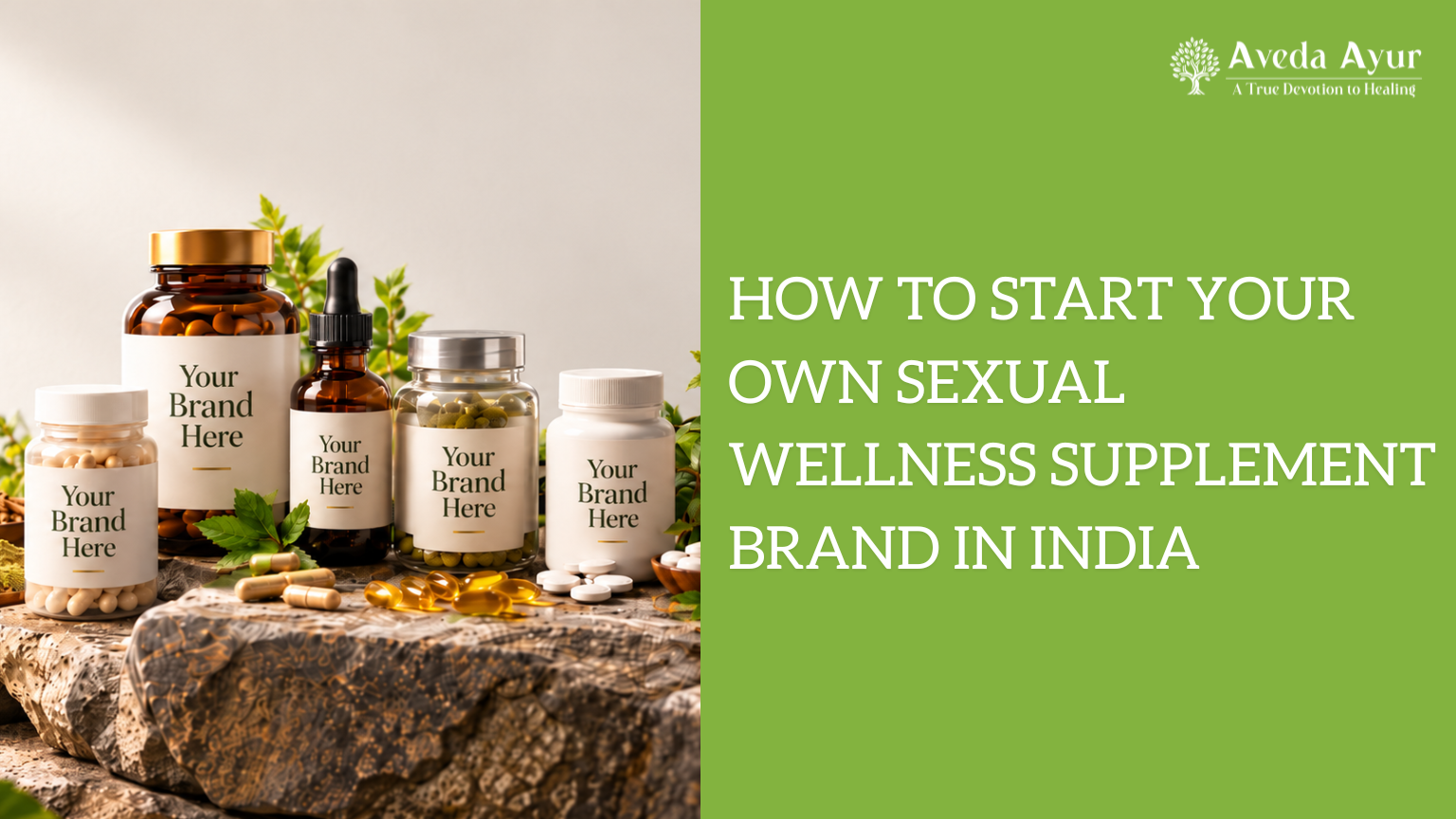
You select from a manufacturer’s existing, pre-validated formulations and sell them under your own brand name and packaging. This is the fastest route to market with lower upfront R&D cost. Well suited to brands entering a product category for the first time.
Contract Manufacturing
You provide or co-develop a proprietary formula, and the manufacturer produces it at scale. Ideal for brands that already have a formulation or have invested in Ayurvedic R&D and want full ownership of their formula.
Third Party Manufacturing
Common in the Indian pharma and Ayurveda sector. A third-party facility produces under your brand, carrying responsibility for production quality. Most Indian Ayurvedic distributors and regional supplement brands operate on this model.
For most wellness entrepreneurs entering the market in 2025, private label is the most practical starting point. It lets you validate demand and build a customer base before committing to the higher investment of custom formulation development.
8 Things to Check Before Choosing a Herbal Private Label Manufacturer
Work through this checklist with every manufacturer you are evaluating. It surfaces the information that actually matters before you commit to a partnership.
- GMP certification. The facility must operate under Good Manufacturing Practices. In India, look for a WHO-GMP or AYUSH-GMP certificate not just a logo on the website. Ask for the certificate number and verify it.
- AYUSH or relevant regulatory licence. For Ayurvedic products specifically, a valid AYUSH manufacturing licence is a baseline requirement. Request the licence number and check its validity and expiry date.
- Raw material testing protocol. Ask directly: ‘Do you test every incoming raw material batch for heavy metals, microbial load, and active compound concentration?’ A verbal yes should be backed by a batch-specific Certificate of Analysis (COA), not a generic template.
- Order flexibility and scalability. A manufacturer’s ability to work with your launch volume and scale with your growth matters more than the lowest per-unit price. Understand clearly what order volumes they are equipped to handle at different stages.
- Dosage form range. Can they produce tablets, capsules, syrups, resin, oils, and effervescents? A manufacturer limited to one or two formats will constrain your product portfolio as your brand grows.
- Custom packaging and labelling support. Full-service manufacturers handle packaging design, label compliance review, and export documentation reducing the number of vendors you have to coordinate and compressing your launch timeline.
- Export experience and regulatory knowledge. If you plan to sell in the UK, USA, UAE, or Australia, your manufacturer needs practical knowledge of the import regulations in those markets not just familiarity with Indian export norms.
- References and communication quality. Ask for references from existing clients in markets similar to yours. A manufacturer who communicates clearly and promptly before the first order will behave the same way when a production question arises mid-batch.
Red Flags That Signal a Manufacturer Is Not the Right Fit
These patterns, seen consistently in manufacturers who are not ready for a serious brand partnership, are worth knowing before you begin evaluation:
- No batch-specific COA available on request only generic certificates with no lot numbers or dates
- Reluctance to allow a facility visit or a video walkthrough of the production floor
- Promises of unrealistically fast production turnarounds quality herbal manufacturing follows fixed timelines for good reason
- Inability to identify the sourcing region of a key ingredient ‘we source the best’ is not an answer
- Communication that slows down or becomes vague once an initial enquiry is made this pattern only worsens after an order is placed
A manufacturer who operates with integrity welcomes detailed questions. Their processes are documented, their certifications are current, and they have nothing to obscure.
Why Indian Manufacturers Offer a Strategic Advantage for Global Brands
India is home to more than 6,000 Ayurvedic manufacturers and supplies medicinal herbs to over 150 countries. For a wellness brand building for a global audience, partnering with an AYUSH-certified Indian herbal supplement manufacturer offers three advantages that are genuinely difficult to replicate elsewhere.
Direct access to authentic ingredients at source
Herbs like Ashwagandha, Shatavari, Brahmi, Tulsi, and Shilajit resin are native to the Indian subcontinent. Sourcing and manufacturing at origin means shorter ingredient supply chains, higher freshness, and verifiable authenticity an increasingly important differentiator as consumers and regulators demand full ingredient traceability.
Classical Ayurvedic formulation knowledge
Authentic Ayurvedic formulation draws on classical references including Charaka Samhita and Ashtanga Hridayam texts that codify how specific herbs interact, which combinations are contraindicated, and how processing methods affect bioavailability. An Indian manufacturer with trained Ayurvedic practitioners on staff brings this depth of knowledge to formulation decisions. This expertise is not replicable by a contract lab that specialises in synthetic nutraceuticals.
Competitive manufacturing economics without quality compromise
Manufacturing costs in India run substantially lower than comparable facilities in Western markets not because quality standards are lower, but because the economics of ingredient sourcing, skilled labour, and infrastructure are structurally different. GMP-certified Indian manufacturers supply the same international supplement markets, under the same regulatory requirements, as their Western counterparts.
Building a Long-Term Manufacturing Partnership
The supplement brands that sustain growth over several years are not necessarily the ones that found the lowest-cost factory. They are the ones that found a manufacturing partner genuinely invested in their outcomes.
In practice, a real manufacturing partnership looks like this:
- The manufacturer identifies a raw material quality variance before production begins not after finished product has already been packed
- They flag a relevant regulatory update in your target market before it becomes your compliance problem
- They bring formulation improvements to your attention when new research on an ingredient changes best-practice dosing
- They treat your production run with the same attention whether it is a small initial order or a large repeat
This kind of relationship develops when you choose a partner based on operational capability, transparent communication, and shared values not price alone.
How Aveda Ayur Approaches Private Label Manufacturing
Aveda Ayur is an AYUSH-licensed, GMP-certified Ayurvedic and herbal supplement manufacturer based in India, working with brands across the UK, UAE, Canada, and Europe.
Our approach to private label manufacturing is built on a few straightforward principles:
- Every raw material batch is tested and documented before it enters production COAs are available for every batch we manufacture
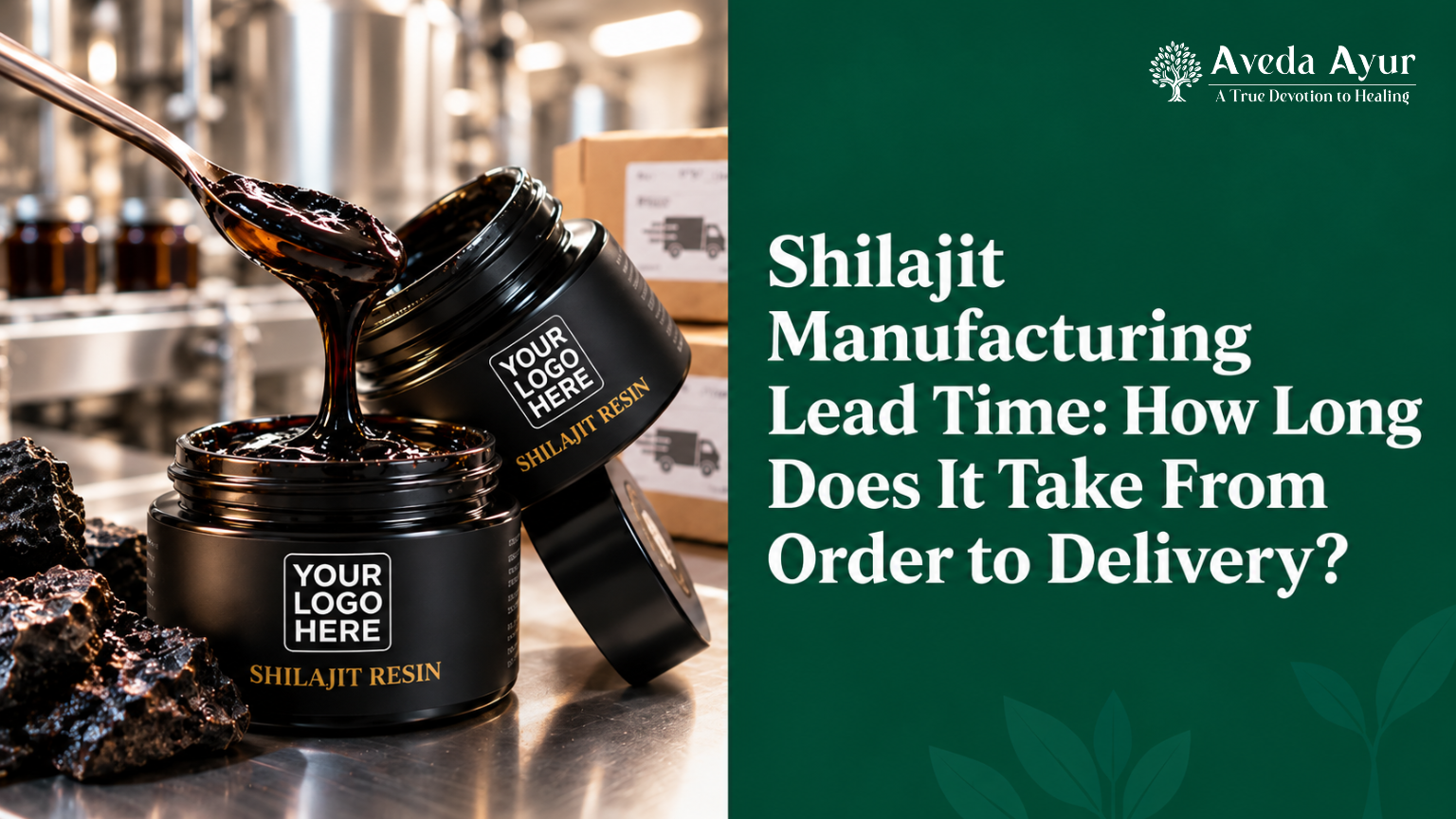
- We produce across a full range of dosage forms: tablets, capsules, herbal syrups, Shilajit resin, effervescents, oils, and powders
- Custom packaging, label compliance review, and export documentation are handled in-house
- We work with brands at different stages of growth and structure our engagements accordingly
- Clients receive transparent communication throughout production not updates only when something goes wrong
If you are evaluating herbal private label manufacturers and want to understand how we work, we are straightforward about our processes, our certifications, and our capacity. Reach out to our team and we will respond with the specifics relevant to your product and market.
Frequently Asked Questions
How do I verify that a herbal supplement manufacturer is genuinely GMP-certified?
Request the GMP certificate number and the name of the issuing authority WHO-GMP, AYUSH-GMP. Then verify it directly on the official portal of that certifying body. In India, AYUSH manufacturing licences are verifiable through the Ministry of AYUSH portal. Always check the certificate’s expiry date, and request batch-specific COAs as further evidence of active quality compliance.
Can I export private label herbal products manufactured in India to the UK or USA?
Yes. Indian-manufactured Ayurvedic and herbal supplements reach more than 150 countries, including the UK, USA, UAE, Canada, and Australia. Each destination has its own regulatory framework the UK requires compliance with the MHRA’s Traditional Herbal Registration scheme for certain product categories, while the USA requires FDA facility registration for dietary supplement manufacturers. Working with a manufacturer who has direct export experience in your target market means these requirements are navigated efficiently rather than discovered at the point of customs clearance.
What is the difference between private label and contract manufacturing for herbal supplements?
Private label means your brand sells a formula that already exists within the manufacturer’s validated product range you apply your branding and packaging. Contract manufacturing means you bring a proprietary formula and the manufacturer produces it under your specification. Private label gets a product to market faster and with lower upfront investment. Contract manufacturing gives you full ownership of a formula unique to your brand. Many supplement brands start with private label to establish revenue, then commission a proprietary formulation once they have validated their market.
Ready to Evaluate Your Options?
Choosing a private label herbal supplement manufacturer is one of the most consequential decisions in building a supplement brand. The right partner protects your quality standards, keeps your production compliant, and scales alongside your growth without you having to start the evaluation process over.
If you are in the process of comparing manufacturers and want to understand how Aveda Ayur can support your product and market, we are happy to have a direct conversation about what you are building.