

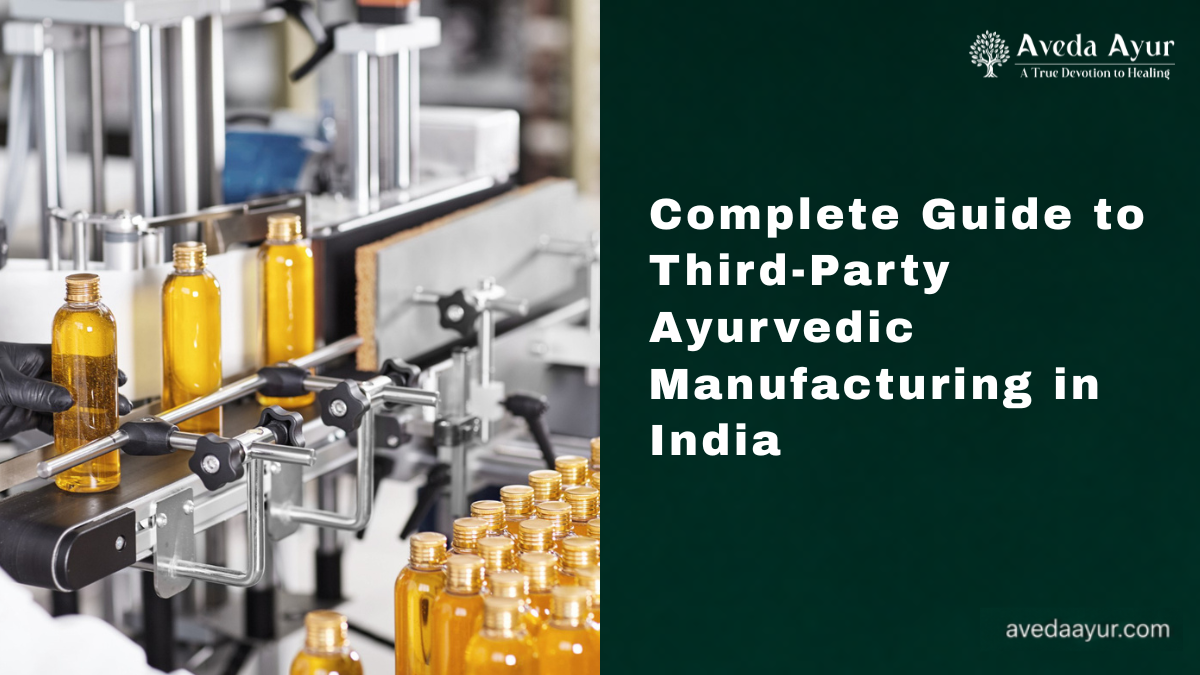
The demand for Ayurvedic products continues to grow across India and international markets, creating new opportunities for healthcare brands, distributors, exporters, and startups. However, setting up a manufacturing facility requires significant investment, regulatory approvals, skilled manpower, and quality control systems. That’s why many businesses choose third-party Ayurvedic manufacturing to launch or expand their product portfolio efficiently.
This guide explains how third-party Ayurvedic manufacturing works, its business advantages, the certifications to look for, and how to choose a reliable manufacturing partner in India.
What Is Third-Party Ayurvedic Manufacturing?
Third-party Ayurvedic manufacturing is a business arrangement where a certified manufacturer produces Ayurvedic products under another company’s brand name. The manufacturer handles formulation, production, packaging, quality testing, and regulatory compliance, while the brand owner focuses on branding, sales, and distribution.
It allows healthcare brands to enter the Ayurvedic market without establishing their own manufacturing facility.
Why India Is a Global Hub for Third-Party Ayurvedic Manufacturing
India has long been recognized as the birthplace of Ayurveda and today combines this traditional knowledge with modern manufacturing capabilities. Government initiatives promoting the AYUSH sector, an extensive network of GMP-certified manufacturing facilities, skilled professionals, and access to herbal raw materials have strengthened India’s position as a preferred manufacturing destination.
For domestic and international healthcare brands, India offers:
- Established Ayurvedic manufacturing expertise
- Competitive production costs
- Access to diverse herbal ingredients
- Skilled research and production teams
- Export-ready manufacturing infrastructure
- Regulatory support through the Ministry of AYUSH
These advantages make India an attractive choice for businesses looking for reliable and scalable manufacturing partnerships.
How Third-Party Ayurvedic Manufacturing Works
A well-established manufacturer follows a structured production process that helps businesses launch products efficiently.
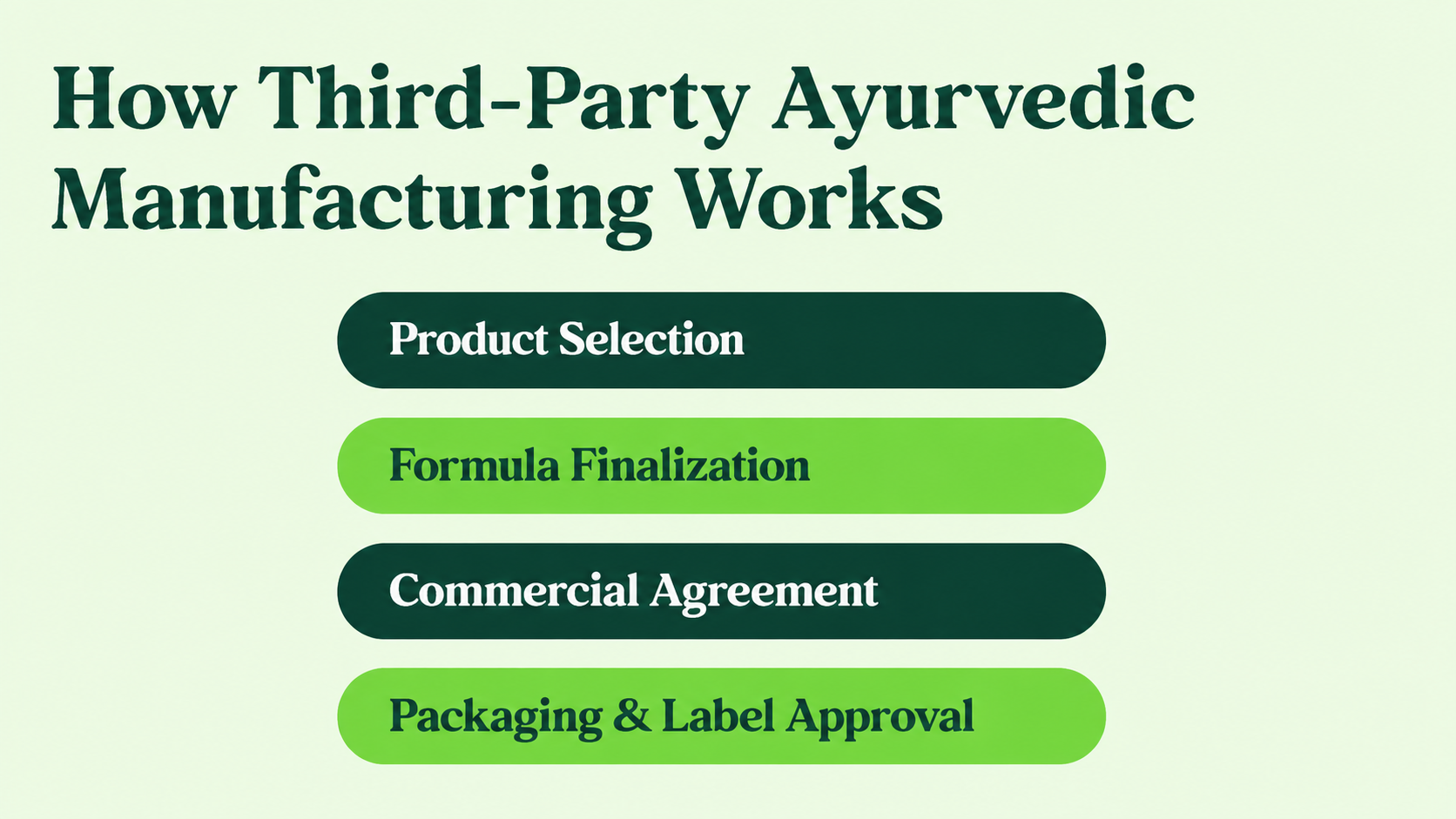
- Product Selection: The brand owner selects the Ayurvedic products they want to market, such as tablets, capsules, syrups, oils, herbal cosmetics, or nutraceuticals.
- Formula Finalization: Businesses can choose from existing formulations or discuss custom product development based on market requirements.
- Commercial Agreement: The manufacturer shares quotations, minimum order quantities (MOQs), production timelines, and documentation requirements.
- Packaging & Label Approval: Labels and packaging are finalized while ensuring compliance with applicable AYUSH and labeling requirements.
- Manufacturing & Quality Control: Products are manufactured following Good Manufacturing Practices (GMP), with quality checks conducted at different production stages.
- Packaging & Delivery: After final inspection, products are packed and dispatched according to the agreed schedule.
Why Healthcare Brands Choose Third-Party Ayurvedic Manufacturing
For businesses,third-party manufacturing is more than a cost-saving option; it is a scalable growth strategy.
- Lower Initial Investment: Manufacturing infrastructure, machinery, and production teams require substantial capital. Third-party manufacturing eliminates these upfront costs.
- Faster Time-to-Market: Partnering with an established manufacturer significantly reduces the time required to launch new products.
- Access to Manufacturing Expertise: Experienced manufacturers have dedicated production, quality assurance, and research teams that help maintain product consistency.
- Easy Product Portfolio Expansion: Businesses can introduce multiple product categories without investing in additional manufacturing facilities.
- Flexible Production Capacity: Production volumes can often be adjusted according to market demand, making it easier to scale operations.
- Reduced Operational Complexity: Manufacturing, quality control, and production management remain the responsibility of the manufacturing partner, allowing businesses to focus on sales and market development.
Third-Party Manufacturing vs. Setting Up Your Own Facility
| Third-Party Manufacturing | Own Manufacturing |
| Lower initial investment | High capital investment |
| Faster product launch | Longer setup timeline |
| No manufacturing infrastructure required | Requires factory, machinery, and manpower |
| Production handled by experts | Full operational responsibility |
| Easier business scalability | Expansion requires additional investment |
| Focus on branding and sales | Focus divided between production and business operations |
For many startups and growing healthcare companies, third-party manufacturing offers a more practical route to market.
Certifications to Verify Before Choosing a Manufacturer
Choosing a compliant manufacturing partner helps protect your brand reputation and ensures product quality.
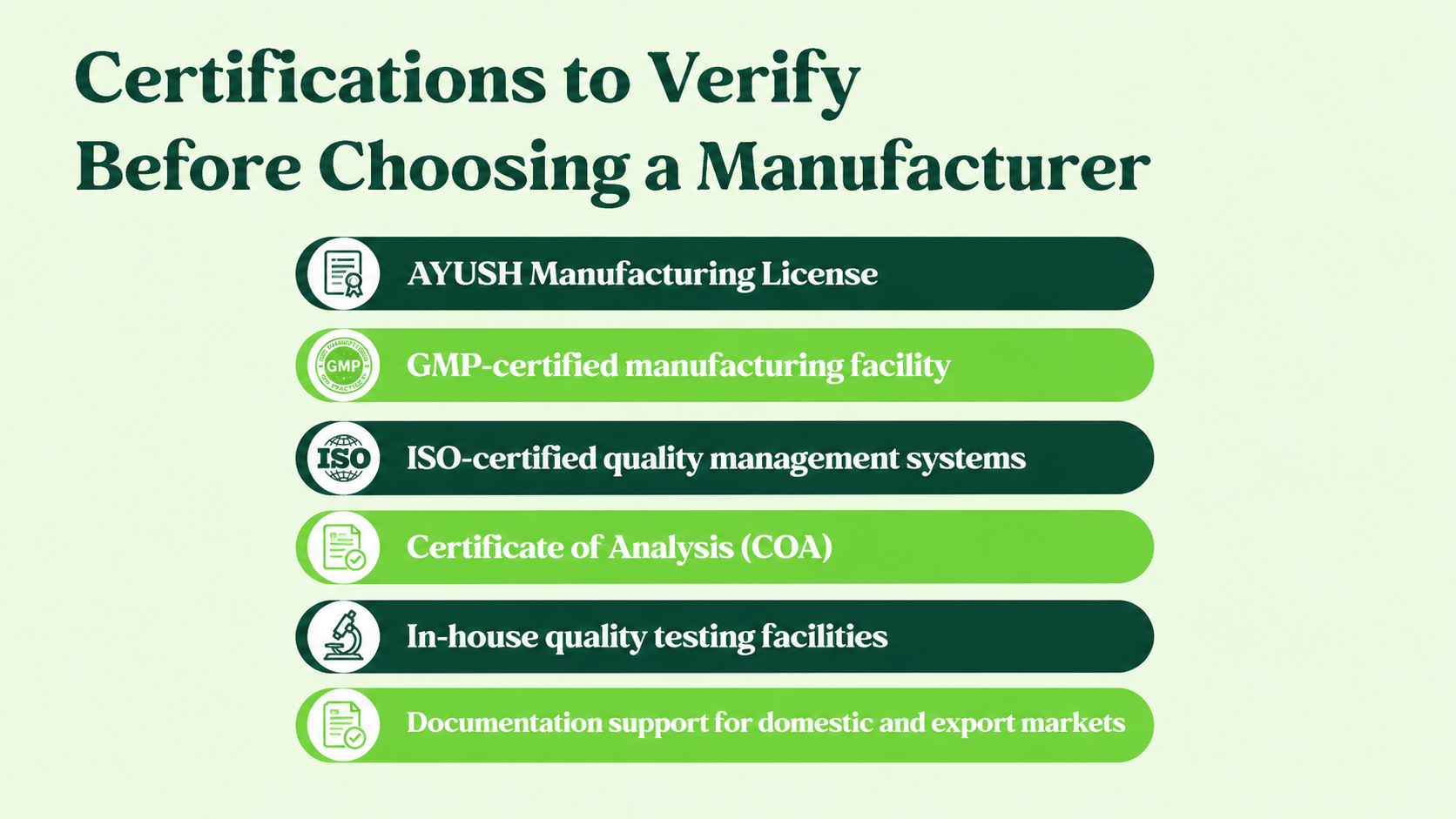
Before finalizing a manufacturer, verify:
- AYUSH Manufacturing License
- GMP-certified manufacturing facility
- ISO-certified quality management systems
- Certificate of Analysis (COA)
- In-house quality testing facilities
- Documentation support for domestic and export markets
Requesting these documents demonstrates due diligence before entering a manufacturing partnership.
How to Choose the Right Third-Party Ayurvedic Manufacturer
Selecting the right manufacturing partner involves more than comparing prices.
- Manufacturing Experience: Look for companies with proven expertise in Ayurvedic manufacturing and private labeling.
- Product Portfolio: A manufacturer with a broad product range can support future business expansion.
- Research & Development: An experienced R&D team can assist with formulation refinement and product innovation.
- Quality Assurance: Understand how raw materials, in-process production, and finished products are tested.
- Packaging & Private Label Services: Choose manufacturers offering labeling, packaging, and branding support to simplify product launches.
- Production Capacity: Ensure the manufacturer can meet current requirements and future growth.
- Transparent Communication: Reliable manufacturers provide clear pricing, production schedules, and regular project updates.
Questions Every Healthcare Brand Should Ask Before Finalizing a Manufacturer
Before signing a manufacturing agreement, ask:
- Is your manufacturing facility licensed by AYUSH?
- Do you manufacture in a GMP-certified facility?
- Can you provide Certificates of Analysis (COAs)?
- What are your minimum order quantities?
- Do you offer private label manufacturing?
- Can you develop custom formulations?
- What quality testing procedures do you follow?
- What are your average production timelines?
- Do you support export documentation?
- How do you handle product consistency across batches?
The answers help businesses evaluate reliability, quality standards, and long-term partnership potential.
Common Mistakes Businesses Should Avoid
Choosing the wrong manufacturing partner can affect product quality, timelines, and brand reputation.
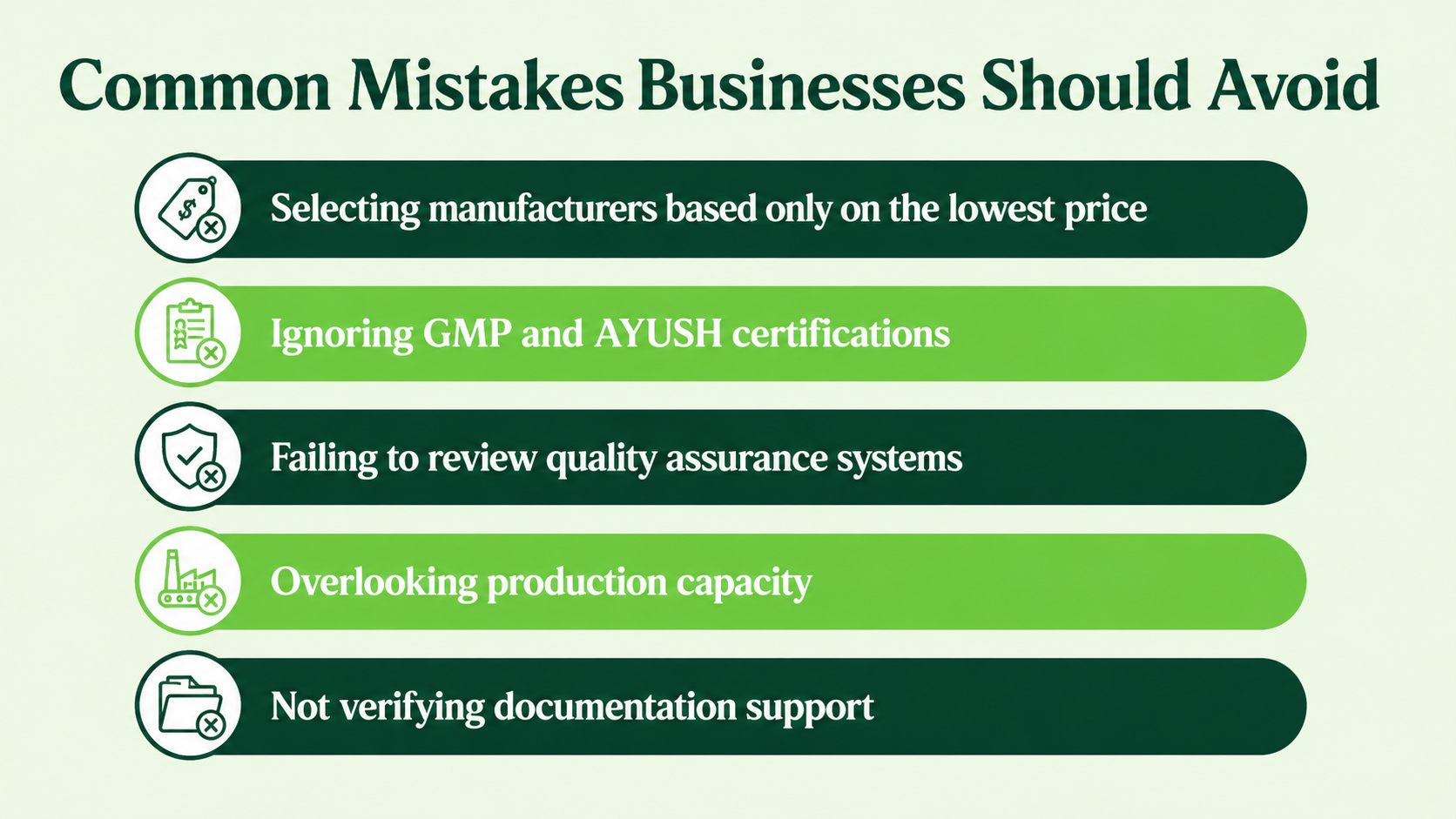
Avoid these common mistakes:
- Selecting manufacturers based only on the lowest price
- Ignoring GMP and AYUSH certifications
- Failing to review quality assurance systems
- Overlooking production capacity
- Not verifying documentation support
- Choosing inadequate packaging options
- Signing agreements without understanding responsibilities
- Focusing only on short-term costs instead of long-term value
A careful evaluation process reduces operational risks and supports sustainable business growth.
Why Choose Aveda Ayur for Third-Party Ayurvedic Manufacturing?
Finding the right manufacturing partner is essential for building a successful healthcare brand. Aveda Ayur offers comprehensive third-party Ayurvedic manufacturing and private label manufacturing solutions designed to support healthcare businesses at every stage of growth.
Our capabilities include:
- GMP-certified manufacturing facility
- End-to-end third-party manufacturing services
- Complete private label manufacturing support
- Wide portfolio of Ayurvedic, herbal, nutraceutical, wellness, and personal care products
- Custom formulation and product development assistance
- Modern manufacturing infrastructure with quality-focused production processes
- Batch-wise quality control and documentation support
- Flexible packaging and branding solutions
- Timely production and delivery
- Manufacturing support for businesses serving both domestic and international markets
Whether you are launching your first Ayurvedic product or expanding an established portfolio, Aveda Ayur works as a long-term manufacturing partner focused on quality, transparency, and consistent production standards.
Conclusion
Third-party Ayurvedic manufacturing has become one of the most efficient ways for healthcare brands to enter the rapidly growing Ayurvedic market without investing in manufacturing infrastructure. By partnering with a certified and experienced manufacturer, businesses can focus on building their brand while benefiting from established production expertise, quality systems, and scalable manufacturing capabilities.
Before selecting a manufacturing partner, evaluate certifications, manufacturing experience, quality assurance practices, production capacity, and private label capabilities. A reliable partnership not only supports product quality but also contributes to long-term business growth and customer trust.
For healthcare brands looking for dependable third-party Ayurvedic manufacturing and private label manufacturing services in India, choosing a manufacturer committed to quality, compliance, and transparency is the first step toward building a successful Ayurvedic product portfolio.
FAQs
- What is third-party Ayurvedic manufacturing?
Third-party Ayurvedic manufacturing is a business model where a certified manufacturer produces Ayurvedic products under another company’s brand name. The manufacturer manages production, quality control, packaging, and regulatory compliance, while the brand owner focuses on marketing, sales, and distribution.
- What certifications should a third-party Ayurvedic manufacturer have?
A reliable third-party Ayurvedic manufacturer should have an AYUSH Manufacturing License, GMP certification, and relevant quality management certifications such as ISO. Depending on the product category, certifications like in-house quality testing capabilities also help ensure consistent manufacturing standards.
- Can I sell Ayurvedic products under my own brand through third-party manufacturing?
Yes. Third-party manufacturing allows healthcare brands, distributors, and startups to market Ayurvedic products under their own registered brand name. The manufacturing partner produces the products according to agreed specifications, while you manage branding, sales, and distribution.
- How do I choose the right third-party Ayurvedic manufacturer in India?
Choose a manufacturer based on their certifications, manufacturing experience, product range, quality assurance systems, production capacity, private label capabilities, documentation support, and delivery reliability. Evaluating these factors helps ensure a long-term and dependable manufacturing partnership.
- Why do healthcare brands prefer third-party Ayurvedic manufacturing?
Healthcare brands prefer third-party Ayurvedic manufacturing because it reduces capital investment, speeds up product launches, provides access to certified manufacturing facilities, and allows businesses to focus on branding and market expansion instead of managing production operations.