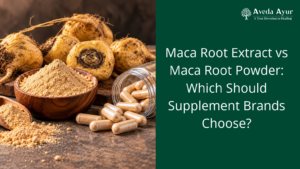


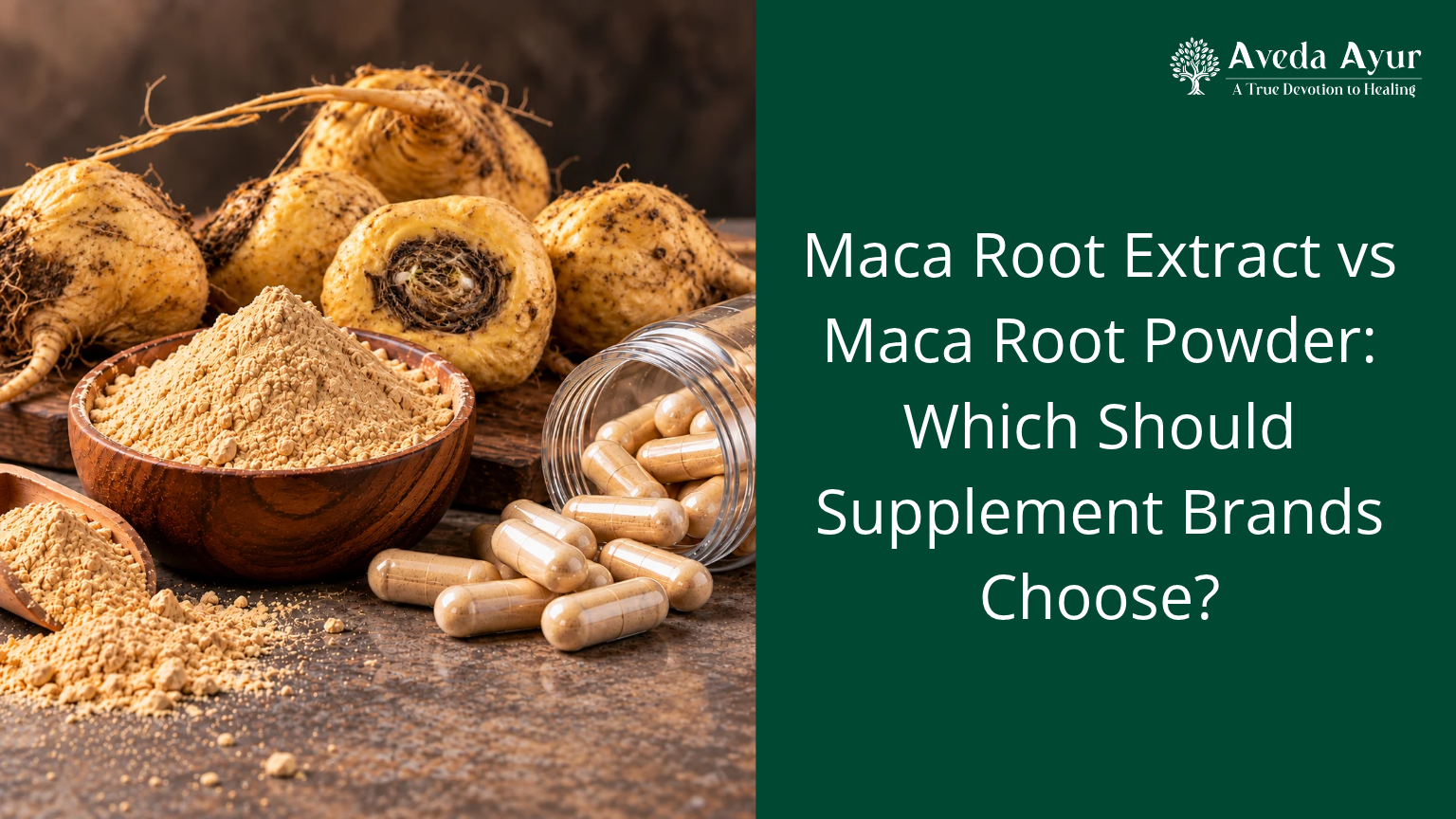
Maca root extract and maca root powder serve different formulation needs, and the right choice depends on the supplement’s intended composition, dosage form, quality specifications, and target market. Maca root powder contains the processed root material in powdered form, while maca root extract is produced by extracting constituents from the root using a defined process.
For supplement brands, the decision should not be based on the assumption that extracts are always more potent or effective. Instead, manufacturers should evaluate ingredient composition, standardization, manufacturing compatibility, and supporting quality documentation before selecting a maca ingredient.
What Is the Difference Between Maca Root Extract and Maca Root Powder?
Maca root powder is produced by drying and grinding maca root. Maca root extract is manufactured by processing the root with an extraction method, such as water- or alcohol-based extraction, to obtain an ingredient with a composition influenced by the process used.
The main difference is how the ingredients are processed and characterised. This affects their specifications, formulation properties, and suitability for different supplement products.
|
Comparison factor |
Maca Root Powder |
Maca Root Extract |
| Processing | Dried and ground root material | Root material processed through extraction |
| Composition | Contains constituents of the processed root | Depends on the extraction method and specifications |
| Standardisation | Assessed against defined identity and quality parameters | May be standardised to specified constituents |
| Formulation | Requires assessment of bulk, flavour and powder properties | Requires assessment of concentration, carriers and other specifications |
| Quality verification | Botanical identity, purity and contaminant limits | Botanical identity, extraction details, composition and contaminant limits |
| Suitable applications | Products requiring whole-root powder | Products requiring a defined extract profile |
The actual characteristics of either ingredient depend on its processing method and supplier specifications.
What Is Maca Root Powder?
Maca root powder is obtained by drying and grinding the root of Lepidium meyenii, a plant native to the Andean region of Peru. Depending on the product, the raw material may undergo additional processing, including gelatinisation.
For supplement brands, maca root powder offers a relatively straightforward ingredient format for formulations that call for powdered root material.
Key considerations when sourcing maca root powder:
- Botanical identity: Verify the species and plant part used.
- Processing method: Confirm whether the material is raw, heat-treated, or gelatinised.
- Quality specifications: Review identity, purity, microbiological limits, and relevant contaminant testing.
- Formulation suitability: Evaluate flavour, bulk density, flow properties and compatibility with the intended dosage form.
These checks help brands assess whether the powder meets their product requirements rather than relying on the ingredient name alone.
What Is Maca Root Extract?
Maca root extract is produced by extracting selected constituents from maca root using a specified manufacturing process. Its final composition depends on factors such as the extraction solvent, processing conditions, and raw material used.
Unlike ordinary root powder, an extract may be manufactured to meet defined specifications for particular constituents. However, standardisation should only be claimed when the supplier provides appropriate analytical evidence.
Key considerations when sourcing maca root extract:
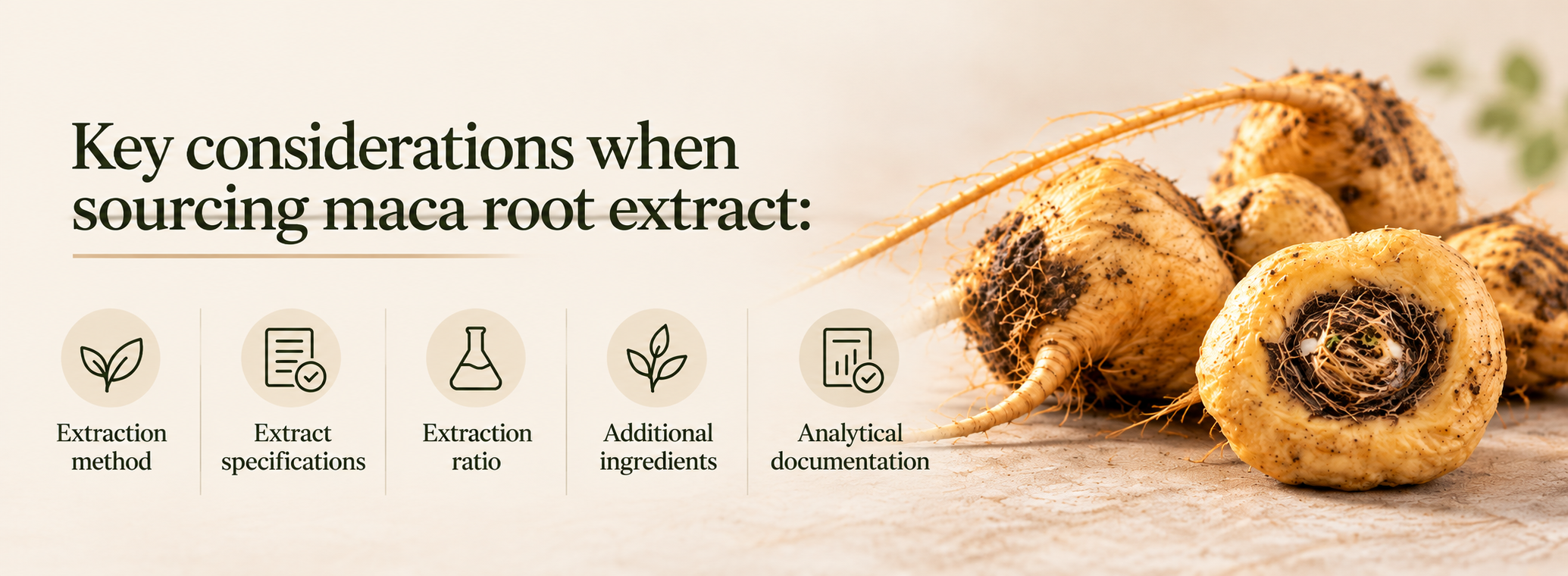
- Extraction method: Identify the solvent and relevant processing details.
- Extract specifications: Review the declared composition and any standardised constituent levels.
- Extraction ratio: Understand the relationship between the starting raw material and the resulting extract.
- Additional ingredients: Check whether carriers or processing aids are present.
- Analytical documentation: Request a certificate of analysis (CoA) and supporting test results.
An extraction ratio alone does not establish the extract’s potency, constituent concentration, or equivalence to a particular quantity of maca root powder. Buyers should assess the complete specification.
Maca Root Extract vs Maca Root Powder: Which Should Supplement Brands Choose?
The choice depends on the ingredient requirements of the finished product, not on a universal ranking of the two formats.
Choose maca root powder when:
- The formulation specifically calls for powdered maca root.
- The product specifications are designed around whole-root material.
- Its flavour, bulk and physical properties are compatible with the intended formulation.
- The ingredient meets the required identity, purity and quality specifications.
Choose maca root extract when:
- The formulation requires an extract with a defined composition.
- The supplier can demonstrate compliance with the required constituent specifications.
- The extract’s processing method and supporting documentation meet the product requirements.
- Its physical properties and ingredient composition are suitable for the intended dosage form.
For private-label supplement brands, the decision should also account for target-market regulations, label declarations, serving size and manufacturing requirements.
Is maca root extract stronger than maca root powder?
Not necessarily. An extract may contain higher concentrations of selected constituents, depending on the extraction process, but the term extract alone does not establish potency.
Brands should compare analytical composition, extract specifications and relevant evidence before concluding. A higher extraction ratio does not automatically demonstrate greater biological activity or better product performance.
Can Maca Root Extract and Maca Root Powder Be Used Interchangeably?
No. Maca root extract and maca root powder should not automatically be treated as interchangeable ingredients.
Extraction can change the relative concentrations of constituents present in the starting material. Consequently, equal weights of powder and extract may have different compositions.
Before substituting one ingredient for another, supplement manufacturers should:
- Compare botanical identity and processing methods.
- Review the powder or extract’s complete specifications.
- Assess the proposed serving size and formulation compatibility.
- Confirm that the ingredient declaration and product claims remain appropriate.
- Evaluate applicable regulatory requirements in the intended market.
Regulatory acceptance may also differ between the two formats. For example, Health Canada has assessed maca root extract separately from maca root powder for certain uses in supplemented foods. This illustrates why brands must verify ingredient eligibility in each target market rather than assume that acceptance of the powder automatically extends to the extract.
How Should Supplement Brands Evaluate Maca Ingredient Quality?
Whether sourcing maca root extract or maca root powder, brands should qualify suppliers against documented quality requirements.
Use this ingredient evaluation checklist:
- Identity verification: Confirm the botanical species and plant part.
- Certificate of analysis: Review the relevant results for the supplied batch.
- Composition: Verify any declared constituent levels or standardisation claims.
- Contaminant testing: Assess microbiological quality, heavy metals, pesticides, and other contaminants as relevant to the material and market.
- Traceability: Check raw-material origin, batch identification, and processing records.
- Stability and storage: Review the recommended conditions and available stability information.
- Regulatory documentation: Confirm that the ingredient is suitable for the intended product category and destination market.
A CoA is an important part of supplier evaluation, but it should not be the only basis for approval. The manufacturer should also assess the supplier’s reliability, testing methods, and ability to meet agreed specifications consistently.
The US FDA’s current good manufacturing practice requirements for dietary supplements provide a useful reference for ingredient identity, specifications, quality controls, and manufacturing documentation in the US market.
What Should Brands Consider When Selecting a Maca Supplement Manufacturer?
For businesses developing private-label maca supplements, ingredient selection is only one part of product development. The manufacturing partner must be able to work with the chosen ingredient and meet the finished product’s specifications.
Before finalising a supplier, confirm:
- Whether the manufacturer can source and verify the required maca ingredient.
- Whether the ingredient is compatible with the planned capsule, tablet, or powder format.
- Whether batch consistency and appropriate quality testing can be demonstrated.
- Whether the manufacturer can support the required documentation and label specifications.
- Whether the product meets the regulatory requirements of the target market.
Brands searching for a maca supplement manufacturer in India should evaluate these capabilities alongside minimum order quantities, production timelines, and private-label requirements. For maca root capsules manufacturing, particular attention should be given to fill weight, powder flow, ingredient compatibility, and finished-product quality.
Conclusion
The choice between maca root extract and maca root powder should be guided by the finished product’s requirements. Powder provides a powdered root ingredient, while extract offers a processed ingredient whose composition depends on the extraction method and specifications.
For supplement brands, the most reliable approach is to compare ingredient documentation, verify quality, assess manufacturing compatibility, and confirm regulatory suitability before finalising the formulation. This helps establish a clear, evidence-based foundation for product development and supplier selection.
FAQs
- Which is better for supplement manufacturing: maca root extract or powder?
Neither is universally better. Root powder is appropriate when the formulation calls for powdered maca root, while extract may be preferable when a defined extract composition is required. The choice depends on specifications, formulation needs, and regulatory requirements.
- Is maca root extract more concentrated than maca root powder?
It may be more concentrated in selected constituents, depending on the extraction process. However, concentration should be verified through analytical data rather than inferred from the ingredient name or extraction ratio.
- What should brands check before buying maca root extract?
Brands should verify botanical identity, extraction method, composition, any standardised constituent levels, contaminant testing, batch documentation, and regulatory suitability.
- Can manufacturers use maca root powder in capsules?
Yes, provided the powder is suitable for the intended formulation and meets the product’s quality and manufacturing specifications. Capsule fill weight, powder flow, and serving size should be evaluated during product development.