



For wellness brands, the challenge is not simply sourcing Shilajit once. It is ensuring that subsequent orders continue to meet the agreed product specifications, quality requirements, and packaging standards.
Batch-to-batch consistency in Shilajit means ensuring that successive batches meet defined quality specifications through appropriate raw-material controls, purification, testing, and batch documentation. For businesses sourcing bulk or private-label Shilajit, these controls are essential when evaluating a manufacturing partner for long-term supply.
Aveda Ayur, a Shilajit resin manufacturer in Mohali, Punjab, India, highlights raw-material sourcing, purification, quality checks, and laboratory testing as part of its manufacturing approach. These measures provide a starting point for understanding how product quality is evaluated across orders.
5 Quality Controls That Support Batch-to-Batch Consistency in Shilajit
Batch-to-batch consistency in Shilajit depends on five key quality controls, including raw-material qualification, standardized purification, defined product specifications, laboratory testing, and batch traceability. These controls help manufacturers assess whether repeat orders meet agreed quality and safety requirements.
-
Raw-Material Selection and Qualification
Consistent Shilajit quality begins with qualifying raw materials against defined acceptance criteria. Because Shilajit is naturally occurring, its composition can vary by source and material characteristics.
Key raw-material checks may include:
- Source verification: Reviewing supplier information and sourcing documentation.
- Incoming inspection: Assessing the material against predefined acceptance criteria.
- Identity verification: Confirming that the material meets the intended identity requirements.
- Material approval: Establishing whether the material is suitable for processing.
-
Standardized Purification and Processing
Documented purification procedures help control variations in Shilajit resin during manufacturing. Processing conditions can influence the finished product’s characteristics, making established procedures and appropriate checks important.
Relevant process controls may include:
- Documented procedures: Following established manufacturing and purification instructions.
- Process monitoring: Controlling relevant operating parameters within defined limits.
- In-process checks: Evaluating applicable quality characteristics during production.
- Deviation management: Investigating departures from established procedures or requirements.
Aveda Ayur describes purification and quality checks in its published Shilajit manufacturing information. Buyers should confirm which process controls apply to their product and how deviations are evaluated.
-
Defined Product Specifications for Repeat Orders
Approved product specifications provide the reference for evaluating each repeat Shilajit batch. They help manufacturers and buyers assess product conformity against agreed requirements.
Specifications may cover:
- Identity: Confirmation of the intended material.
- Physical characteristics: Defined criteria for color, appearance, and texture, where applicable.
- Composition: Specified markers, such as fulvic acid content, where relevant to the product.
- Safety parameters: Applicable limits for heavy metals and microbiological quality.
- Packaging requirements: Approved container type, net quantity, and labeling.
The applicable specifications depend on the product and intended market. Agreeing on these requirements before production helps establish a consistent basis for evaluating repeat orders.
-
Laboratory Testing and Batch Verification
Laboratory testing helps verify whether a Shilajit batch meets specified quality and safety requirements. Testing should be appropriate to the product, its specifications, and applicable regulatory requirements.
Depending on those requirements, testing may cover:
- Composition testing: Assessing specified markers, where applicable.
- Heavy-metal testing: Checking relevant contaminants against applicable limits.
- Microbiological testing: Evaluating relevant microbiological parameters.
- Results review: Comparing test results with established acceptance criteria.
For repeat orders, buyers should request the relevant batch-specific Certificate of Analysis (CoA), where available, and verify the results against agreed specifications.
-
Batch Documentation and Quality Records
Maintaining appropriate batch documentation helps manufacturers evaluate whether successive Shilajit batches meet established product specifications and quality requirements. These records provide a reference for reviewing manufacturing processes, quality checks, and testing outcomes across repeat orders.
Relevant documentation may include:
- Manufacturing records: Documentation of relevant production and purification activities.
- Quality-control records: Applicable inspection results and in-process quality checks.
- Product specifications: Approved criteria for identity, composition, physical characteristics, and safety parameters, as applicable.
- Laboratory test reports: Results used to assess whether the finished product meets defined acceptance criteria.
- Change records: Documentation of relevant changes to sourcing, processing, formulation, or packaging, where maintained.
For repeat orders, buyers should confirm which quality records and test reports the manufacturer can provide. Reviewing these documents against agreed specifications helps establish clear quality expectations and supports informed supplier evaluations.
Why Does Batch Consistency Matter for Shilajit Brands?
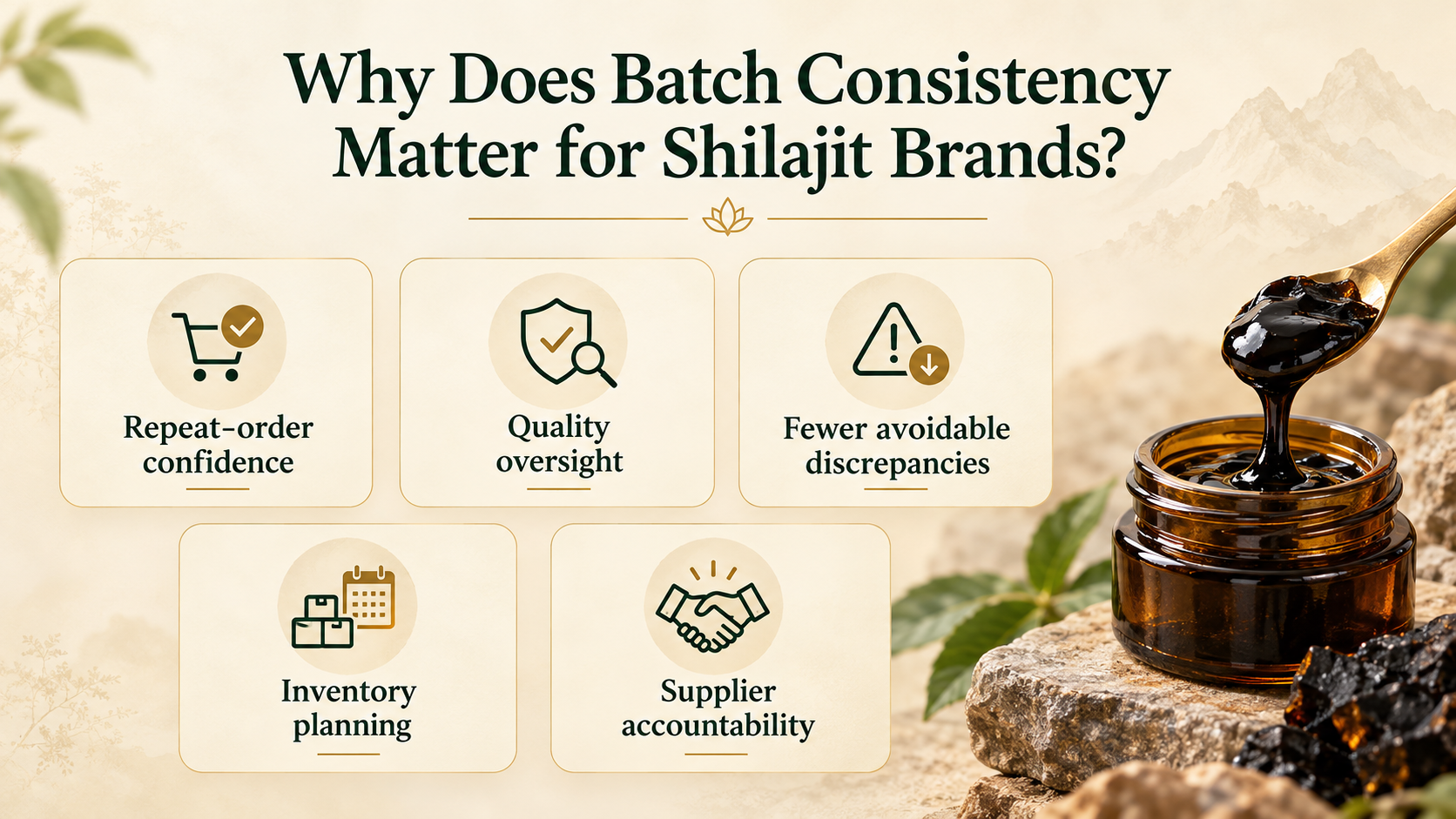
For B2B buyers, consistent quality supports more predictable procurement and product management.
- Repeat-order confidence: Agreed specifications provide a reference for evaluating successive batches.
- Quality oversight: Relevant test reports help buyers verify that defined parameters are met.
- Fewer avoidable discrepancies: Clear product and packaging requirements reduce misunderstandings.
- Inventory planning: Defined order specifications support replenishment and production planning.
- Supplier accountability: Documented requirements make it easier to investigate deviations and agree on corrective action.
Importantly, consistency does not mean every batch of a naturally derived material must have an identical chemical profile. It means that batches meet their established acceptance criteria and that relevant variation is appropriately assessed.
How Aveda Ayur Supports Bulk and Private-Label Shilajit Orders
Aveda Ayur offers Shilajit resin manufacturing, bulk supply, and private-label solutions for businesses sourcing products from India. Its published product information also highlights purification, quality checks, laboratory testing, and manufacturing certifications.
For brands evaluating Aveda Ayur as a repeat-order supplier, the practical next step is to discuss the requirements that will govern future orders:
- Product specifications and applicable acceptance criteria
- Relevant batch testing and available CoA documentation
- Required quantities and packaging formats
- Private-label and labeling requirements
- Destination-market documentation and compliance needs
Confirming these requirements before production helps establish a shared reference for future procurement.
Looking for a Shilajit manufacturing partner in India? Aveda Ayur works with businesses seeking bulk Shilajit resin and private-label manufacturing solutions.
Visit Aveda Ayur’s Shilajit resin manufacturing page to discuss your product specifications, testing documentation, packaging requirements, and repeat-order plans.
Conclusion
Batch-to-batch consistency is essential for brands seeking reliable Shilajit supply, predictable quality, and long-term manufacturing partnerships. From raw-material qualification to laboratory testing and batch traceability, every quality control contributes to meeting agreed product specifications.
Looking for a reliable Shilajit manufacturing partner in India? Connect with Aveda Ayur to discuss bulk Shilajit resin, private-label manufacturing, and quality requirements for your repeat orders.
FAQs
- How do manufacturers maintain batch-to-batch consistency in Shilajit?
Manufacturers use raw-material qualification, documented purification procedures, defined product specifications, relevant laboratory testing, and batch traceability. These controls help verify whether successive batches meet established quality requirements.
- How can buyers verify the quality of repeat Shilajit orders?
Buyers should compare the supplied product against agreed specifications and review the applicable batch-specific CoA, relevant safety test results, and lot identification. Testing requirements should reflect the product and its intended market.
- Can Shilajit naturally vary between batches?
Yes. Shilajit is naturally occurring, so its composition can vary. Quality controls help assess and manage this variation against defined specifications rather than assuming every batch will be chemically identical.
- Does Aveda Ayur supply bulk and private-label Shilajit?
Yes. Aveda Ayur lists bulk Shilajit resin supply and private-label manufacturing among its offerings. Businesses can contact the company to discuss product specifications, order quantities, packaging, and applicable quality documentation.
- What should brands confirm before placing a repeat Shilajit order?
Brands should confirm that the product specifications remain agreed, relevant batch testing is available, packaging requirements are unchanged, and any sourcing or processing changes have been appropriately reviewed.