

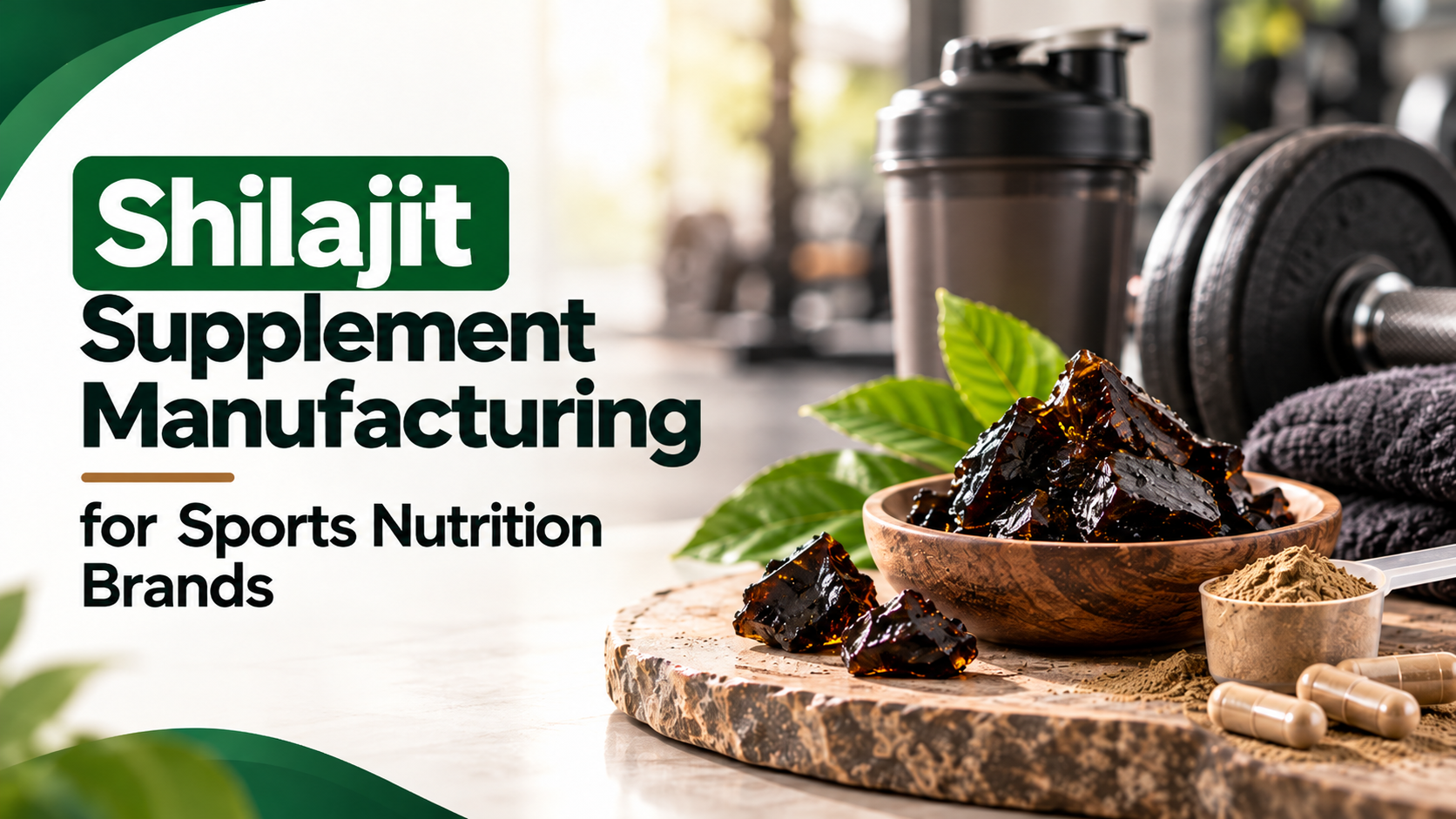
The sports nutrition industry includes a wide range of products, from protein powders and nutritional supplements to herbal and plant-based formulations. As brands explore different ingredients and product categories, Shilajit has become a subject of interest within the broader supplement market.
Traditionally associated with Ayurveda, Shilajit is a naturally occurring, resin-like substance found in mountainous regions, including the Himalayas. Its distinctive composition and availability in different product formats make it an ingredient worth evaluating for businesses developing herbal supplement portfolios.
For sports nutrition companies, introducing Shilajit products involves several important decisions, including ingredient sourcing, formulation, manufacturing, quality testing, packaging and regulatory compliance.
This article explores Shilajit supplement manufacturing, available product formats and the considerations sports nutrition brands should evaluate before launching a Shilajit product.
Understanding Shilajit as a Supplement Ingredient
Shilajit is a complex natural substance containing a mixture of organic and inorganic components. Its composition varies depending on geographical origin, raw material characteristics and processing methods.
Commonly discussed constituents include:
- Fulvic acid and related organic compounds
- Humic substances
- Naturally occurring minerals
- Other organic and inorganic constituents
The presence and concentration of these components can differ across Shilajit sources. Therefore, supplement manufacturers must consider raw material specifications, identification methods and analytical testing before selecting Shilajit for product development.
For sports nutrition brands, the focus should be on understanding the ingredient’s characteristics and determining whether it is suitable for the intended product category and market.
Why Are Sports Nutrition Brands Exploring Shilajit?
Sports nutrition brands operate in a competitive market where product selection, ingredient transparency and brand positioning influence purchasing decisions.
Shilajit presents several areas for businesses to explore from a product-development perspective.
1. Interest in Ayurveda-Inspired Supplement Products
Ayurvedic ingredients have traditionally been used in various preparations across India. Today, businesses are exploring how these ingredients can be incorporated into contemporary supplement portfolios.
Shilajit’s association with Ayurveda provides a distinct ingredient identity for brands interested in developing products around traditional herbal materials.
However, traditional use should not be interpreted as evidence of a specific physiological effect. Product positioning and labeling must remain consistent with applicable regulations.
2. Opportunities for Product Portfolio Expansion
Sports nutrition businesses often develop multiple product categories to serve different consumer preferences.
Alongside established products such as protein powders, amino acid formulations and electrolyte products, some brands may consider introducing separate herbal supplement ranges.
Shilajit can be evaluated as an ingredient for such a product range, subject to formulation suitability and regulatory permissions.
Before adding a new category, businesses should assess consumer interest, competitor offerings, product costs and distribution requirements.
3. Multiple Product Format Options
Shilajit can be processed into different commercial forms. This allows businesses to explore various packaging concepts and product presentations.
The selection of a suitable format depends on the properties of the ingredient, manufacturing feasibility, regulatory requirements and the intended market.
4. Private Label Manufacturing Opportunities
Businesses that do not operate their own manufacturing facilities may consider working with third-party or private-label manufacturers.
Under this arrangement, a manufacturing partner produces goods according to agreed specifications, while the brand manages its identity, positioning and distribution.
The exact responsibilities of each party depend on the manufacturing agreement and applicable regulatory requirements.
Shilajit Product Formats for Sports Nutrition Brands
Selecting a product format is one of the first steps in planning a Shilajit supplement range.
Different formats involve distinct processing methods, packaging requirements and quality-control considerations.
Shilajit Resin
Shilajit resin is a semi-solid format commonly associated with traditional Shilajit preparations.
Brands considering resin products should evaluate:
- Raw material sourcing and traceability
- Purification and processing methods
- Resin consistency and composition
- Container compatibility
- Storage and handling requirements
- Packaging sizes and labeling specifications
Resin packaging may include jars or other suitable containers, depending on product specifications and manufacturer capabilities.
Shilajit Capsules
Capsule products provide a pre-measured format that may be considered for certain supplement portfolios.
Manufacturing considerations include ingredient processing, powder flow characteristics, capsule material, fill-weight consistency and packaging compatibility.
The formulation and regulatory status must be assessed before commercial production.
Shilajit Powder
Powdered Shilajit presents another product-development option.
For powder manufacturing, important factors include moisture characteristics, particle size, handling conditions, ingredient specifications and packaging selection.
Brands should also determine whether the intended application requires additional processing or formulation development.
Shilajit Liquid Formulations
Liquid product development requires evaluation of ingredient compatibility, dispersion or solubility characteristics, formulation stability and suitable packaging.
Additional considerations may include preservative requirements, container selection and storage conditions.
Not every Shilajit ingredient is suitable for every liquid formulation. Feasibility should be established through appropriate product-development and testing procedures.
Important Manufacturing Considerations for Shilajit Supplements
Manufacturing a Shilajit product requires attention to ingredient quality and consistency throughout the production process.
1. Raw Material Selection and Sourcing
Shilajit’s natural origin makes raw material sourcing an important consideration.
Brands should discuss the following with potential suppliers:
- Geographical origin and source documentation
- Raw material identification
- Supplier qualification procedures
- Purification methods
- Material specifications
- Batch traceability
These details help businesses establish procurement requirements and evaluate material consistency.
2. Purification and Processing
Raw Shilajit may contain unwanted substances or contaminants.
Appropriate purification and processing procedures are therefore important before the material is considered for commercial products.
Manufacturers should define processing requirements and establish suitable controls for the intended product.
3. Quality Testing and Documentation
A documented quality-control process is an important part of Shilajit supplement manufacturing.
Depending on the product format and applicable standards, testing may include:
Identity Testing: Examination of the material against established identification criteria.
Composition Analysis: Assessment of selected constituents using suitable analytical methods.
Heavy Metal Testing: Analysis of relevant elements, such as lead, arsenic, cadmium and mercury, according to applicable specifications.
Microbiological Testing: Evaluation of relevant microbial parameters.
Contaminant Testing: Assessment of additional contaminants based on material-specific risks.
Stability Testing: Evaluation of the finished product under defined storage conditions to establish appropriate shelf-life information.
Brands should request relevant quality documentation, including a Certificate of Analysis where applicable, and confirm that testing is appropriate for the product and destination market.
4. Packaging and Labeling
Packaging affects product presentation, handling, storage and distribution.
For Shilajit supplements, packaging decisions should consider the product’s physical properties, container compatibility, protection from contamination and expected storage conditions.
Labels should be developed according to the requirements of the applicable regulatory category.
Businesses should also confirm that ingredient descriptions, instructions, warnings and marketing communications meet relevant legal requirements.
Private Label Shilajit Manufacturing for Sports Nutrition Businesses
Private-label manufacturing provides an option for businesses looking to introduce products under their own branding without establishing an in-house production facility.
A typical manufacturing arrangement may involve several stages.
Product Requirement Discussion
The brand identifies its intended product format, target market, packaging preferences and commercial requirements.
Formulation and Specification Development
The manufacturer and brand discuss the ingredient specifications, production feasibility and any formulation requirements.
Sample Evaluation
Where sampling is available, the brand evaluates the proposed product against agreed specifications before approving commercial production.
Packaging and Label Finalization
The brand finalizes artwork, packaging materials, labeling information and other presentation requirements.
Commercial Manufacturing
Production begins after the required specifications, commercial terms and regulatory considerations have been addressed.
Quality Checks and Dispatch
The finished batch undergoes applicable quality checks and documentation procedures before release and dispatch.
The exact workflow may differ according to the manufacturing partner, product format and commercial arrangement.
How to Choose a Shilajit Supplement Manufacturer
Selecting a manufacturing partner requires more than comparing product prices.
Sports nutrition brands should evaluate the manufacturer’s capabilities and suitability for their proposed product.
Manufacturing Capabilities: Determine whether the manufacturer can produce the required Shilajit format and meet the agreed specifications.
Quality Management: Review relevant quality-control procedures, testing arrangements and documentation practices.
Regulatory Requirements: Confirm the product’s applicable regulatory classification and the manufacturer’s relevant authorizations.
Minimum Order Quantity: Discuss the minimum production quantity and whether it aligns with the brand’s purchasing plans.
Packaging Options: Review available containers, labeling arrangements and customization requirements.
Production Timeline: Understand expected lead times for sampling, approvals, packaging procurement and commercial manufacturing.
Commercial Terms: Confirm pricing, payment conditions, responsibilities and other contractual details before proceeding.
A structured manufacturer evaluation can help businesses identify a suitable production arrangement.
Regulatory Considerations for Shilajit Sports Nutrition Products
Regulatory compliance should be evaluated before a Shilajit product is developed, manufactured or marketed.
In India, the applicable requirements depend on the product’s composition, intended use and legal classification.
For example, FSSAI maintains regulations covering health supplements, nutraceuticals and certain other food categories. However, these categories should not be assumed to automatically permit Shilajit or every proposed Shilajit formulation.
Businesses must verify whether the ingredient, product format and intended use are permitted under the relevant regulatory framework.
Products regulated under other applicable frameworks, including AYUSH-related requirements where relevant, must meet their respective conditions.
For international markets, ingredient permissions, import rules, labeling standards and marketing restrictions may differ.
Brands should establish the correct regulatory pathway before finalizing a product for manufacturing or sale.
Shilajit Manufacturing with Aveda Ayur
For businesses exploring Shilajit products, selecting an appropriate manufacturing partner is an important part of the product-development process.
Aveda Ayur works in the Ayurvedic and herbal product manufacturing sector, serving businesses interested in third-party and private-label manufacturing arrangements.
Sports nutrition brands exploring Shilajit can discuss their requirements relating to:
- Shilajit resin manufacturing
- Bulk product requirements
- Private-label product development
- Packaging and branding options
- Manufacturing specifications
- Quality documentation
- Production quantities and timelines
The availability of specific formats, customization options and manufacturing services should be confirmed according to the proposed product requirements.
Brands can explore Aveda Ayur’s Shilajit Resin Manufacturing page for further information.
Conclusion
Shilajit is an ingredient that sports nutrition brands may consider when evaluating opportunities within the Ayurvedic and herbal supplement category.
Its use in commercial products requires careful consideration of raw material selection, processing, formulation, packaging, quality testing and applicable regulations.
For businesses planning to introduce Shilajit products, a clear product-development strategy and suitable manufacturing arrangements are essential considerations.
Looking for a Shilajit Supplement Manufacturing Partner?
Connect with Aveda Ayur to discuss your Shilajit product requirements, private-label options, packaging preferences and manufacturing specifications.
Frequently Asked Questions (FAQs)
1. Can sports nutrition brands introduce Shilajit products?
Sports nutrition brands may evaluate Shilajit as a potential product category. Commercial introduction depends on ingredient suitability, manufacturing feasibility and applicable regulatory permissions.
2. What formats are available for Shilajit supplement manufacturing?
Potential formats include resin, capsules, powders and certain liquid formulations. Availability depends on manufacturer capabilities, formulation requirements and regulatory approval or permissions, where applicable.
3. What is private-label Shilajit manufacturing?
Private-label Shilajit manufacturing is an arrangement in which a manufacturing partner produces a product according to agreed specifications for sale under another business’s brand name.
4. What quality tests should brands consider for Shilajit?
Relevant tests may include identity verification, composition analysis, heavy metal testing, microbiological examination, contaminant assessment and finished-product stability evaluation, depending on the product and applicable requirements.
5. What is the MOQ for Shilajit supplement manufacturing?
Minimum order quantities vary based on the manufacturer, product format, packaging requirements and production arrangement. Businesses should request a product-specific quotation.
6. Can Shilajit supplements be manufactured for international markets?
Manufacturing for international distribution requires consideration of destination-country regulations, ingredient permissions, product classification, import requirements and labeling standards.
7. Does Aveda Ayur offer Shilajit private-label manufacturing?
Aveda Ayur provides herbal and Ayurvedic manufacturing services. Businesses can contact its team to discuss Shilajit resin, bulk requirements, private-label arrangements and available manufacturing options.