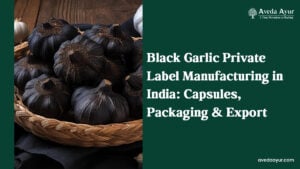


Choosing the right black garlic private label manufacturer is an important decision for brands, importers, and distributors entering international markets. A suitable manufacturer should offer consistent processing, documented quality controls, reliable testing, private-label capabilities, compliant packaging and export support.
For businesses sourcing black garlic from India, the selection process should focus on verifiable manufacturing capabilities, product consistency and long-term supply reliability, not simply the lowest quotation.
Demand for Black Garlic in Global Markets
Black garlic is gaining commercial attention across culinary, food and wellness categories as brands look for differentiated, value-added ingredients. Recent market research indicates continued global growth, although estimates vary significantly by methodology and market definition. One 2026 analysis projects the global black garlic market to grow from about USD 132.4 million in 2025 to USD 208.3 million by 2032.
For B2B buyers, this growing interest creates opportunities for private-label products but also makes consistent quality, traceability, documentation and reliable manufacturing increasingly important. Brands entering markets such as North America, Europe, Asia-Pacific, and the Middle East need suppliers capable of meeting both product specifications and destination-market requirements.
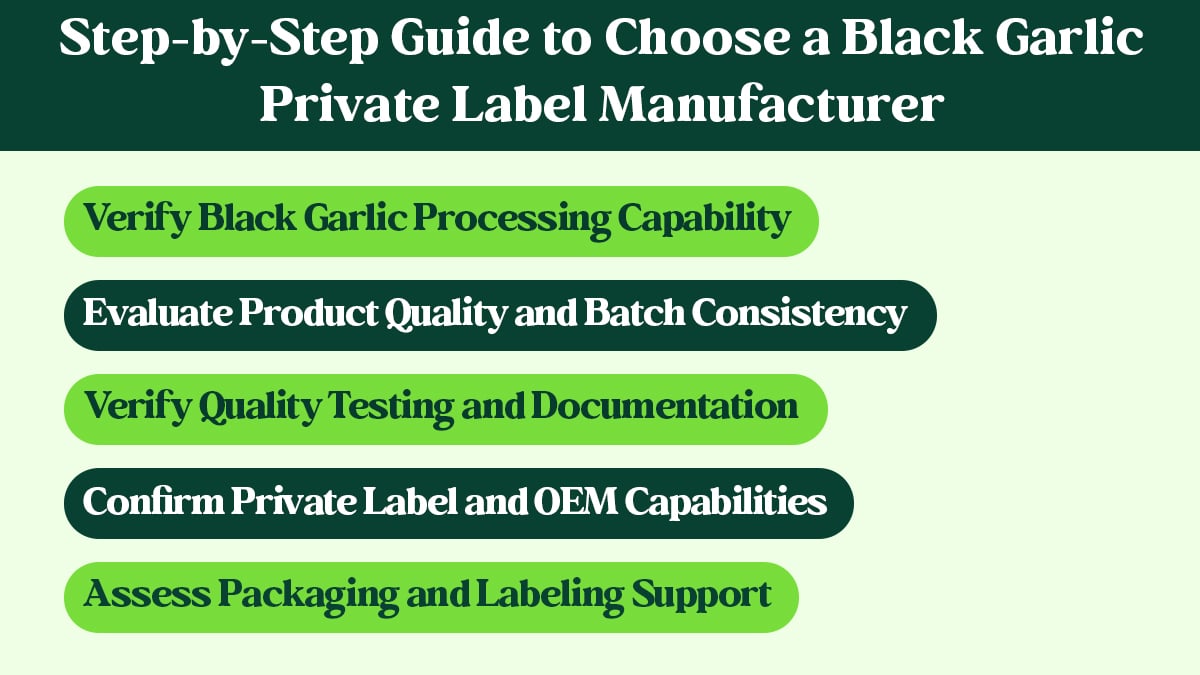
Step-by-Step Guide to Choose a Black Garlic Private Label Manufacturer
-
Verify Black Garlic Processing Capability
Start by confirming how the manufacturer produces black garlic and whether the process is sufficiently controlled for repeat commercial production.
Ask about:
- Raw garlic sourcing and incoming quality controls
- Processing and aging conditions
- Process monitoring
- Hygiene and food-handling procedures
- In-house versus outsourced production
- Production capacity
- Batch traceability
The key question is repeatability. A capable manufacturer should be able to reproduce the approved product specification across subsequent batches.
When sourcing from India, establish whether the quoted supplier is the actual manufacturer or a trading company coordinating production elsewhere. This can affect production control, communication, and accountability.
-
Evaluate Product Quality and Batch Consistency
Before selecting a supplier, establish clear product specifications and evaluate samples against them.
Check:
- Clove appearance and color
- Texture and moisture characteristics
- Taste and aroma
- Size or grade consistency
- Foreign-matter controls
- Shelf-life requirements
- Batch-to-batch uniformity
Do not qualify a manufacturer based only on one attractive sample. Ask how the supplier maintains the same specifications across repeat production.
-
Verify Quality Testing and Documentation
A credible black garlic private label manufacturer should be able to explain its quality-control and testing procedures.
Depending on the product and destination market, request the following:
- Certificate of Analysis (COA)
- Microbiological test reports
- Relevant contaminant testing
- Pesticide-residue testing where applicable
- Product specifications
- Batch records
- Applicable food-safety certifications and licenses
- Laboratory and testing information
For Indian manufacturers, buyers should verify applicable FSSAI licensing and regulatory requirements. FSSAI maintains regulations covering food-business licensing, food standards, packaging and labeling. Its regulations are updated through official notifications, so buyers should verify the requirements applicable to their product and operation.
Do not rely solely on certificates displayed on a website. Check that documents are current, relevant to the manufacturing operation and issued to the same legal entity you will contract with.
-
Confirm Private Label and OEM Capabilities
A supplier offering private labeling is not necessarily equipped to manage a long-term private-label program.
Confirm whether the manufacturer can provide:
- Buyer-specific product specifications
- Brand labeling
- Customized packaging
- Required pack sizes
- Batch and lot coding
- Label artwork coordination
- Product documentation
- Repeat production to an approved specification
Ask whether private-label production is handled within the manufacturer’s own facility or through a third party. For B2B buyers, this distinction can affect consistency, lead times and accountability.
-
Assess Packaging and Labeling Support
Packaging should protect the product while meeting the requirements of the destination market.
Verify:
- Available packaging materials
- Moisture and barrier protection
- Pack-size options
- Customized labels
- Batch coding
- Shelf-life and storage information
- Export packaging suitability
- Destination-market labeling support
For pre-packaged foods in India, FSSAI’s labeling framework specifies mandatory information for relevant packaged foods, including requirements for non-retail containers.
For exports, the manufacturer should work from the buyer’s destination-specific labeling specifications rather than assuming Indian requirements are sufficient for international sale.
-
Check Compliance for Your Target Market
A manufacturer that exports to one country may not automatically meet the requirements of another.
Before choosing a black garlic manufacturer for global markets, ask:
- Which countries has the manufacturer supplied?
- Can it provide destination-specific documentation?
- Can it support required product testing?
- Can it accommodate destination-market label requirements?
- Does it understand importer documentation requirements?
- Can it maintain the same specifications for repeat shipments?
The supplier should be evaluated against the requirements of the specific country or region where the finished product will be sold.
-
Review Export Documentation and Experience
International supply requires more than manufacturing capacity.
Depending on the product, destination and importer, documentation may include
- Commercial invoice
- Packing list
- Certificate of Origin
- Certificate of Analysis
- Shipping documents
- Product-specific certificates
- Other documents requested by the importer or destination authority
Ask whether the manufacturer regularly handles international orders and can coordinate documentation with production and dispatch.
An experienced black garlic export manufacturer in India should be able to explain its normal export documentation process clearly.
-
Compare MOQ, production capacity, and Lead Times
The manufacturer’s commercial capabilities should match your purchasing model.
Check:
- MOQ per SKU
- MOQ for customized packaging
- Production capacity
- Sample lead time
- Production lead time
- Dispatch timeline
- Repeat-order capability
- Ability to scale with increasing demand
Do not select a manufacturer solely because it offers the lowest price. A lower unit cost may not represent better value if the supplier has inconsistent quality, long lead times or limited capacity.
-
Request Samples Before Bulk Production
Sampling should be part of formal supplier qualification.
Compare the production-representative sample with the agreed specification and review:
- Appearance
- Texture
- Taste and aroma
- Consistency
- Packaging
- Label information
- Supporting quality documentation
Once approved, record the product specification and sample reference for future production.
A practical procurement sequence is:
Shortlist → verify documents → request sample → evaluate quality → confirm private-label capability → negotiate commercial terms → approve supplier.
This creates a documented basis for the final supplier decision.
Red Flags to Watch Out For While Choosing a Private Label Manufacturer
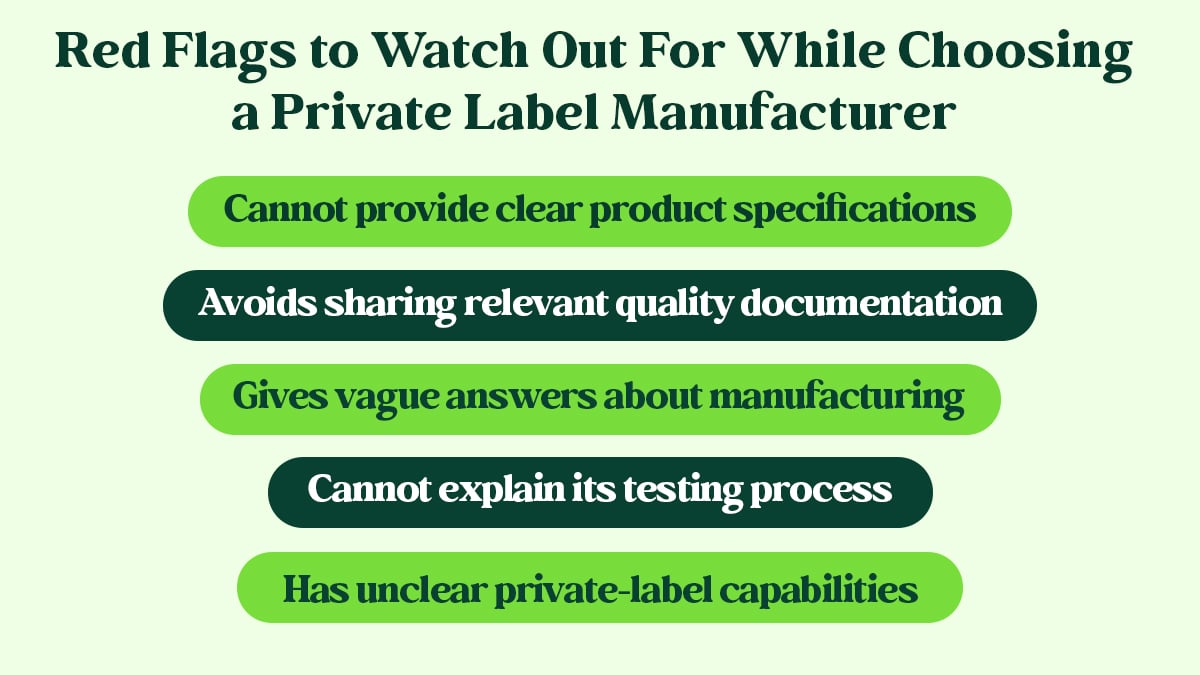
Be cautious when a supplier
- Cannot provide clear product specifications
- Avoids sharing relevant quality documentation
- Gives vague answers about manufacturing
- Cannot explain its testing process
- Has unclear private-label capabilities
- Cannot demonstrate batch traceability
- Refuses to provide representative samples
- Gives unclear MOQ or lead-time commitments
- Cannot provide evidence of relevant export experience
- Offers unusually low pricing without explaining the specification or cost difference
Certificates, production claims and export experience should be verified rather than accepted at face value.
Why Choose Aveda Ayur for Black Garlic Private Label Manufacturing?
Aveda Ayur provides black garlic private label manufacturing in India for brands, importers and distributors developing products for domestic and international markets.
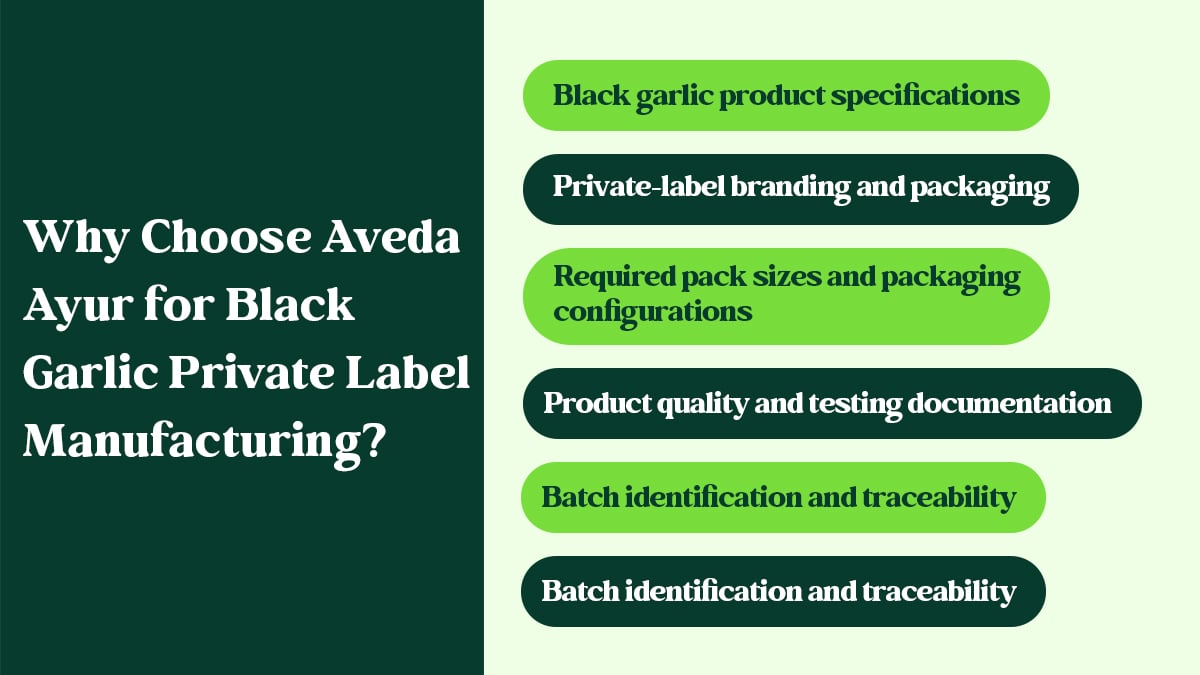
For B2B buyers evaluating Aveda Ayur as a manufacturing partner, key requirements can be discussed around:
- Black garlic product specifications
- Private-label branding and packaging
- Required pack sizes and packaging configurations
- Product quality and testing documentation
- Batch identification and traceability
- Production quantities and MOQ
- Export documentation
- Destination-market requirements
- Repeat production and supply planning
For international buyers, the important consideration is whether the manufacturer’s capabilities align with the specific product, packaging, quality and regulatory requirements of the target market.
Buyers can provide their product specifications and destination-market requirements during the quotation and sampling stage to establish the appropriate production and documentation requirements.
Conclusion
Choosing a black garlic private label manufacturer for global markets requires more than comparing quotations. Buyers should evaluate manufacturing capability, product consistency, quality testing, traceability, private-label support, packaging, compliance, MOQ, production capacity and export experience.
For businesses sourcing black garlic from India, qualifying the manufacturer through documentation, representative samples and clear production specifications can help establish a more reliable long-term supply relationship.
FAQs
- What should I check before choosing a black garlic private label manufacturer?
Check processing capability, product consistency, testing, traceability, private-label services, packaging, regulatory readiness, MOQ, production capacity, lead times and export experience.
- How can I verify the quality of a black garlic manufacturer?
Request product specifications, recent COAs or relevant test reports, applicable food-safety documentation and batch-traceability information. Then compare the documentation with a representative sample.
- What is the MOQ for private-label black garlic?
There is no universal MOQ. It depends on product specifications, order volume, packaging customization and production requirements. Ask for MOQ by SKU and packaging configuration.
- Can Indian manufacturers supply black garlic for international markets?
Yes. Indian manufacturers can supply international markets when they have the required production, packaging, documentation and export capabilities for the destination country.
- Can I request a sample before placing a bulk private-label order?
Yes. Buyers should evaluate a representative sample against agreed specifications and review relevant quality documentation before approving commercial production.