


The global wellness industry is expanding rapidly, but scaling a wellness brand beyond early-stage growth requires more than strong branding and product demand. As order volumes increase, many brands struggle with formulation scalability, regulatory compliance, raw material procurement, and batch-to-batch consistency.
This is why growing businesses increasingly partner with an experienced ayurvedic contract manufacturing company to commercialize products efficiently without investing in their own production infrastructure. From herbal supplements and nutraceuticals to botanical extracts and functional wellness products, contract manufacturing of ayurvedic herbs in India has become a scalable growth strategy for startups, D2C wellness brands, exporters, and retail-focused companies.
Quick Overview: How Contract Manufacturing Scales a Wellness Brand
Contract manufacturing helps wellness brands scale by outsourcing formulation development, production, analytical testing, packaging, and regulatory compliance to specialized manufacturing partners. This reduces capital expenditure, improves production scalability, accelerates time-to-market, and ensures regulatory alignment through certifications such as WHO-GMP, AYUSH, ISO 22000, and FSSAI.
Why Wellness Brands Struggle to Scale Internally
Many wellness businesses start with small-batch or localized production models. However, operational bottlenecks emerge quickly once monthly demand increases or retail distribution expands.
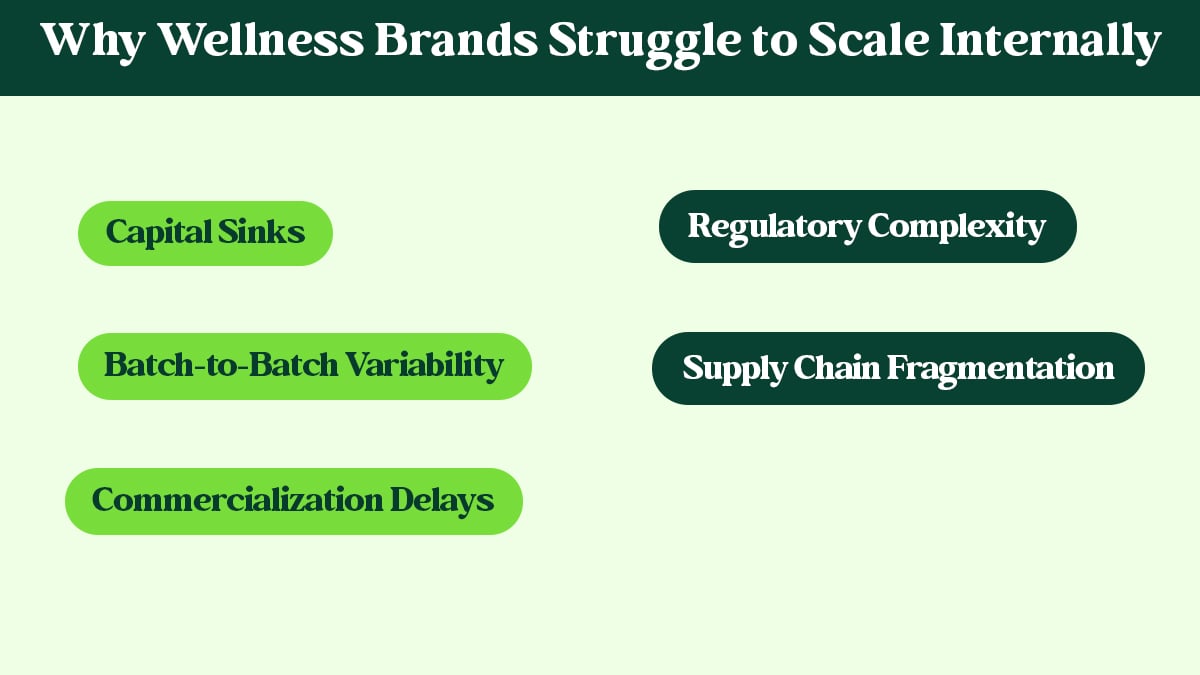
Common scaling barriers include:
- Capital Sinks: Setting up an AYUSH-certified, GMP-compliant manufacturing facility requires significant upfront investment in infrastructure, equipment, validation systems, and regulatory approvals, making in-house production capital intensive for most wellness brands.
- Regulatory Complexity: Managing WHO-GMP compliance, FSSAI documentation, COA testing, and AYUSH licensing internally requires dedicated regulatory expertise.
- Batch-to-Batch Variability: Inconsistent botanical sourcing and poor analytical testing protocols often lead to formulation instability and fluctuating product quality.
- Supply Chain Fragmentation: Handling raw material procurement, packaging vendors, labeling compliance, and inventory forecasting simultaneously can disrupt operational efficiency.
- Commercialization Delays: Limited production capacity often slows down SKU expansion and delays product launches into retail and export channels.
These operational challenges become more critical once brands begin scaling beyond direct-to-consumer sales.
When Should a Wellness Brand Transition to Contract Manufacturing?
Most wellness brands delay outsourcing production until operational inefficiencies begin affecting growth and profitability.
Key operational signs your business is ready for commercial contract manufacturing:
- Monthly demand exceeds 1,000–3,000 units per SKU
- Production lead times regularly delay order fulfillment
- Product spoilage or stability failure rates exceed 20%
- Retail distributors request compliance documentation
- Internal production costs reduce margin scalability
- Your business plans to enter export or pharmacy channels
- You need faster formulation commercialization
At this stage, scaling production internally often becomes more expensive than outsourcing to a specialized manufacturing partner.
Strategic Benefits of Third-Party Production
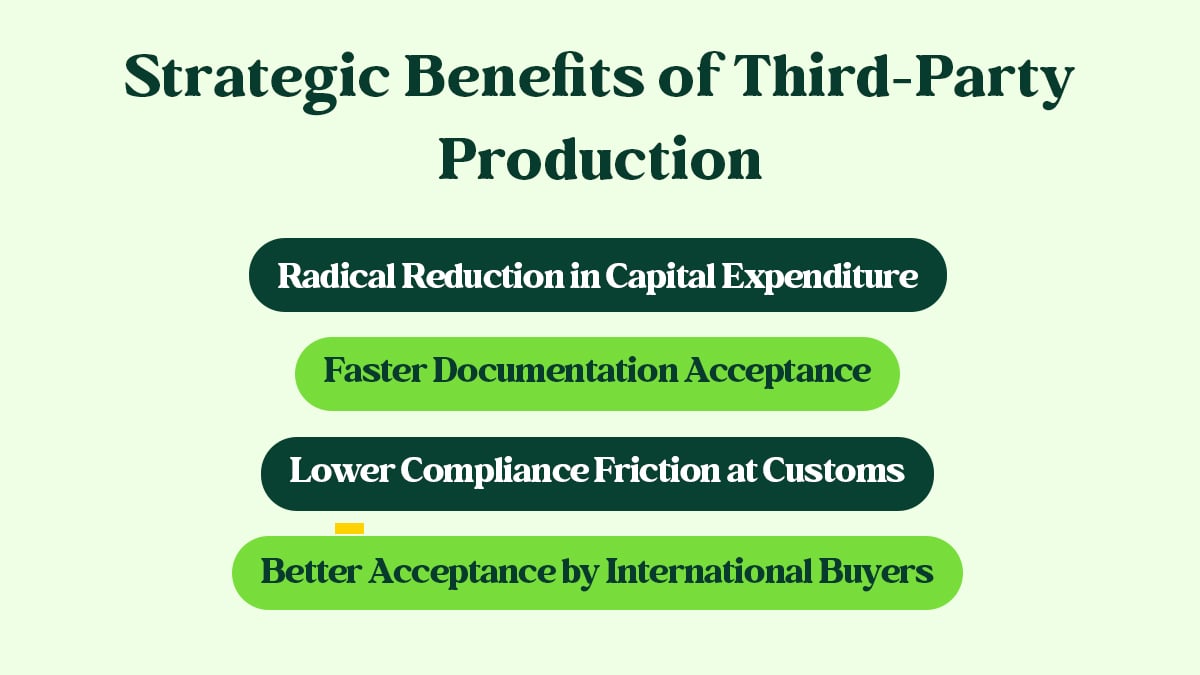
Partnering with an established ayurvedic contract manufacturing company provides operational advantages that directly impact scalability, profitability, and speed to market.
-
Radical Reduction in Capital Expenditure
Manufacturing infrastructure is one of the largest financial barriers for emerging wellness brands.
Commercial facilities require:
- Automated processing equipment
- HVAC-controlled production zones
- Testing capabilities
- Cleanroom packaging systems
- Water purification infrastructure
- Compliance auditing systems
Contract manufacturing eliminates these fixed capital expenditures and converts them into variable operational costs.
This allows businesses to redirect capital toward:
- Customer acquisition
- Retail expansion
- Product positioning
- Market penetration
- Inventory optimization
-
Accelerated Time-to-Market
Speed is critical in the wellness sector, particularly for trend-driven categories such as:
- Herbal immunity products
- Adaptogenic supplements
- Functional nutrition
- Plant-based wellness formulations
Experienced manufacturers already maintain:
- Raw material procurement networks
- Standardized production SOPs
- Existing compliance systems
- Packaging supply chains
This significantly reduces formulation commercialization timelines.
Instead of spending 12–18 months building infrastructure and obtaining certifications, brands can launch products in a fraction of the time.
-
Regulatory & Compliance Alignment
Regulatory compliance is one of the most overlooked risks in wellness manufacturing.
A qualified manufacturing partner should support:
- WHO-GMP certification
- AYUSH licensing
- ISO 22000 food safety systems
- FSSAI registration
- US FDA dietary supplement regulations
This becomes especially important for brands entering:
- International markets
- Modern retail chains
- Pharmacy distribution
- Amazon global marketplaces
Strong compliance systems improve both brand credibility and operational continuity.
-
Improved Formulation Scalability
Many formulations perform well in small-batch production but fail during commercial-scale manufacturing.
Professional manufacturers help optimize:
- Ingredient compatibility
- Shelf-life validation
- Dosage uniformity
- Moisture sensitivity control
- Botanical extraction consistency
This ensures scalable commercialization without compromising product integrity.
Why Is India the Preferred Global Hub for Ayurvedic Contract Manufacturing?
India has emerged as one of the largest manufacturing ecosystems for herbal and wellness products due to its combination of traditional ayurvedic expertise and industrial-scale production capabilities.
Today, contract manufacturing ayurvedic herbs in India is preferred globally for several operational reasons.
Key manufacturing advantages include:
- Botanical Sourcing Infrastructure: India has direct access to a large network of medicinal herbs, botanical extracts, and ayurvedic raw materials.
- Cost-Efficient Production Economics: Manufacturing and labor costs remain significantly lower compared to North America and Europe.
- Established Regulatory Ecosystem: Indian manufacturers commonly operate under WHO-GMP, AYUSH, ISO, and FSSAI frameworks.
- Export Manufacturing Capabilities: Many facilities are already optimized for international documentation, labeling, and export compliance.
- Skilled Formulation Expertise: India has decades of experience in herbal extraction, nutraceutical formulation, and ayurvedic commercialization.
This combination makes India a strategic production hub for global wellness brands.
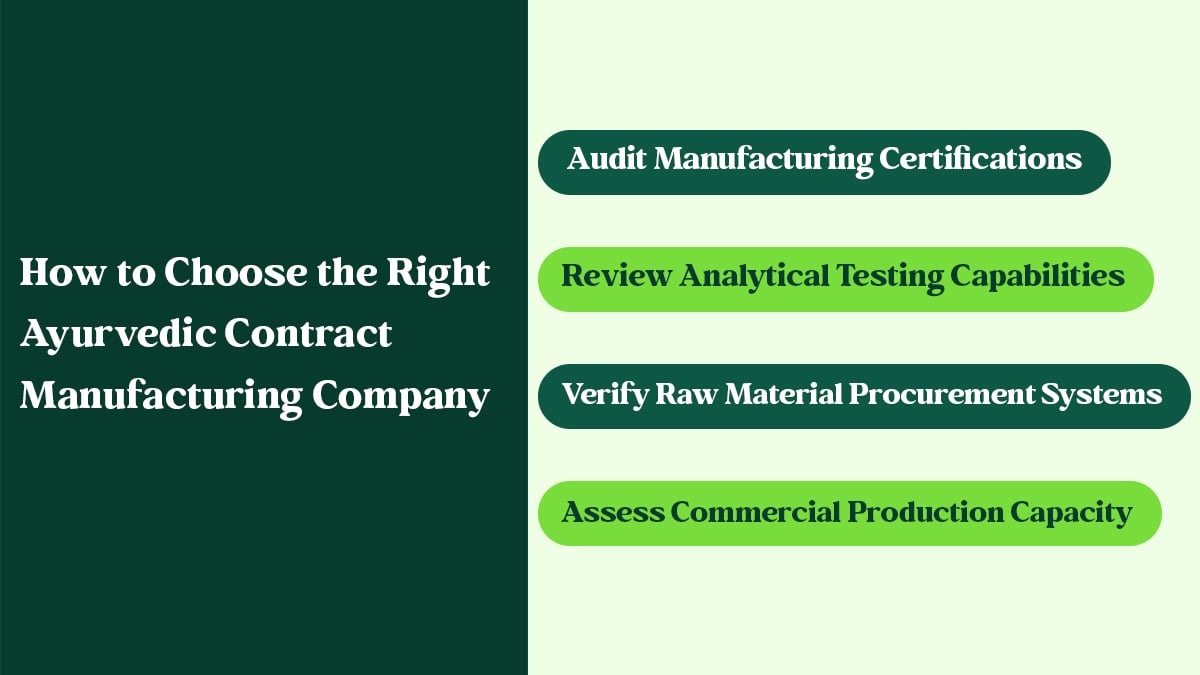
How to Choose the Right Ayurvedic Contract Manufacturing Company
Selecting the wrong manufacturing partner can create operational, regulatory, and reputational risks.
Before signing any agreement, brands should evaluate manufacturing capabilities systematically.
Audit Manufacturing Certifications
Verify whether the facility complies with:
- WHO-GMP
- AYUSH licensing
- ISO 22000
- FSSAI
- Export documentation standards
Avoid manufacturers unwilling to share certification records or audit documentation.
Review Analytical Testing Capabilities
Evaluate whether the manufacturer performs:
- Microbial testing
- Heavy metal testing
- Ingredient verification
- Batch documentation
Analytical testing directly impacts product consistency and regulatory reliability.
Verify Raw Material Procurement Systems
Ask how botanical sourcing is managed.
Strong manufacturers typically maintain:
- Approved vendor programs
- Raw material check
- COA documentation
- Standardized botanical procurement protocols
Poor sourcing practices often lead to formulation inconsistencies.
Assess Commercial Production Capacity
Review:
- Monthly production capacity
- Lead times
- MOQ flexibility
- Packaging scalability
- Multi-SKU production handling
Your manufacturing partner should support long-term growth, not just current demand.
Red Flags That Signal the Wrong Manufacturing Partner
Not all manufacturers operate with the same operational transparency or compliance standards.
Watch for these warning signs:
- Hidden Testing Charges: Unexpected analytical testing or compliance fees added after onboarding.
- Non-Transparent Botanical Sourcing: Inability to verify ingredient origin or COA documentation.
- Unrealistic Lead Time Promises: Overcommitting production schedules without infrastructure support.
- Weak Documentation Systems: Missing batch documentation or incomplete compliance records.
- No Scalability Planning: Limited ability to support future SKU expansion or retail growth.
A low-cost manufacturer with weak compliance systems can create far greater long-term business risk.
Conclusion
Scaling a wellness brand requires operational infrastructure that can support increasing demand, regulatory complexity, and product consistency at commercial volumes.
Partnering with an experienced ayurvedic contract manufacturing company allows businesses to scale efficiently without carrying the financial and operational burden of in-house manufacturing. From formulation scalability and analytical testing to regulatory compliance and botanical sourcing, contract manufacturing of ayurvedic herbs in India provides wellness brands with a faster and more cost-effective path to commercial growth.
For brands preparing to expand into retail, export, or high-volume D2C markets, contract manufacturing is no longer just a production solution, it is a strategic growth infrastructure.
FAQs
- What is an ayurvedic contract manufacturing company?
An ayurvedic contract manufacturing company is a third-party production partner that handles formulation development, manufacturing, analytical testing, packaging, and compliance for wellness and herbal brands under private-label or custom manufacturing agreements.
- Why is India the preferred global hub for Ayurvedic contract manufacturing?
India is preferred because of its strong botanical sourcing ecosystem, cost-efficient production infrastructure, WHO-GMP-certified facilities, skilled formulation expertise, and established AYUSH regulatory framework.
- What certifications should a wellness contract manufacturer have?
A reliable manufacturer should typically maintain WHO-GMP certification, AYUSH licensing, ISO 22000 compliance, FSSAI registration, and export documentation capabilities, depending on the target market.
- How does contract manufacturing reduce operational costs?
Contract manufacturing eliminates the need for facility setup, production equipment investment, compliance infrastructure, and in-house analytical testing, significantly reducing capital expenditure.
- When should a wellness brand switch to contract manufacturing?
Most brands should consider outsourcing production once monthly demand exceeds 1,000 units, production delays impact fulfillment, or retail and export expansion require commercial-scale manufacturing compliance.