

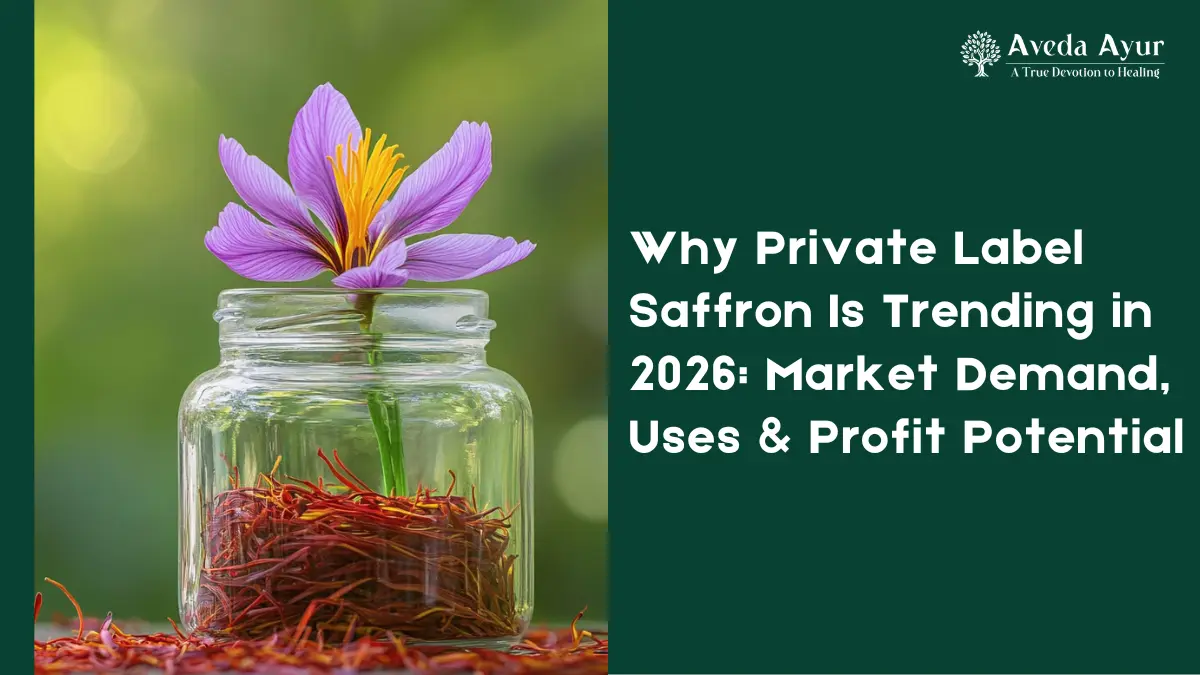
Private-label saffron products are acquiring traction in 2026, driven by the growth in demand from across the world, which is shifting from culinary uses to wellness, nutraceutical, cosmetic, and pharmaceutical applications. What was once termed as heritage spice is defined today as a strategic spice at play.
Rather than competing on crowded branded retail shelves, businesses are increasingly choosing private label models that allow them to control grade, sourcing, certifications, and pricing. This shift is supported by measurable market growth, evolving buyer expectations, and the increasing commercial relevance of saffron across industries.
Global Market Demand for Saffron in 2026
The global saffron market is showing consistent, sustainable growth at the ingredient and processing level. In 2025, the market was valued at approximately USD 482.4 million and is projected to reach USD 883.8 million by 2033, growing at CAGR of 7.9% from 2026 to 2033 . This growth is being driven by saffron’s expanding role as a functional, natural, and high-value ingredient. Derived from the stigmas of Crocus sativus, saffron contains bioactive compounds such as crocin, safranal, and picrocrocin, which contribute to its color strength, aroma, flavor, and functional properties.
From a demand standpoint, the market is no longer dependent on a single end use. Food products, supplements, cosmetics, and medical research create a strong market throughout the year. Regionally, the Middle East & Africa has the largest revenue share, mainly driven by culinary traditions and cultural usage, while Asia-Pacific is the fastest-growing region, driven by traditional medicine practices, premiumization, and rising wellness markets.
Why Private Label Is Overtaking Branded Saffron
Private label saffron is becoming more popular than branded saffron in 2026 due to several reasons. Branded saffron products may emphasize aesthetics in packaging and marketing exposure, but private label solutions may stress integrity, personalization, and transparency. This becomes important in a marketplace where quality differentials may directly influence efficacy, taste, and monetary value.
Key factors accelerating the private label shift include:
- Over 52% of global revenue is generated from grade I saffron, which means that customers prefer quality over brand names.
- Customers require ISO compliant quality standards and lab-tested authenticity on the part of the buyers/suppliers with the help of private label schemes.
- This allows for flexibility in form, whether it be a stigma, powder, liquid, or extract, depending upon the requirements for end-use.
- Companies gain price and margin control while avoiding brand commitment to established retailers.
For B2B buyers, “private label saffron” is not about branding; it’s about owning quality and differentiation.
Expanding Applications of Saffron Across Industries
Profit Potential of Private Label Saffron in 2026
Saffron is not just for culinary purposes anymore in 2026. The distinctive quality of saffron flavor and its use for natural coloring, along with its active compounds, has enabled its use in food, nutritional supplements, cosmetics, and medical research to enhance its long-term benefits.
Food & Beverage
Currently, food and beverage is the largest application segment, generating more than half of the market’s revenue. Saffron is most sought after for its usage in gourmet food, beverages, ready-to-eat food, etc., as it offers a combination of flavor, aroma, and natural color.
The fact that this compound is chemically stable when used as a food colorant, along with its health advantages, adds more value to its use in food technology.
Dietary Supplements & Nutraceuticals
It has also gained popularity for use in supplements related to mood balance, cognition enhancement, anti-inflammatory activity, and overall wellness. Compounds such as crocin and safranal make saffron a very valued ingredient for plant-based supplements with scientific evidence.
This segment enjoys strong demand elasticity and premium price support and is considered one of the most attractive private label opportunity areas.
Cosmetics & Personal Care
The cosmetics segment is also forecast to expand at the fastest rate. Antioxidant, anti-inflammatory, and skin-brightening properties of Saffron have led to its usage in skincare, haircare, and Ayurvedic beauty products.
With the shift towards natural and organic beauty products, the exclusive connotation of saffron makes it a suitable candidate for private labeling.
Medical & Research Applications
Beyond consumer products, saffron continues to attract interest in pharmaceutical and medical research due to its bioactive profile, supporting long-term demand beyond lifestyle trends. In this context, the Reference : Review of several research studies revealed that C. sativus (saffron) and its components are promising agents when it comes to the management of nervous system disorders.
Profit Potential of Private Label Saffron in 2026
Saffron offers a rare combination of high unit value and low volume, which is particularly favorable for private label economics.
While production is labor-intensive, saffron commands premium pricing due to its purity requirements and limited supply. For private label buyers, profitability is supported by:
- Strong demand for Grade-I saffron
- Multi-industry application reducing demand volatility
- Long shelf life under proper storage conditions
- Premium positioning in supplements and cosmetics
- Low logistics and inventory footprint compared to bulk commodities
Advancements in controlled-environment farming, hydroponics, and processing technologies are also improving yield consistency and quality control, helping stabilize supply over time.
Quality, Authenticity & Compliance Buyers Expect in 2026
Quality assurance is a non-negotiable factor in today’s saffron trade. Due to high prices and rising demand, adulteration remains a known market challenge, increasing the importance of standardized testing.
In 2026, buyers expect:
- Good saffron quality based on color, aroma, and flavor strength
- Clearly documented grade classifications
- Lab testing to confirm heavy metals within limits
- Consistent quality across batches and formats
- Transparent processing standards
Private label suppliers that meet these criteria are better positioned to build long-term B2B relationships rather than transactional sales.
Future of Private Label Saffron Beyond 2026
The outlook for private label saffron remains positive beyond 2026. Market growth is expected to be supported by:
- Rising demand for natural, plant-based ingredients
- Expansion of ethically sourced saffron
- Growth in saffron derivatives, such as extracts and concentrates
- Increased automation in cultivation and processing
- Greater focus on formulation-led differentiation in supplements and cosmetics
As brands prioritize quality, traceability, and functional value, private label saffron is set to play an increasingly central role in global ingredient supply chains.
Looking to Launch Your Own Private Label Saffron Brand?
For businesses looking to enter or expand within the premium spice and wellness ingredient space, choosing the right private label partner is critical.
Aveda Ayur supports B2B buyers with private-label saffron solutions designed around quality assurance, customization, and compliance-ready manufacturing. From grade selection to application-specific formats, the right partnership can help simplify market entry and support long-term growth.
FAQs
- Is private label saffron profitable in 2026?
Yes. Strong global demand, premium pricing, and diversified applications make private-label saffron commercially attractive when quality standards are maintained.
- Which grade of saffron is most in demand?
Grade I saffron leads the market, accounting for over half of global revenue due to its superior color, aroma, and potency.
- What industries drive saffron demand today?
Food & beverage, dietary supplements, cosmetics, and personal care are the primary demand drivers.