

Giloy, botanically known as Tinospora cordifolia, is one of the most respected and foundational medicinal plants in Ayurveda. Traditionally referred to as Guduchi or Amrita, Giloy is classified as a Rasayana herb, indicating its role in systemic balance, metabolic regulation, and preventive health support. This pillar page presents a detailed, authority-focused explanation of Giloy based on classical Ayurvedic literature and supportive modern understanding, structured for clarity, depth, and long-term reference value.
What is Giloy in Ayurveda?
Giloy is a perennial climbing shrub recognized in Ayurveda as a Rasayana herb that supports systemic balance, metabolic regulation, and long-term vitality. Classical Ayurvedic texts describe Giloy as a plant that works at the root level by strengthening Agni, digesting Ama, and supporting the body’s natural adaptive capacity.
From a classical Ayurvedic perspective, Giloy is valued not for a single therapeutic action but for its ability to harmonize bodily systems according to individual needs. It supports metabolic clarity, internal purification, and tissue nourishment while maintaining Dosha balance. Because of this multidimensional action, Ayurveda considers Giloy suitable for both preventive care and supportive use in various imbalances when applied with proper rationale.
Botanically, Giloy is a perennial climbing shrub belonging to the Menispermaceae family. Its morphology, habitat, and phytochemical composition complement its Ayurvedic description, reinforcing its role as a cornerstone herb in preventive and therapeutic Ayurveda.
Key Ayurvedic characteristics of Giloy include:
- Classification as a Rasayana herb for long-term health support
- Ability to support Agni without causing excess heat
- Role in Ama digestion and metabolic clarity
- Contribution to tissue nourishment and resilience
Together, these characteristics explain why Ayurveda regards Giloy as a foundational herb rather than a condition-specific remedy.
Botanical Identity of Giloy
The botanical identification of Giloy is essential for ensuring authenticity, therapeutic accuracy, and correct medicinal application. Classical Ayurveda emphasizes precise plant identification before therapeutic use.
1 Scientific Classification of Giloy
|
Taxonomic Rank |
Classification |
|
Kingdom |
Plantae |
|
Order |
Ranunculales |
|
Family |
Menispermaceae |
|
Genus |
Tinospora |
|
Species |
Tinospora cordifolia |
2 Botanical Description of the Giloy Plant
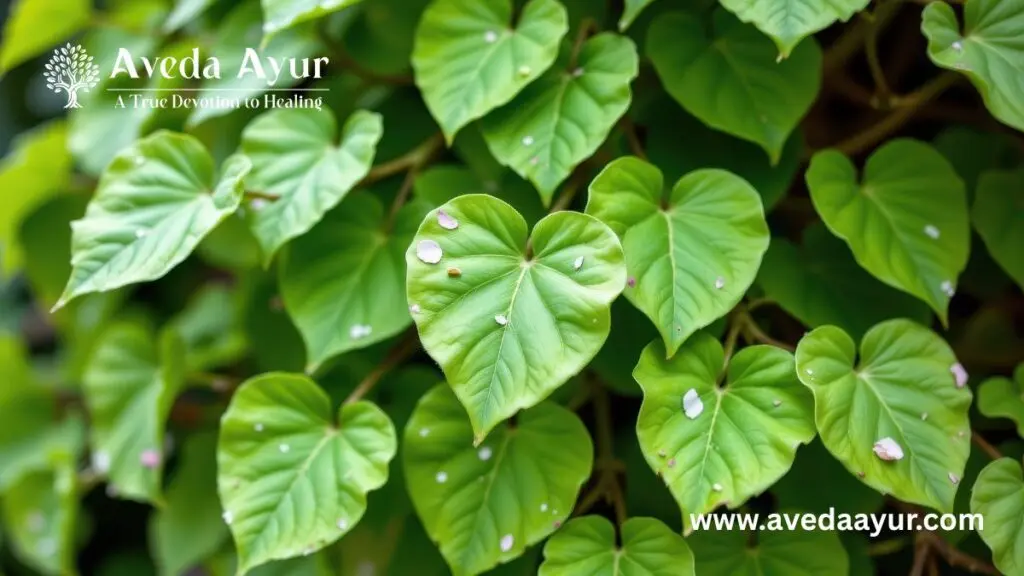
Giloy is a large, deciduous, woody climber with heart-shaped leaves and long, fleshy stems. The stems are rich in starch and possess a mucilaginous texture. Aerial roots often develop from mature branches, contributing to the plant’s regenerative nature.
3 Natural Habitat and Geographical Distribution
Giloy grows abundantly in tropical and subtropical regions of India. It commonly climbs on large trees such as Neem and Mango. Traditional Ayurvedic texts note that Giloy growing on Neem trees is considered especially potent.
Names of Giloy in Different Languages
Giloy is known by various names across different regions, reflecting its widespread traditional use.
Sanskrit – Guduchi, Amrita
Hindi – Giloy
English – Heart-leaved Moonseed
Tamil – Seenthil Kodi
Telugu – Tippa Teega
Malayalam – Amruthu
Kannada – Amruthaballi
Marathi – Gulvel
Bengali – Gulancha
Gujarati – Galo
Punjabi – Giloy
Urdu – Gilo
French – Guduchi
German – Guduchi
Spanish – Guduchi
Italian – Guduchi
Chinese – Qing Teng (青藤)
Japanese – Guduchi
Korean – Guduchi
Arabic – Giloy (جيلوي)
Giloy in Ayurveda
In Ayurveda, Giloy holds a central place due to its Rasayana nature and its ability to balance Doshas while strengthening bodily tissues.
1 Ayurvedic Definition of Giloy
Ayurvedic texts define Guduchi as a bitter and astringent herb that purifies the system, strengthens metabolism, and supports tissue rejuvenation.
2 References in Classical Ayurvedic Texts
Giloy is extensively mentioned in authoritative texts such as Charaka Samhita, Sushruta Samhita, Ashtanga Hridaya, and Bhavaprakasha Nighantu, particularly for its role in fever, metabolism, and rejuvenation therapies.
3 Rasayana Classification of Giloy
Giloy is classified under Kamya Rasayana, indicating its use for general health maintenance, vitality enhancement, and disease prevention. Learn more about Giloy and its medicinal benefits.
Ayurvedic Pharmacological Profile (Dravyaguna Vigyana)
The therapeutic action of Giloy is explained in Ayurveda through its Rasa, Guna, Virya, Vipaka, and Dosha Karma.
1 Rasa, Guna, Virya and Vipaka
|
Parameter |
Description |
|
Rasa |
Bitter and Astringent |
|
Guna |
Light and Unctuous |
|
Virya |
Heating |
|
Vipaka |
Sweet |
2 Dosha Karma of Giloy
Giloy primarily pacifies Pitta and Kapha Dosha. When used appropriately, it also supports Vata balance through its rejuvenative effect.
Medicinal Properties of Giloy (Classical Perspective)
Classical Ayurvedic literature attributes multiple therapeutic actions to Giloy, making it a versatile medicinal herb.
1 Jwaraghna, Rasayana, and Deepana Properties
Giloy is traditionally used to support the body during fever states, enhance vitality, and stimulate digestive fire without causing imbalance.
2 Role of Giloy in Ama and Agni Balance
Giloy helps digest Ama and strengthens Agni, addressing one of the fundamental causes of disease according to Ayurvedic theory.
Chemical Constituents and Phytochemical Profile
Giloy contains a wide range of bioactive compounds that help explain its broad Ayurvedic utility and classical Rasayana status. Scientific analysis of Tinospora cordifolia has identified multiple phytochemicals that contribute to metabolic regulation, cellular protection, and adaptive resilience, supporting its long-standing traditional use.
Modern phytochemical studies indicate that Giloy is rich in diverse compound groups rather than a single dominant constituent. This diversity aligns with the Ayurvedic view that the herb works holistically rather than through a narrow, single-target mechanism.
Key chemical constituents identified in Giloy include:
- Alkaloids such as tinosporine and magnoflorine are associated with metabolic and immune modulation
- Diterpenoid lactones, which contribute to cellular protection and systemic balance
- Glycosides that support tissue-level nourishment and physiological regulation
- Polysaccharides linked to immune adaptability and resilience
- Steroids that assist in maintaining the inflammatory and metabolic equilibrium
Together, these constituents form a complex phytochemical profile that complements Giloy’s Ayurvedic description as a balancing and rejuvenative herb rather than a symptom-specific agent.
Giloy: Ayurvedic Mechanism of Action
From an Ayurvedic perspective, Giloy acts by restoring balance at the fundamental levels of digestion, metabolism, and tissue nourishment. Rather than targeting isolated symptoms, it supports coordinated physiological function by strengthening Agni, reducing Ama, and promoting internal adaptability.
Giloy’s mechanism of action is explained through its influence on key Ayurvedic principles. Supporting digestive and metabolic efficiency, it helps prevent the accumulation of Ama, which Ayurveda considers a root cause of many imbalances. Simultaneously, its Rasayana nature supports Ojas formation, contributing to vitality and systemic resilience.
Key aspects of Giloy’s Ayurvedic mechanism include:
- Enhancement of Agni without excessive heat or depletion
- Facilitation of Ama digestion and metabolic clarity
- Support of Dhatu nourishment and tissue stability
- Promotion of Vyadhi Kshamatva, or the body’s natural resistance
This integrated mechanism explains why Giloy is valued in Ayurveda for both preventive care and long-term physiological support.
Giloy in Classical Ayurvedic Formulations
Giloy is a key ingredient in many traditional formulations.
- Guduchi Ghrita: Used traditionally to support neurological health and chronic conditions related to imbalance.
- Amritarishta: Commonly used in post-fever recovery and metabolic support formulations.
- Sudarshan Churna: A classical formulation centered on fever management and metabolic purification.
- Panchatikta Ghrita: Traditionally applied in skin and bone-related conditions due to its bitter-dominant formulation.
Research and Scientific Studies on Giloy
Modern scientific research increasingly supports the traditional Ayurvedic understanding of Giloy. Experimental and observational studies have explored its antioxidant, immunomodulatory, hepatoprotective, anti-inflammatory, and metabolic regulatory properties. These studies suggest that Giloy supports cellular defense mechanisms, helps regulate immune responses, and contributes to liver and metabolic health.
Importantly, research findings are generally viewed as supportive evidence that aligns with classical Ayurvedic indications rather than replacements for traditional knowledge. Ayurveda emphasizes holistic application, formulation context, and individual assessment, which modern research often studies in isolation.
Role of Giloy in Preventive Ayurveda
Preventive Ayurveda focuses on preserving health, maintaining balance, and strengthening the body’s adaptive capacity before disease manifests. Giloy plays a supportive role in this approach by helping maintain metabolic clarity, supporting digestive efficiency, and promoting balanced immune function.
As a Rasayana herb, Giloy contributes to tissue nourishment, resilience, and long-term vitality when used appropriately. Its traditional use aligns with the Ayurvedic principle of sustaining health through regular, measured interventions rather than reactive treatment.
Safety Profile, Contraindications, and Classical Cautions
Giloy is generally considered safe in Ayurveda when used in proper forms, doses, and durations under traditional guidance. Its safety depends on correct identification, proper processing, and individual suitability. Classical texts and modern interpretations advise caution in people with autoimmune conditions, during pregnancy, and in those with a strong Vata constitution, especially if taken in excess or without balancing herbs. Ayurveda emphasizes Yukti, meaning individualized and rational use, to maximize benefits while minimizing risks. For practical guidance, see our comprehensive guide on traditional Giloy preparations and usage.
Common Myths and Authentic Ayurvedic Clarifications
One common misconception is that Giloy functions solely as an immunity booster. In classical Ayurveda, Giloy is classified as a complete Rasayana herb with systemic actions that extend beyond immune support, including metabolic regulation and tissue nourishment.
Another widespread belief is that increased bitterness directly indicates higher potency. Authentic Ayurvedic texts clarify that therapeutic effectiveness depends on factors such as botanical authenticity, habitat, harvesting practices, processing methods, and appropriate formulation rather than taste intensity alone.
Conclusion: Giloy as a Foundational Ayurvedic Herb
Giloy holds a distinguished position in Ayurveda due to its Rasayana classification, extensive classical references, and broad systemic relevance. Its role in supporting metabolic balance, tissue nourishment, and adaptive resilience makes it a foundational herb rather than a condition-specific remedy.
In the wider context of Ayurvedic medicine manufacturers in India, authentic formulations rooted in classical principles continue to preserve the traditional integrity of Giloy. Brands such as Aveda Ayur reflect this approach by emphasizing classical understanding, correct sourcing, and responsible application within the Ayurvedic framework.
Frequently Asked Questions
What is the Ayurvedic name of Giloy?
The Ayurvedic name of Giloy is Guduchi.
Which Doshas does Giloy balance?
Giloy primarily helps balance Pitta and Kapha Dosha when used appropriately.
Is Giloy mentioned in classical Ayurvedic texts?
Yes, Giloy is extensively described in Charaka Samhita, Sushruta Samhita, Ashtanga Hridaya, and Bhavaprakasha Nighantu.
Is Giloy considered a Rasayana herb?
Yes, Giloy is classified as a Rasayana, indicating its role in nourishment, resilience, and preventive health support.
Does Ayurveda consider Giloy suitable for long-term use?
Ayurvedic texts allow long-term use of Giloy when taken in proper form, dosage, and under suitable guidance.
What part of the Giloy plant is used in Ayurveda?
The stem of Giloy is most commonly used for medicinal preparations in classical Ayurveda.