

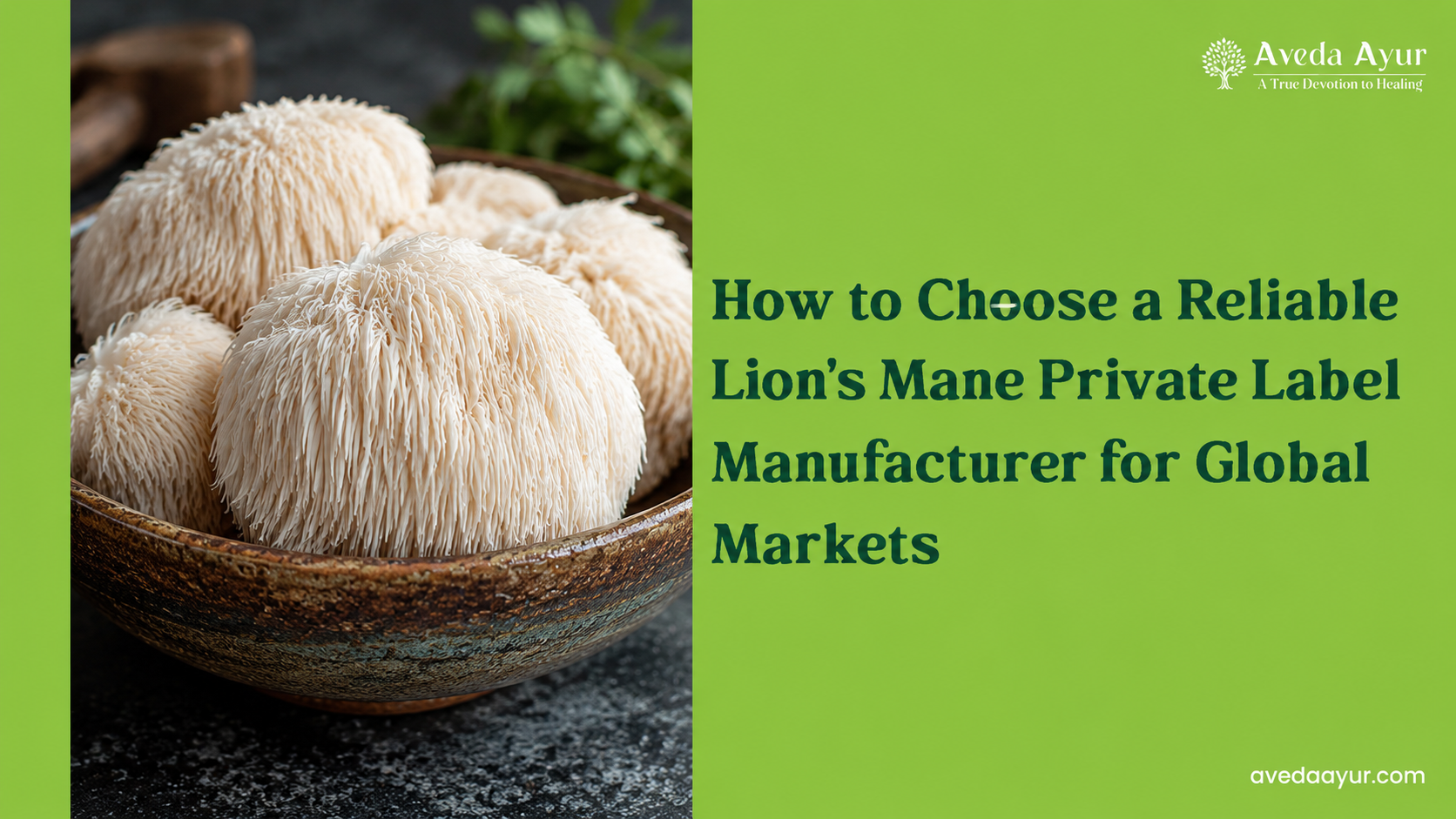
Choosing the right Lion’s Mane private label manufacturer is an important decision for brands planning to enter or expand in the global mushroom supplement market. Price and minimum order quantity (MOQ) matter, but they should not be the only deciding factors.
A reliable manufacturing partner should offer verified Lion’s Mane quality, consistent production, appropriate testing, private-label flexibility, regulatory documentation, and dependable international supply. Evaluating these factors before placing a large order can reduce quality, compliance, and supply-chain risks.
What Should You Look for in a Lion’s Mane Private Label Manufacturer?
Before choosing a supplier, evaluate these key areas:
| Factor | What to Verify |
| Ingredient identity | Hericium erinaceus and clearly defined raw material |
| Ingredient type | Fruiting body, mycelium, or specified combination |
| Quality specifications | Extract ratio and relevant active-compound specifications |
| Testing | Identity, microbiological, heavy metals, and relevant contaminants |
| Manufacturing | Appropriate GMP and quality-control systems |
| Certifications | Current, relevant certifications |
| Customization | Formulation, dosage form, packaging, and labeling |
| Documentation | COA, specifications, testing and regulatory documents |
| Scalability | MOQ, production capacity, and lead times |
| Export capability | Experience supplying international markets |
A manufacturer that performs well across these areas is more likely to be a suitable long-term B2B partner than one selected solely because it offers the lowest quote.
How to Evaluate a Lion’s Mane Private Label Manufacturer
A reliable Lion’s Mane private label manufacturer should be evaluated on more than price and MOQ. Before placing an order, assess the supplier across ingredient quality, testing, manufacturing standards, customization, regulatory support, documentation, scalability, and export capability.
Verify the Lion’s Mane Ingredient Quality
Start by confirming exactly what the manufacturer is supplying.
- Scientific identity: The ingredient should be clearly identified as Hericium erinaceus.
- Material used: Confirm whether the product contains fruiting body, mycelium, or a defined combination.
- Extract specifications: Ask for the extract ratio, extraction method, powder/extract form, and relevant standardization details.
- Active-compound specifications: Check whether beta-glucans or other declared markers are specified and tested.
- Evaluate Testing and Quality Control: Quality claims should be supported by test reports. Ask how the manufacturer tests both raw materials and finished products.
A representative or batch-specific Certificate of Analysis (COA) should, where applicable, include the following:
- Batch or lot number
- Ingredient identity
- Relevant assay or specification results
- Microbiological results
- Heavy-metal results
- Applicable contaminant testing
- Test methods or laboratory details
Do not evaluate a manufacturer only from one good sample. Ask how it maintains batch-to-batch consistency and verifies that commercial production continues to meet the agreed specifications.
-
Check Manufacturing Standards and Certifications
Certifications can strengthen supplier evaluation, but they should be verified rather than treated as proof of quality on their own.
Depending on the product and destination market, relevant credentials may include GMP, HACCP, ISO-based quality systems, organic, kosher, or halal certifications.
Always check that certifications are current, relevant to the manufacturing facility, and issued by an appropriate certification body.
-
Assess Private Label and Customization Capabilities
A capable private label partner should be able to support more than basic branding.
Evaluate whether the manufacturer offers:
Formula options
- Ready-to-launch Lion’s Mane formulas
- Single-ingredient products
- Custom formulations
- Mushroom blends
- Different dosage strengths
Dosage forms
- Capsules
- Powders
- Tablets
Packaging and labeling
- Custom bottles, pouches, or other formats
- Custom labels
- Multiple pack sizes
- Product specifications for label development
The key question is whether the manufacturer can take your product from formulation and specifications to finished, market-ready packaging.
Evaluate Regulatory Support for Your Target Market
A formula that works in one country may require different documentation, ingredients, or labeling in another. Your manufacturer should understand this distinction.
- United States: Confirm that the manufacturer’s processes and documentation support applicable dietary supplement requirements. GMP compliance should not be presented as a guarantee of FDA approval or market authorization.
- European Union: Regulatory treatment can depend on the specific Lion’s Mane preparation. The European Commission’s novel-food consultation information distinguishes between certain fruiting-body preparations and mycelium preparations.
- Other markets: Requirements may also differ across the UK, Canada, Australia, the Middle East, and Asian markets.
Before production, ask:
Can you provide the regulatory and technical documentation required for the exact Lion’s Mane ingredient and formulation I intend to sell?
Compare MOQ, Pricing, lead times, and Scalability
The lowest unit price does not always represent the lowest total cost.
Compare the full commercial quote, including:
- Raw materials
- Manufacturing
- Packaging
- Testing
- Tooling, where applicable
- Documentation
- Shipping
- Repeat-order pricing
Also assess MOQ, production capacity, and lead times. A manufacturer may handle an initial small order well but lack the capacity to support rapid growth.
Choose a supplier whose production capability can match your current requirements and expected future volume.
Verify Export and Supply-Chain Experience
For global B2B brands, manufacturing is only one part of supplier performance.
Ask whether the manufacturer has experience with:
- International shipments
- Export documentation
- Batch traceability
- Market-specific packaging
- Commercial-scale production
- Freight coordination
- Long-term B2B supply
Ask which regions the supplier currently serves and, where possible, request relevant non-confidential examples of international projects.
Review Documentation Before Placing a Commercial Order
Documentation should be available before you commit to a large production run.
Depending on the product and market, request the following:
- Product specification sheet
- Ingredient specification
- Sample or batch-specific COA
- Manufacturing certificates
- Testing information
- Allergen information
- Shelf-life or stability data
- Packaging specifications
- Relevant regulatory documentation
Clear and consistent documentation makes it easier to verify the product before purchase and manage quality throughout the supplier relationship.
Order Samples Before Scaling Production
A sample allows you to evaluate both the product and the manufacturer’s execution before committing to commercial volumes.
Check:
- Appearance
- Odor
- Taste, where relevant
- Solubility or dispersion, where relevant
- Packaging quality
- Label accuracy
Most importantly, compare the physical sample with its specifications and supporting documentation.
Also assess the supplier’s communication during the sample stage. A manufacturer that responds clearly to technical, quality, and documentation questions is generally easier to work with as your order volumes grow.
Red Flags When Choosing a Lion’s Mane Manufacturer
Be cautious if a supplier:
- Cannot clearly identify the Lion’s Mane material used
- Makes vague “high potency” claims without specifications
- Cannot provide relevant testing information
- Provides COAs that are not traceable to batches
- Has unclear or unverifiable certifications
- Offers unusually low pricing without explaining the difference
- Cannot provide appropriate regulatory documentation
- Refuses to provide samples
- Gives inconsistent information about sourcing or manufacturing
- Has unclear production capacity or lead times
These signs do not automatically prove that a manufacturer is unreliable, but they indicate that further verification is needed.
Questions to Ask a Lion’s Mane Private Label Manufacturer
Before selecting a supplier, ask:
- Is your Lion’s Mane sourced from fruiting bodies, mycelium, or both?
- What is the scientific identity and specification of the ingredient?
- What testing is performed on the raw material and finished product?
- Can you provide a batch-specific COA?
- Which manufacturing certifications do you currently hold?
- What private-label formats and customization options are available?
- What is the MOQ for a custom product?
- What are your standard production lead times?
- Which international markets do you currently supply?
- Can you provide documentation for my target market?
Final Checklist Before Choosing a Manufacturer
- Confirm Hericium erinaceus identity
- Verify fruiting body/mycelium specification
- Review product and ingredient specifications
- Request relevant COAs and testing information
- Verify current manufacturing certifications
- Assess private-label capabilities
- Review target-market regulatory documentation
- Compare MOQ, pricing, and lead times
- Test product samples
- Confirm export and supply-chain experience
- Discuss quality and supply terms before scaling
Conclusion
Choosing a reliable Lion’s Mane private label manufacturer requires more than comparing prices and MOQs. Global B2B buyers should evaluate the manufacturer’s ingredient specifications, testing systems, manufacturing standards, documentation, customization capabilities, regulatory support, and ability to scale.
The right manufacturing partner should be able to provide consistent product quality, transparent documentation, dependable production, and support for the markets you plan to serve. Taking the time to verify these factors before placing a commercial order can create a stronger foundation for long-term growth.
FAQs
- How do I choose a reliable Lion’s Mane private label manufacturer?
Look for a manufacturer with verified Hericium erinaceus specifications, robust testing, appropriate certifications, private-label capabilities, regulatory documentation, consistent production, and international export experience.
- What should I check in a Lion’s Mane COA?
Check the batch number, ingredient identity, relevant potency or assay results, microbiological and heavy-metal testing, applicable contaminant results, and laboratory or test-method details.
- What documents should I request from a Lion’s Mane private label manufacturer?
Request the product specification sheet, ingredient specifications, COA, testing reports, current manufacturing certifications, allergen information, shelf-life data, and relevant regulatory documentation for your target market, testing, and suitability for the intended formulation and target market.
- Can I customize Lion’s Mane supplements with a private label manufacturer?
Yes. Depending on the manufacturer, customization can include formulation, dosage form, dosage strength, packaging, labeling, and product specifications.
- What should I ask a Lion’s Mane manufacturer before placing a bulk order?
Ask about ingredient specifications, testing and COAs, certifications, MOQ, lead time, customization, regulatory documentation, production capacity, and experience exporting to your target markets.